Excerpted from Maps for Lost Lovers by Nadeem Aslam. Copyright © 2005 by Nadeem Aslam. Excerpted by permission of Vintage, a division of Random House, Inc. All rights reserved. No part of this excerpt may be reproduced or reprinted without permission in writing from the publisher.
Nadeem Aslam is the author of three highly acclaimed novels: Season of the Rainbirds, which won a Betty Trask Award; Maps for Lost Lovers, which was a New York Times Notable Book, winner of the Kiriyama Prize, shortlisted for the IMPAC prize, and longlisted for the Booker Prize; and, most recently, The Wasted Vigil. He is also the recipient of a Lannan Literary Fellowship. Born in Pakistan, he lives in England.
1. Early in the novel, Shamas remembers a visitor from Pakistan who was so impressed by England’s affluence that he imagined the Queen venturing forth in disguise to discover the desires of her subjects. How does one reconcile this attitude with the characters’ other feelings about England?
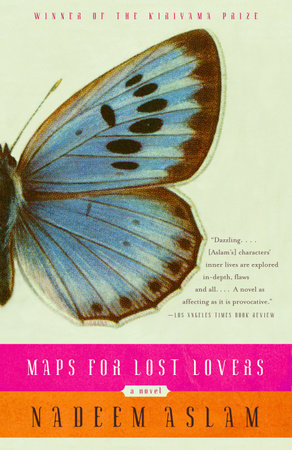
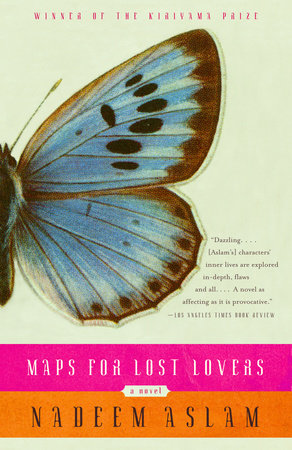
2. Maps for Lost Lovers is fraught with images of nature: Jugnu’s prized moths and butterflies, the peacocks that invade his house after his and Chanda’s disappearance, the lilacs used to entice fish, the flock of Indian rose-ringed parakeets that mysteriously appear in English gardens. How does Aslam use these images to evoke mood, explore his characters’ psychology, and even advance his plot? Is there a difference in the way he treats the natural elements of England and Asia? Which seems more “natural”?
3. Many of Aslam’s characters, Kaukab chief among them, have rejected English culture and manners, and even the English language. But some of them feel that it is England that has rejected them: “We are stranded in a foreign country where no one likes us” [p. 278]. Does Aslam give the reader any evidence to support this claim? Are his Asian characters only responding to English racism, or does the book describe a more nuanced interaction between different kinds of small-mindedness and mistrust?
4. The novel has several scenes in which characters are deeply affected by music: among them, Shamas’s memory of listening to jazz records with Kiran and her father and a concert by the ecstatic singer Nusrat Fateh Ali Khan. What role does music play in the lives of these people? And what is the significance of an evening of religious songs paving the way for adultery?
5. The lovers of the title appear to be Chanda and Jugnu, whom some people prefer to imagine as being in hiding rather than being dead (though “lost” can also be a euphemism for dead). Their love is both passionate and illicit, and it leads to their destruction. What other instances of forbidden love occur in this novel, and what are their consequences? What is it that makes them forbidden? Could it be passion itself? And what other lovers in Dasht-e-Tanhaii might be described as lost?
6. Throughout the novel Kaukab displays a puritanical squeamishness about sex, even rebuffing her husband’s advances. Yet we learn earlier in their marriage that she used to wake him by seductively sprinkling him with drops of water from her freshly washed hair. What might account for the change in her attitude? What other kinds of passion has she allowed herself in place of sex?
7. Before he became involved with Chanda, Jugnu was seeing a white woman, whom Kaukab once entertained unwillingly and disastrously. Her son Charag has also had a white lover with whom he has a child. Does Kaukab see those relationships as more or less shameful than the one that cost Jugnu his life? How would you sum up the Asian characters’ feelings about whites and how are those feelings inconsistent? For example, how do some of them feel about the town’s white prostitute?
8. For Kaukab and her neighbors, shame is not individual but communal. Chanda’s adultery disgraces not just her but her entire family, just as Suraya’s visit to the home of her in-laws’ enemies humiliates her husband and leads to the breakup of their marriage. Contrast this with what you know of the English (or American) sense of shame. Is the Asian characters’ sensitivity to the sins of their relatives entirely negative? Is there any significance to the fact that Shamas’s affair with Suraya is never discovered by their spouses?
9. The novel’s principal characters are Muslim. However, they also have relationships with Hindus, and Shamas’s father lived as a Hindu for a time, after he lost his memory as a child. How has his ambiguous status affected his son? What other roles do Hindus (and Sikhs) play in Maps for Lost Lovers, and how do they–and the Muslim characters’ feelings about them–amplify the book’s themes of difference and defilement?
10. In the course of this novel, we see Kaukab alienating her sons, bullying her daughter into a loveless marriage, and betraying her brother-in-law in a way that leads to his murder. How does Aslam keep her from being an unsympathetic character–and, indeed, make her intensely sympathetic? Might this manipulative and closed-minded woman actually be the most loving character in the book?
11. Because Shamas is more worldly and tolerant than his wife, we may be inclined to see him as the wronged party in their marriage. Is this perception accurate? Is Shamas a better person than Kaukab, or just more familiar to a western reader? What role has he played in Kaukab’s unhappiness, and in her estrangement from her children? Might he have some responsibility for his brother’s murder?
12. Most of the characters seem to suffer from some form of homesickness. Their name for their town means “Desert of Loneliness.” The neighbors of a woman from Bangladesh wonder why her children refer to that country as “‘abroad’ because Bangladesh isn’t abroad, England is abroad; Bangladesh is home” [p. 47]. Yet what is the experience of those who return to Pakistan–particularly those children who are sent back for arranged marriages? Is homesickness, as Aslam imagines it, a condition treatable simply by going home?
13. At various points in the narrative different characters use Islam as a justification for brutalizing wives and daughters, condoning the sexual abuse of a small child, and, of course, murder, not to mention forgoing kinds of happiness that most westerners take for granted. Does Maps for Lost Lovers constitute an indictment of Islam? Does it present any counterarguments in Islam’s favor? Might Kaukab be right when she observes that Muslim morality is higher than that of its western counterpart because it recognizes that certain actions hurt not just other people, but God [p. 44]?
14. Would you characterize this novel as a work of realist fiction? What are we to make of such elements as Jugnu’s phosphorescent hands or the human heart that is found in town? (It makes its appearance just after Jugnu discovers his father’s severed tongue.) What is the effect of these suspensions or interruptions of reality? How do they work with the novel’s heightened–almost fragrant–language?