Author Q&A
“NO COCKTAILS ON THE BEACH”:
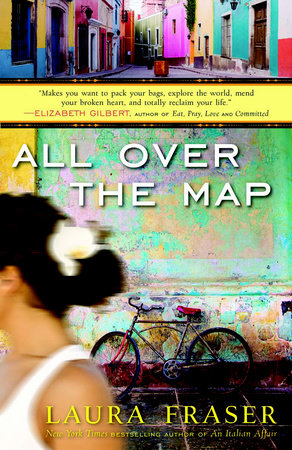
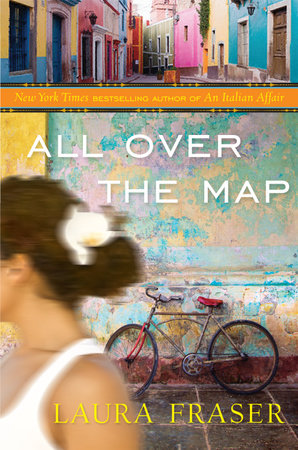
A Q&A between Laura Fraser, author of ALL OVER THE MAP
and Mary Roach, author of STIFF and SPOOK
MR: I loved your new book, Laura. I found it to be really wise. There were some lines that really stayed with me, like, “Whatever happens, in spring there will always be rhubarb.” I also loved, “It’s not that the grass is greener, it’s that you can never be on both sides of the lawn.” Amen.
LF: Thanks, Mary. I’m wiser, I hope, than when we first met in our twenties!
MR: With this book, there’s something about the fact that you’re writing it in “middle age”–there’s a wisdom to it, and your perspectives on yourself, relationships and marriage had a lot of depth. An Italian Affair was a wonderful, sweeping romance, but this one has more depth and lessons for so many people who are in similar situations.
LF: I guess there are a few advantages to being middle-aged. You’re not as much of an idiot.
MR: I was wondering why there was such a big gap in time between An Italian Affair and this book? I mean, I know, book ideas are not easy to come up with, particularly when you’re writing from your own life—and there’s that sense that you have do always be doing something book-worthy.
LF: That’s right. An Italian Affair was successful enough that it was hard to come up with an idea that people in the book world thought would be as successful. I went to see a mentor, William Zinsser, who wrote On Writing Well, who’s an old-school journalist, with an office in New York City that’s like an oasis of craft where agents and publishers dare not enter. When I told him I felt like I couldn’t write anything because I didn’t think anything would be as successful as my last book, he said that was the most ridiculous thing he’d ever heard. He told me to just get back to writing about what moves me most.
MR: Good advice.
LF: Absolutely. And the funny thing about this book is that it ended up being quite different from what I set out to write, and I like it better. Everything happens in the process of writing. You can’t plan it all out. The book is a little hodge-podge—“All Over the Map” is kind of the theme as well.
MR: You’re giving your critics a big, fat target. Here’s your headline! Run with it! (Both laugh). But life is all over the map, and maybe because you travel so much, you’re skilled at finding the angle in covering the things you report that fit a larger narrative—you did a really good job of thematically weaving in issues about women and the struggles they have all over the world and the ways they find of dealing with what society expects of them. The book is really not all over the map at all.
LF: I in no way wanted to compare the issues I’m dealing with to those of the women I interviewed—prostitutes in Naples, genocide survivors in Rwanda.
MR: I feel your pain, honey. Just try being me! You can’t believe some of the dates I’ve had on Match.com! You think your Saturday night is rough! (Laughs) No, I don’t think you in any way belittled their experiences, because the stories of those women are very compassionately told.
LF: Good. I just wanted to get across that we’re at a funny time in history when women all over the world are in a double bind about what’s expected of them.
MR: So, did you think about writing this book in the second person like An Italian Affair? I remember you went back and forth when you wrote that, deciding between first person or second.
LF: Or the royal “we.” With this book, it’s part of that sense of being older and wiser–I felt I could land on the first person. I’ve got something to say, I have more confidence about my voice. With An Italian Affair, the second person worked, partly because it gave it a dreamy quality, like a fable. But this is a different book.
MR: This is such an honest book, I don’t think the “you” would work. You can say about yourself, “You’re the most impulsive person, always blurting things out,” but the reader might take offense at the “you.”
LF: I’m not sure men who read An Italian Affair appreciated the “you,” either. “You’re having an affair with a sexy French professor.” Wait! No I’m not! It just doesn’t work for everyone.
MR: My publisher did an audio book for my last book, Bonk, and they found a male reader. I asked, “What about that chapter where I have sex with Ed in the ultrasound lab?” That’s going to be a little problem, since it’s in the first person. They hired a woman.
LF: That’s hilarious. Since An Italian Affair was about my thirties, and All Over the Map is about my forties, that means there’s less sex in it, sadly. But it’s harder to write about sex in the first person, so it’s just as well.
MR: One of the things I like about this book, in an age where there’s a blurry line between fact and fiction in a lot of memoirs, is that this one is absolutely true. You didn’t exaggerate anything, or change things around to make them fit. It’s a really real story about coming to grips with who you are, and what you thought you’d be.
LF: I guess the journalist in me believes that memoirs should be true. I mean, dialogue is never word for word, and memory is always faulty—memoir is about the truth to the best of your ability to remember it– but I don’t believe in embellishing anything. If you want to do that, just call it “fiction.”
MR: I was especially touched by your portrait of your mom, and just a generation back, how hard it was for her to balance an adventurous spirit with family life and pretty rigid social expectations of women. I liked your exploration of whether women can have it all. When you talked to women at your reunion who seemed to have great jobs and family lives, you scratched the surface and saw a lot of stress, and they envied your life. Like you said, it’s not that the grass is always greener, it’s that you can’t be on both sides of the lawn.
LF: The whole dating thing in your forties is brutal. Thank God you vetted a lot of my Internet dating matches over the years, or I would’ve gotten into bigger trouble. Or maybe I would’ve had more to write about. But you had an unerring sense with the “delete” button.
MR: Yeah, I remember the guy who took you to Muslim Malaysia where Americans weren’t very welcome, in the middle of monsoon season.
LF: No cocktails on the beach.
MR: You didn’t run him by me!
LF: My mistake. Older and wiser.
MR: Let’s go have a cocktail.




 QUICK VIEW