Author Q&A
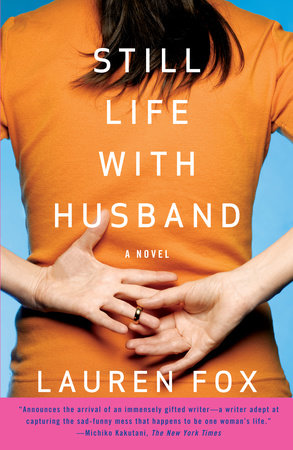
Q: STILL LIFE WITH HUSBAND is your debut novel. Where did the idea come from? And how long have you been working on it?
A: I had the idea for this novel several years ago. It struck me that men who cheat on their partners receive so much attention in literature and popular culture, but, aside from a few obvious examples women who stray are sort of ignored. I know people whose relationships have been affected by infidelity, and it’s not always the men who are guilty. I started to wonder if I could tell a sympathetic story about a woman who has an affair.
It took me five years to write this book, but I had a baby in the middle of that time period, so I took a brief two-year break to wallow in a cesspool of hormonal muck, then to run around after a kamikaze toddler, then finally, when things were slightly more under control, to sit and stare at the computer screen and wonder where my brain had gone…
Q: So your narrator is a young married woman. You are a young married woman. Your narrator freelances for magazines. You freelance for magazines. You see where I’m going with this? You’re writing about infidelity. Are you worried you will be confused with your narrator?
A: Yeah, and I lifted many, many more superficial details from my life and plopped them into Emily’s story—she lives in my apartment, hangs out at my favorite places, and she has my frizzy hair. Maybe I was looking for a fictional thrill. In fact, I think that, because this was my first novel, I did rely on a lot of those surface elements because they made it easier for me to delve into the heart and mind of someone who’s not like me at all. Fiction is fiction. If I had called the book STILL LIFE WITH HUSBAND: A MEMOIR, well, that would be another story altogether —a much more boring story.
Q: Since I already know you are a happily married woman, how did you come to the idea of writing about infidelity? What parts of it proved to be challenging?
A: The whole idea was challenging and complicated and even a little bit painful, and I think those are the things that drew me to it. The pull between loyalty and desire, between what’s ethical and what seems crucial for your own survival, and the decision to hurt someone you love—those are really interesting struggles to me, and I liked spelunking in Emily’s psyche, figuring out what decisions she would come to based on what she thought she needed most. I really grew to like her, and sometimes as I was writing the novel, I’d think, “Oh, Emily, don’t do it!” And then, of course, I’d make her do it.
Q: I heard a rumor that your husband didn’t see the manuscript until it was completed. Is this true?
A: Absolutely. My husband is an insightful reader and a careful critic, but I just couldn’t make good use of his skills while I was writing this book. “Honey, could you read the passage where the wife— hmm, yes, I guess she does look like me!—decides to sleep with another man, and tell me if you think the verbs are strong enough?” In fact, though, hardly anybody saw the manuscript while I was working on it. I felt that I would be too susceptible to criticism. I felt protective of Emily and her complicated world, and I wasn’t ready for anyone to mess with it until I was finished.
Q: You started this book before you were a mother, and completed it after. Do you think the birth of your daughter had any influence on the book’s resolution, and do you think it will influence your writing in the future?
A: Having a child made me a more productive writer, because when I know I only have ninety minutes to work, I tend not to fiddle around the way I used to when I had the whole day stretching out in front of me. You can’t spend three hours reading about the history of lentils when preschool pickup time is 11:15. As children do, my daughter has also changed the way I think about myself. I’m much less invested in my success or failure as a writer, which has freed me to write exactly what I want to write.
I don’t think that my daughter’s birth affected the resolution of this novel specifically, but it is true that, toward the end of the writing of the book, I was closer to the experience of pregnancy and able to imagine that aspect of Emily’s experience more fully.
One thing I’ve noticed since my daughter was born is that I find it much harder to think about, much less write about, really awful, sad things. I’m planning to focus on musical comedies from now on.
Q: You earned your MFA from the University of Minnesota. Have you always known you wanted to be a writer?
A: When I was young, when everyone else was outside playing, I was holed up in my bedroom, filling notebooks with tragic rhyming poems about horses dying in barn fires (“And sometimes in my dreams / I can still hear their screams”) and sentimental tales of blind orphans triumphing over adversity. Also, I’m spectacularly untalented at just about everything: I’m klutzy and bad with numbers and really frighteningly disorganized, and I’m the kind of person you feel sorry for when I try public speaking. It made the choice to be a writer an easy one.
Q: What other writers do you admire / who are your literary influences?
A: I like writers who play tug of war between humor and sorrow in their work, and I also appreciate a really excellent literary page-turner. So I love Michael Chabon and Lorrie Moore, Alice Munro, Graham Greene, William Trevor (especially The Story of Lucy Gault) and Ian McEwan (particularly Enduring Love and Atonement).
Q: The best friendship between Emily and Meg is one most women will recognize. Do you have a real life Meg?
A: I’m lucky to have more than one Meg in my life. I have several brilliant, beautiful, hilarious and kind friends whose affection I constantly aspire to deserve. They’re like editors of my daily life: they laugh at the good jokes, help me make sense of the complicated parts, and they tell me when I’m spouting nonsense. Meg is a composite of these women. More than one friend who has read the book has informed me that she knows she is Meg. One actually refers to herself as Meg. I just nod.
Q: What’s next for you?
A: I’m working on another novel. It’s about three close friends, two of whom are married to each other, and the messiness of friendship and betrayal.




 QUICK VIEW