Random House: Bringing You the Best in Fiction, Nonfiction, and Children's Books
Authors
Books
Features
Newletters and Alerts

Buy now from Random House

  • Hotel on the Corner of Bitter and Sweet
  • Written by Jamie Ford
  • Format: Trade Paperback | ISBN: 9780345505347
  • Our Price: $15.00
  • Quantity:
See more online stores - Hotel on the Corner of Bitter and Sweet

Buy now from Random House

  • Hotel on the Corner of Bitter and Sweet
  • Written by Jamie Ford
  • Format: Hardcover | ISBN: 9780345505330
  • Our Price: $25.00
  • Quantity:
See more online stores - Hotel on the Corner of Bitter and Sweet

Buy now from Random House

  • Hotel on the Corner of Bitter and Sweet
  • Written by Jamie Ford
  • Format: eBook | ISBN: 9780345512505
  • Our Price: $9.99
  • Quantity:
See more online stores - Hotel on the Corner of Bitter and Sweet

Buy now from Random House

  • Hotel on the Corner of Bitter and Sweet
  • Written by Jamie Ford
    Read by Feodor Chin
  • Format: Unabridged Compact Disc | ISBN: 9780739382837
  • Our Price: $39.95
  • Quantity:
See more online stores - Hotel on the Corner of Bitter and Sweet

Buy now from Random House

  • Hotel on the Corner of Bitter and Sweet
  • Written by Jamie Ford
    Read by Feodor Chin
  • Format: Unabridged Audiobook Download | ISBN: 9780739382844
  • Our Price: $20.00
  • Quantity:
See more online stores - Hotel on the Corner of Bitter and Sweet

Hotel on the Corner of Bitter and Sweet

    Select a Format:
  • Book
  • eBook
  • Audiobook

A Novel

Written by Jamie FordAuthor Alerts:  Random House will alert you to new works by Jamie Ford


eBook

List Price: $9.99

eBook

On Sale: January 27, 2009
Pages: | ISBN: 978-0-345-51250-5
Published by : Ballantine Books Ballantine Group

Audio Editions

Read by Feodor Chin
On Sale: January 27, 2009
ISBN: 978-0-7393-8284-4
More Info...
$39.95

Published by: Random House Audio

Read by Feodor Chin
On Sale: January 27, 2009
ISBN: 978-0-7393-8283-7
More Info...
Listen to an excerpt
Visit RANDOM HOUSE AUDIO to learn more about audiobooks.


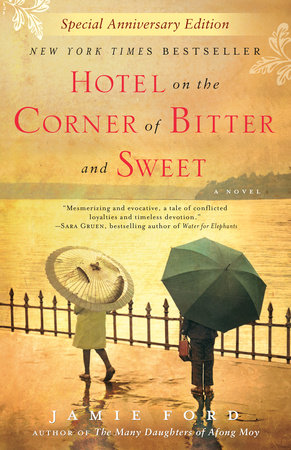
Hotel on the Corner of Bitter and Sweet Cover

Bookmark,
Share & Shelve:

  • Add This - Hotel on the Corner of Bitter and Sweet
  • Email this page - Hotel on the Corner of Bitter and Sweet
  • Print this page - Hotel on the Corner of Bitter and Sweet
ABOUT THE BOOK ABOUT THE BOOK
ABOUT THE AUTHOR ABOUT THE AUTHOR
PRAISE & AWARDS PRAISE & AWARDS
READER'S GUIDE READER'S GUIDE
RELATED VIDEOS RELATED VIDEOS
» see more tags
Synopsis|Excerpt

Synopsis

"Sentimental, heartfelt….the exploration of Henry’s changing relationship with his family and with Keiko will keep most readers turning pages...A timely debut that not only reminds readers of a shameful episode in American history, but cautions us to examine the present and take heed we don’t repeat those injustices."-- Kirkus Reviews

“A tender and satisfying novel set in a time and a place lost forever, Hotel on the Corner of Bitter and Sweet gives us a glimpse of the damage that is caused by war--not the sweeping damage of the battlefield, but the cold, cruel damage to the hearts and humanity of individual people. Especially relevant in today's world, this is a beautifully written book that will make you think. And, more importantly, it will make you feel."
-- Garth Stein, New York Times bestselling author of The Art of Racing in the Rain

“Jamie Ford's first novel explores the age-old conflicts between father and son, the beauty and sadness of what happened to Japanese Americans in the Seattle area during World War II, and the depths and longing of deep-heart love. An impressive, bitter, and sweet debut.”
-- Lisa See, bestselling author of Snow Flower and the Secret Fan


In the opening pages of Jamie Ford’s stunning debut novel, Hotel on the Corner of Bitter and Sweet, Henry Lee comes upon a crowd gathered outside the Panama Hotel, once the gateway to Seattle’s Japantown. It has been boarded up for decades, but now the new owner has made an incredible discovery: the belongings of Japanese families, left when they were rounded up and sent to internment camps during World War II. As Henry looks on, the owner opens a Japanese parasol.

This simple act takes old Henry Lee back to the 1940s, at the height of the war, when young Henry’s world is a jumble of confusion and excitement, and to his father, who is obsessed with the war in China and having Henry grow up American. While “scholarshipping” at the exclusive Rainier Elementary, where the white kids ignore him, Henry meets Keiko Okabe, a young Japanese American student. Amid the chaos of blackouts, curfews, and FBI raids, Henry and Keiko forge a bond of friendship–and innocent love–that transcends the long-standing prejudices of their Old World ancestors. And after Keiko and her family are swept up in the evacuations to the internment camps, she and Henry are left only with the hope that the war will end, and that their promise to each other will be kept.

Forty years later, Henry Lee is certain that the parasol belonged to Keiko. In the hotel’s dark dusty basement he begins looking for signs of the Okabe family’s belongings and for a long-lost object whose value he cannot begin to measure. Now a widower, Henry is still trying to find his voice–words that might explain the actions of his nationalistic father; words that might bridge the gap between him and his modern, Chinese American son; words that might help him confront the choices he made many years ago.

Set during one of the most conflicted and volatile times in American history, Hotel on the Corner of Bitter and Sweet is an extraordinary story of commitment and enduring hope. In Henry and Keiko, Jamie Ford has created an unforgettable duo whose story teaches us of the power of forgiveness and the human heart.


From the Hardcover edition.

Excerpt

The Panama Hotel (1986)

Old Henry Lee stood transfixed by all the commotion at the Panama Hotel. What had started as a crowd of curious onlookers eyeballing a television news crew had now swollen into a polite mob of shoppers, tourists, and a few punk-looking street kids, all wondering what the big deal was. In the middle of the crowd stood Henry, shopping bags hanging at his side. He felt as if he were waking from a long forgotten dream. A dream he’d once had as a little boy.

The old Seattle landmark was a place he’d visited twice in his lifetime. First when he was only twelve years old, way back in 1942—“the war years” he liked to call them. Even then the old bachelor hotel had stood as a gateway between Seattle’s Chinatown and Nihonmachi, Japantown. Two outposts of an old-world conflict—where Chinese and Japanese immigrants rarely spoke to one another, while their American-born children often played kick the can in the streets together. The hotel had always been a perfect landmark. A perfect meeting place—where he’d once met the love of his life.

The second time was today. It was 1986, what, forty-plus years later? He’d stopped counting the years as they slipped into memory. After all, he’d spent a lifetime between these bookended visits. A marriage. The birth of an ungrateful son. Cancer, and a burial. He missed his wife, Ethel. She’d been gone six months now. But he didn’t miss her as much as you’d think, as bad as that might sound. It was more like quiet relief really. Her health had been bad—no, worse than bad. The cancer in her bones had been downright crippling, to both of us, he thought.

For the last seven years Henry had fed her, bathed her, helped her to the bathroom when she needed to go, and back again when she was all through. He took care of her night and day, 24/7 as they say these days. Marty, his son, thought his mother should have been put in a home, but Henry would have none of it. “Not in my lifetime,” Henry said, resisting. Not just because he was Chinese (though that was a part of his resistance). The Confucian ideal of filial piety—respect and reverence for one’s parents—was a cultural relic not easily discarded by Henry’s generation. He’d been raised to care for loved ones, personally, and to put someone in a home was unacceptable. What his son, Marty, never fully understood was that deep down there was an Ethel-shaped hole in Henry’s life, and without her, all he felt was the draft of loneliness, cold and sharp, the years slipping away like blood from a wound that never heals.

Now she was gone for good. She needed to be buried, Henry thought, the traditional Chinese way, with food offerings, longevity blankets, and prayer ceremonies lasting several days—despite Marty’s fit about cremating her. He was so modern. He’d been seeing a counselor and dealing with his mother’s death through an online support group, whatever that was. Going online sounded like talking to no one, which Henry had some firsthand experience in—in real life. It was lonely. Almost as lonely as Lake View Cemetery, where he’d buried Ethel. She now had a gorgeous view of Lake Washington, and was interred with Seattle’s other Chinese notables, like Bruce Lee and his own son, Brandon. But in the end, each of them occupied a solitary grave. Alone forever. It didn’t matter who your neighbors were. They didn’t talk back.

When night fell, and it did, Henry chatted with his wife, asking her how her day was. She never replied, of course. “I’m not crazy or anything,” Henry would say to no one, “just open-minded. You never know who’s listening.” Then he’d busy himself pruning his Chinese palm or evergreen—houseplants whose brown leaves confessed his months of neglect. But now he had time once again. Time to care for something that would grow stronger for a change.

Occasionally, though, he’d wonder about statistics. Not the cancer mortality rates that had caught up with dear Ethel. Instead he thought about himself, and his time measured on some life insurance actuarial table. He was only fifty-six—a young man by his own standards. But he’d read in Newsweek about the inevitable decline in the health of a surviving spouse his age. Maybe the clock was ticking? He wasn’t sure, because as soon as Ethel passed, time began to crawl, clock or no clock.

He’d agreed to an early retirement deal at Boeing Field and now had all the time in the world, and no one to share the hours with. No one with whom to walk down to the Mon Hei bakery for yuet beng, carrot mooncakes, on cool autumn evenings.

Instead here he was, alone in a crowd of strangers. A man between lifetimes, standing at the foot of the Panama Hotel once again. Following the cracked steps of white marble that made the hotel look more like an Art Deco halfway house. The establishment, like Henry, seemed caught between worlds. Still, Henry felt nervous and excited, just like he had been as a boy, whenever he walked by. He’d heard a rumor in the marketplace and wandered over from the video store on South Jackson. At first he thought there was some kind of accident because of the growing size of the crowd. But he didn’t hear or see anything, no sirens wailing, no flashing lights. Just people drifting toward the hotel, like the tide going out, pulling at their feet, propelling them forward, one step at a time.

As Henry walked over, he saw a news crew arrive and followed them inside. The crowd parted as camera-shy onlookers politely stepped away, clearing a path. Henry followed right behind, shuffling his feet so as not to step on anyone, or in turn be stepped upon, feeling the crowd press back in behind him. At the top of the steps, just inside the lobby, the hotel’s new owner announced, “We’ve found something in the basement.”

Found what? A body perhaps? Or a drug lab of some kind? No, there’d be police officers taping off the area if the hotel were a crime scene.

Before the new owner, the hotel had been boarded up since 1950, and in those years, Chinatown had become a ghetto gateway for tongs—gangs from Hong Kong and Macau. The city blocks south of King Street had a charming trashiness by day; the litter and slug trails on the sidewalk were generally overlooked as tourists peered up at egg-and-dart architecture from another era. Children on field trips, wrapped in colorful coats and hats, held hands as they followed their noses to the mouthwatering sight of barbecue duck in the windows, hanging red crayons melting in the sun. But at night, drug dealers and bony, middle-aged hookers working for dime bags haunted the streets and alleys. The thought of this icon of his childhood becoming a makeshift crack house made him ache with a melancholy he hadn’t felt since he held Ethel’s hand and watched her exhale, long and slow, for the last time.

Precious things just seemed to go away, never to be had again.

As he took off his hat and began fanning himself with the threadbare brim, the crowd pushed forward, pressing in from the rear. Flashbulbs went off. Standing on his tippy toes, he peered over the shoulder of the tall news reporter in front of him.

The new hotel owner, a slender Caucasian woman, slightly younger than Henry, walked up the steps holding . . . an umbrella? She popped it open, and Henry’s heart beat a little faster as he saw it for what it was. A Japanese parasol, made from bamboo, bright red and white—with orange koi painted on it, carp that looked like giant goldfish. It shed a film of dust that floated, suspended momentarily in the air as the hotel owner twirled the fragile-looking artifact for the cameras. Two more men brought up a steamer trunk bearing the stickers of foreign ports: Admiral Oriental Lines out of Seattle and Yokohama, Tokyo. On the side of the trunk was the name Shimizu, hand-painted in large white letters. It was opened for the curious crowd. Inside were clothing, photo albums, and an old electric rice cooker. The new hotel owner explained that in the basement she had discovered the belongings of thirty-seven Japanese families who she presumed had been persecuted and taken away. Their belongings had been hidden and never recovered—a time capsule from the war years.

Henry stared in silence as a small parade of wooden packing crates and leathery suitcases were hauled upstairs, the crowd marveling at the once-precious items held within: a white communion dress, tarnished silver candlesticks, a picnic basket—items that had collected dust, untouched, for forty-plus years. Saved for a happier time that never came.

The more Henry thought about the shabby old knickknacks, the forgotten treasures, the more he wondered if his own broken heart might be found in there, hidden among the unclaimed possessions of another time. Boarded up in the basement of a condemned hotel. Lost, but never forgotten.


From the Hardcover edition.
Jamie Ford|Author Q&A

About Jamie Ford

Jamie Ford - Hotel on the Corner of Bitter and Sweet

Photo © Laurence Kim

Jamie Ford is the great-grandson of Nevada mining pioneer Min Chung, who emigrated from Kaiping, China, to San Francisco in 1865, where he adopted the Western name “Ford,” thus confusing countless generations. Ford is an award-winning short-story writer, an alumnus of the Squaw Valley Community of Writers, and a survivor of Orson Scott Card’s Literary Boot Camp. Having grown up near Seattle’s Chinatown, he now lives in Montana with his wife and children.

www.jamieford.com

Author Q&A

Random House Reader’s Circle: Where did the idea for Hotel on the Corner of Bitter and Sweet come from? 

Jamie Ford:
It really started with the “I am Chinese” button, which my father mentioned wearing as a kid. There was a bit of an identity crisis in the International District in the wake of Pearl Harbor. Many Chinese families feared for their safety, especially as the FBI was rounding up prominent members of the Japanese community. It piqued my curiosity and really led me to research the whole period. 

From there I wrote a sliver of a short story, really nothing more than a vignette, and I submitted it to the now- defunct Picolata Review, where it was ultimately accepted. A few weeks later I was accepted to an intensive, immersive, week- long literary boot camp run by science fiction and fantasy writer Orson Scott Card, where we literally read and wrote fifteen to seventeen hours a day. It was while attending that camp in Virginia that Scott inspired me to write what he termed “a noble romantic tragedy.” That story was called “The Button,” about a Chinese boy (Henry) that tried to prevent his best friend (Keiko) from being taken away. I workshopped the story, changed the title to “I Am Chinese” and sent it off to Glimmer Train, where it became a finalist in their 2006 Short- Story Award for New Writers. That story became a chapter in the book. 

RHRC: You’re part Chinese. Tell us about your Chinese family. And the name Ford, where does it come from? 

JF:
Actually, I didn’t even know the whole story until last year. I finally tracked it all down. It turns out my great- grandfather, a man named Min Chung, immigrated to America and later adopted the name William Ford– supposedly from the famous outdoorsman, not the father of Henry Ford. My grandfather, oddly enough, switched back to Chung as a screen name, going by George Chung and appearing as an extra in movies during the ’50s. He went on to be a consultant for the ’70s TV series Kung Fu. His son, my father, was 100 percent Chinese and fluent. Unfortunately, I don’t speak Chinese–I had four years of German and that doesn’t get me very far at family reunions. 

In general, I had a very American childhood, though when you’re half Chinese, you never fully fit in. You don’t feel white and you don’t feel Chinese–you’re half, or hapa, as they say in Hawaii. Census forms don’t have a box to check for half. 

RHRC: How did you come to learn about the Panama Hotel? 

JF:
That came about as I was researching a different story—one dealing with the Wa Mei Massacre, which was a mass shooting in the mid- ’80s at a backroom casino in Chinatown, where my grandfather once worked. I was paging through some old news articles and there was an unrelated mention of the Panama Hotel about the owner finding the belongings of all these Japanese families. When I wrote Hotel on the Corner of Bitter and Sweet, I dug further into that story and eventually contacted the hotel owner and flew out to Seattle. It was amazing and humbling to see what still remains to this day in that dank, dusty basement. 

RHRC: Do you personally know anyone who was affected by the Japanese Internment? 

JF:
I do, but I didn’t know it at the time. I lived in Ashland, Oregon, until I was twelve, and one of my best friend’s fathers had been uprooted as a child and sent to a camp in Arkansas. I never knew that until I was doing my research and saw that he’d written a book of poetry about his camp experiences (five actually). His name is Lawson Inada–he’s now Oregon’s Poet Laureate, by the way. We were able to reconnect and he was kind enough to read an early version of my manuscript. 

RHRC: Do you see any parallels between the Japanese Internment and, say, the desire by some to lock our borders, or round up Muslims because they might be a threat? 

JF:
Only vague similarities. The empire of Japan had been cornered, and lashed out by attacking Pearl Harbor, Singapore, the Philippines, etcetera–it was an unexpected, vicious attack, but it was an all- out declaration of war between nations with very obvious borders. It’s very different than having cells of foreign- sponsored terrorists within our country or operating overseas. And now, for the most part, we’re a much more integrated society. Rounding up 120,000 Japanese Americans didn’t slow down the ambitions of the empire of Japan, and I don’t think rounding up Muslim Americans will stop the machinations of evilminded people along the Afghan/Pakistani border. Let’s hope that we learned our lesson sixty- five years ago. 

RHRC: What about people like conservative columnist Michelle Malkin who have spoken out in favor of the Japanese Internment, even writing a book about it– saying it was a just endeavor? 

JF:
First of all, I really set out to write a people story—- a love story and a family story. It ended up as a bit more than that, but any kind of oblique political thing was not my intention. However, after I’d written Hotel on the Corner of Bitter and Sweet, someone pointed out the Malkin book and I guess my answer to that is this: Ronald Reagan, the most beloved conservative in recent memory, was the one who signed legislation apologizing for the Internment and authorizing $1.6 billion in reparations to be paid to those who lost their homes and livelihoods in the camps. Case closed. 

RHRC: You delve a little into the Seattle jazz scene of the ’40s. How did that come about? 

JF:
I’ve always had a fascination with the paved- over history of Chinatown and Nihonmachi. My grandparents were always having these anniversary dinners at the China Gate restaurant–this funky old place that was originally a Chinese theater and after that a jazz club where greats like Cab Calloway and Duke Ellington played. As a kid, I was always fascinated by that. It’s sad because now the International District is ripe with decay, but in its heyday–from Prohibition until the Internment– it was the place to go for a wild time on a Saturday night. You could find booze, gambling, and jazz. I find it sad that these great places, like the Black Elks Club where Ray Charles had his first paid gig, have basically vanished. 

Also, growing up in Seattle my grandfather would always take me to his favorite seafood restaurant, which was in Rainier Beach between a soul- food restaurant and a Hispanic grocer. I was always fascinated with how Seattle’s ethnic communities ended up right on top of one another. Turns out it was because of the zoning laws in the ’30s and ’40s. It was illegal (though how well enforced, I don’t know) to sell land to certain minorities outside of certain zones. 

RHRC: The novel is told in a split- narrative: past and present. What made you decide to go that route? 

JF:
I wanted to give the book a more redemptive ending. That’s a literary way of saying, “And everyone lived happily ever after.” 

The short story wrapped up on a fairly tragic note. And even if I continued the story in the ’40s, there really wasn’t a way to give it an ending that felt satisfying. I mean, after the war was over, it didn’t suddenly get better for Japanese American families. Their lives had been completely turned upside down–sort of like people who survive a hurricane. Sure the wind stops blowing and the floodwaters recede, but what do you have left except rubble, and does that provide happiness, or just relief? It took decades for most of these families to recover. It just seemed natural to have that redemptive ending come years later as well. 

Also, I think that most people can relate to seeing their first love again, at a class reunion or just by chance, and there’s this wave of nostalgia and melancholy—- it’s very poignant and universal, I think. Plus, as a writer, it was interesting to explore Henry’s character as an adult. As the saying goes, everyone has two chances at a parent/child relationship, once as a child and once as a parent. To me, that was a rich dynamic worth exploring.

RHRC: You’ve written a compelling and touching novel, which also sheds light on an important time in American history. Which of those elements came most naturally to you? 

JF:
I’d have to say that the “love story/family drama” came most naturally. If I were to list my all- time favorite movies, they tend to be complicated people stories, a bit sentimental, and devoid of car chases and epic gun battles—- it’s just what I relate to and what I like writing about. 

The historical aspects are a close second, though. I love cultural history and am always pleasantly surprised at how much I enjoy the research process. I feel like an archaeologist, dusting off the past and presenting it to the reader. And of course, it adds context to my characters, giving them a rich world to splash around in. I find the whole process incredibly motivating as a writer. 

Plus, deep down, I think most of us like entertainment that is somewhat enlightening. My grandmother used to watch Jeopardy! because it was “educational.” Do game shows really boost your IQ? Probably not, but they can be strangely satisfying to a lot of people. 

RHRC: What is your writing process? 

JF:
It seems as though some authors meticulously outline everything, while others just write extemporaneously–working without a net. I tend to do a little bit of both. I do start with a few notes that are probably the least amount of words on a page that could possibly be mistaken for an outline– really nothing more than a beginning and an ending, with maybe a few scene ideas in the middle. But that ending is all- important for me. And by ending, I mean a real, unambiguous, nonmetaphorical ending. I look at storytelling as either banking or spending emotional currency with the reader. Good or bad, happy or sad, the ending is where those emotional debts are paid–if that makes sense? Plus, if I have a clear ending in mind, then the more nails I lay in the path of my characters, the more motivated I am as a writer to help them overcome them. 

And of course along the way I’ll take a lot of spontaneous twists, turns, and unexpected detours. 

Process- wise, I try to get the entire story nailed in one draft–one chapter or one scene at a time. I’ll start my day by cleaning up what I wrote the previous day and just keep going from there, occasionally backing up a chapter and starting over. I try not to slather words on the page with the intent to clean the whole thing up later. If I do, my stories tend to suffer a “death of a thousand cuts.” 

RHRC: Is Henry you? 

JF:
I think readers sometimes feel that there is some sort of linkage between protagonists and their creators. The truth is, there’s a little bit of me in Henry–a small bit. Growing up in Oregon, I was the only Chinese kid in my grade school and my best friend was the only Japanese kid. That’s probably where the Henry/Keiko dynamic came from. But we weren’t outcasts–I think one year we were the class president and vice president. See what a difference thirty years can make! 

RHRC: Do you have a favorite character in the book? 

JF:
Honestly, I tend to fall in love with the characters that I’m writing at the moment. I’m working on a new book so I’m sort of emotionally vested in these other characters right now. But in the world of Hotel on the Corner of Bitter and Sweet, I really love Sheldon–Mrs. Beatty, too. I love them so much that I’ve written short stories starring each of them. I just wasn’t ready to say goodbye, I guess. 


From the Hardcover edition.

Praise | Awards

Praise

"Mesmerizing and evocative, Hotel on the Corner of Bitter and Sweet is a tale of conflicted loyalties, devotion, as well as a vibrant portrait of Seattle's Nihonmachi district in its heyday."

-- Sara Gruen,
New York Times bestselling author of Water for Elephants

“A tender and satisfying novel set in a time and a place lost forever, Hotel on the Corner of Bitter and Sweet gives us a glimpse of the damage that is caused by war--not the sweeping damage of the battlefield, but the cold, cruel damage to the hearts and humanity of individual people. Especially relevant in today's world, this is a beautifully written book that will make you think. And, more importantly, it will make you feel."
--Garth Stein, New York Times bestselling author of The Art of Racing in the Rain

“Jamie Ford's first novel explores the age-old conflicts between father and son, the beauty and sadness of what happened to Japanese Americans in the Seattle area during World War II, and the depths and longing of deep-heart love. An impressive, bitter, and sweet debut.”
Lisa See, bestselling author of Snow Flower and the Secret Fan

"Sentimental, heartfelt novel portrays two children separated during the internment of Japanese-Americans during World War II. In 1940s Seattle, ethnicities do not mix. Whites, blacks, Chinese and Japanese live in separate neighborhoods, and their children attend different schools. When Henry Lee’s staunchly nationalistic father pins an “I am Chinese” button to his 12-year-old son’s shirt and enrolls him in an all-white prep school, Henry finds himself friendless and at the mercy of schoolyard bullies. His salvation arrives in the form of Keiko, a Japanese girl with whom Henry forms an instant—and forbidden—bond. The occasionally sappy prose tends to overtly express subtleties that readers would be happier to glean for themselves, but the tender relationship between the two young people is moving. The older Henry, a recent widower living in 1980s Seattle, reflects in a series of flashbacks on his burgeoning romance with Keiko and its abrupt ending when her family was evacuated. A chance discovery of items left behind by Japanese-Americans during the evacuation inspires Henry to share his and Keiko’s story with his own son, in hopes of preventing the dysfunctional parent-child relationship he experienced with his own father. The major problem here is that Henry’s voice always sounds like that of a grown man, never quite like that of a child; the boy of the flashbacks is jarringly precocious and not entirely credible. Still, the exploration of Henry’s changing relationship with his family and with Keiko will keep most readers turning pages while waiting for the story arc to come full circle, despite the overly flowery portrait of young love, cruel fate and unbreakable bonds. A timely debut that not only reminds readers of a shameful episode in American history, but cautions us to examine the present and take heed we don’t repeat those injustices." - Kirkus Reviews

"Fifth-grade scholarship students and best friends Henry and Keiko are the only Asians in their Seattle elementary school in 1942. Henry is Chinese, Keiko is Japanese, and Pearl Harbor has made all Asians-even those who are American born-targets for abuse. Because Henry's nationalistic father has a deep-seated hatred for Japan, Henry keeps his friendship with and eventual love for Keiko a secret. When Keiko's family is sent to an internment camp in Idaho, Henry vows to wait for her. Forty years later, Henry comes upon an old hotel where the belongings of dozens of displaced Japanese families have turned up in the basement, and his love for Keiko is reborn. In his first novel, award-winning short-story writer Ford expertly nails the sweet innocence of first love, the cruelty of racism, the blindness of patriotism, the astonishing unknowns between parents and their children, and the sadness and satisfaction at the end of a life well lived. The result is a vivid picture of a confusing and critical time in American history. Recommended for all fiction collections." - Library Journal


Advance praise for Hotel on the Corner of Bitter and Sweet

“Jamie Ford’s novel Hotel on the Corner of Bitter and Sweet is deeply informed by an intimate knowledge of Seattle during World War II, of the tribulations of Asian peoples during the time of Japanese internment, and even of the Seattle jazz scene of that time. His story of an innocent passion that crosses racial barriers–and then, of the whole life of a man who forsook the girl he loved–is told with an artistic technique that makes emotion inevitable.”
–Louis B. Jones, author of Particles and Luck

“I loved it! Hotel on the Corner of Bitter and Sweet is a beautiful and tender masterpiece. A book everyone will be talking about, and the best book you’ll read this year.”
–Anne Frasier, USA Today bestselling author of Garden of Darkness

Hotel on the Corner of Bitter and Sweet tells a heartwarming story of fathers and sons, first loves, fate, and the resilient human heart. Set in the ethnic neighborhoods of Seattle during World War II and Japanese American internment camps of the era, the times and places are brought to life by the marvelous, evocative details.”
–Jim Tomlinson, winner of the 2006 Iowa Short Fiction Award and author of Things Kept, Things Left Behind


From the Hardcover edition.

Awards

FINALIST 2010 Washington State Book Award
Discussion Questions|Teachers Guide

Discussion Guides

1. Father- son relationships are a crucial theme in the novel. Talk about some of these relationships and how they are shaped by culture and time. For example, how is the relationship between Henry and his father different from that between Henry and Marty? What accounts for the differences?

 2. Why doesn’t Henry’s father want him to speak Cantonese at home? How does this square with his desire to send Henry back to China for school? Isn’t he sending his son a mixed message? 

3. If you were Henry, would you be able to forgive your father? Does Henry’s father deserve forgiveness? 

4. From the beginning of the novel, Henry wears the “I am Chinese” button given to him by his father. What is the significance of this button and its message, and how does Henry’s understanding of that message change by the end of the novel? 

5. Why does Henry provide an inaccurate translation when he serves as the go-between in the business negotiations between his father and Mr. Preston? Is he wrong to betray his father’s trust in this way? 

6. The United States has been called a nation of immigrants. In what ways do the families of Keiko and Henry illustrate different aspects of the American immigrant experience? 

7. What is the bond between Henry and Sheldon, and how is it strengthened by jazz music? 

8. If a novel could have a soundtrack, this one would be jazz. What is it about this indigenous form of American music that makes it an especially appropriate choice? 

9. Henry’s mother comes from a culture in which wives are subservient to their husbands. Given this background, do you think she could have done more to help Henry in his struggles against his father? Is her loyalty to her husband a betrayal of her son? 

10. Compare Marty’s relationship with Samantha to Henry’s relationship with Keiko. What other examples can you find in the novel of love that is forbidden or that crosses boundaries of one kind or another? 

11. What struggles did your own ancestors have as immigrants to America, and to what extent did they incorporate aspects of their cultural heritage into their new identities as Americans? 

12. Does Henry give up on Keiko too easily? What else could he have done to find her? 

13. What about Keiko? Why didn’t she make more of an effort to see Henry once she was released from the camp? 

14. Do you think Ethel might have known what was happening with Henry’s letters? 

15. The novel ends with Henry and Keiko meeting again after more than forty years. Jump ahead a year and imagine what has happened to them in that time. Is there any evidence in the novel for this outcome? 

16. What sacrifices do the characters make in pursuit of their dreams for themselves and for others? Do you think any characters sacrifice too much, or for the wrong reasons? Consider the sacrifices Mr. Okabe makes, for example, and those of Mr. Lee. Both fathers are acting for the sake of their children, yet the results are quite different. Why? 

17. Was the U.S. government right or wrong to “relocate” Japanese Americans and other citizens and residents who had emigrated from countries the U.S. was fighting in WWII? Was some kind of action necessary following Pearl Harbor? Could the government have done more to safeguard civil rights while protecting national security? 

18. Should the men and women of Japanese ancestry who were rounded up by the U.S. government during the war have protested more actively against the loss of their property and liberty? Remember that most were eager to demonstrate their loyalty to the United States. What would you have done in their place? What’s to prevent something like this from ever happening again? 

Teacher's Guide


NOTE TO TEACHERS

Please click on the PDF link below to download the Teacher's Guide.

Download a PDF of the Teacher's Guide
Related Videos

On the Web


Hotel on the Corner of Bitter and Sweet trailer

Your E-Mail Address
send me a copy

Recipient's E-Mail Address
(multiple addresses may be separated by commas)

A personal message: