Author Q&A
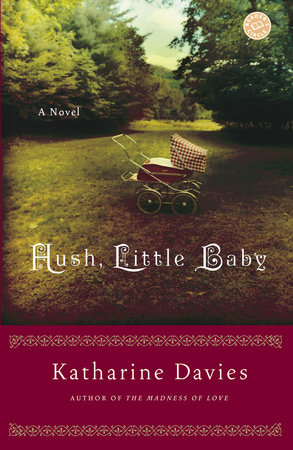
RANDOM HOUSE: Hush, Little Baby is deeper and more serious than
your previous novel, The Madness of Love, yet it retains a similar
mythical, dreamlike quality. Is this characteristic conscious or unconscious?
KATHARINE DAVIES: I think it is unconscious; it may come from my
experience of the world and my particular way of seeing things,
and also perhaps from the way that I work, which is often through
writing poetry. The opening of Hush, Little Baby began as a poem
written at the very beginning of the spring, although I later cut out
quite a lot of the images to give a greater feeling of momentum at
the start of the novel. There is a section later in the book that
comes directly from a poem I had written, too. This is the poem—
I’m sure you can relate it to the relevant part of the book.
MOTHS
The moths returned.
They laid their eggs in dust.
They came in the aftermath.
They floated ghostly through kicked-in doors,
they rested on the edges of dents in the walls,
they flickered in the empty grate.
They were indiscriminate:
they flew from drawers;
they didn’t distinguish mine from yours.
They issued, dazed, from the pages of books.
They were fragile flinders,
they masqueraded
as splinters, as smithereens.
I killed them without qualm.
In my palm they were nothing.
Brittle carcasses. Dust.
But you could not.
When I left I thought of how they would seize their chance
to feast in your shirts undisturbed.
I thought of the tiny opening and shutting of their wings.
Of the closing of a door.
Of the extinguishing of lights.
Of the brush of your fingers,
like moths settling and then taking flight.
RH: Do you write short stories as well?
KD: Yes, but I would like to do so more often—I think they are the
most difficult form to write in, but they can be tremendous. I often
read them. One short-story writer I love to read is Lorrie Moore. I
find her story Terrific Mother extraordinarily moving and funny at
the same time. The subject matter of that story is not a million
miles away from Hush, Little Baby.
RH: Sometimes, after finishing a novel, the author mentions that
she will never really feel as though it is completed, but just as
often, a writer will say that she couldn’t possibly imagine adding
another scene or word. Does Hush, Little Baby fall into one of
these categories? If so, can you say a little bit about why?
KD: When I wrote the last chapter of Hush, Little Baby, I knew,
quite passionately, that I would never want to change a word of it,
especially the final sentences. But I felt that way about the ending
of The Madness of Love, too. I found that the endings of both these
books took me by surprise and almost wrote themselves. In both
cases, I found myself thinking, Ah! So this is how it ends!
RH: Many writers try to read other works that touch on topics similar
to those in their own writing, while others swear that they have
to stay away from anything that reminds them of their own work.
Do you fall into one these groups, and if so, why?
KD: I think the things I want to read about and write about are
often similar, but they are very universal subjects—love and relationships
and “being human”—so I don’t avoid reading anything
particularly. Perhaps if I were in the middle of writing a book I
wouldn’t read one that was about exactly the same subject matter.
However, I did read one or two books that were somewhat related
to mine. For example, I reread George Eliot’s Adam Bede, which
contains the story of poor Hetty Sorrel and her illegitimate baby.
RH: How do you determine how much research is necessary to
your work, and how much of it is just a story that comes to you
with no need for background research?
KD: I find research quite difficult to do and am much happier
working from my own thoughts and imagination. I think research
can become never-ending, with each new discovery resulting in
another bit of research. Even though this can be fascinating to do,
and can result in wonderful novels, I personally often end up using
only a fraction of any research I have done. I think you also have
to be careful that it doesn’t become an inhibiting factor—if you
are basing a story on fact, or merging fact and fiction, it can be
hard to make decisions about what to keep the same and what to
change. If the whole thing is imaginary, then you are much more
liberated. That’s why I like using made-up places. Having said
this, I sometimes do research by visiting a location I want to include
in my book and then coming home and writing about it. I did
that with the chapter set in the London Butterfly House in Hush,
Little Baby. This is the most enjoyable kind of research because I
get to visit lots of new and interesting places or I revisit places I already
know and see them in a different light.
RH: How long did it take you to complete the first draft of Hush,
Little Baby? And how long was it from the original idea to the
completed book? How does this time line compare with that of The
Madness of Love?
KD: They probably took about the same amount of time, although
my first book was easier to write because the subject matter was
lighter and I always had Shakespeare ’s Twelfth Night to refer to, as
I was basing the book on the plot of the play. Funnily enough,
Hush, Little Baby was in my mind even before I wrote The Madness
of Love, so all the ideas were there; it was just a case of getting
it down on paper and working out how to do the shifts between the
adult and child perspectives.
RH: In addition to writing, you also teach. Do you find it difficult
to juggle your writing schedule with your work schedule? How
often do you write?
KD:When I am in the middle of a book, I write a thousand words
a day, every day, and I edit the writing from the previous day in the
evening, so I try to take breaks away from teaching to do this properly.
When I teach creative writing, though, I find it stimulating
because I get ideas from doing the exercises in class with my students
and I love the immediacy and freshness of new writing and
new ideas, which is all very inspiring. I think it is easier to juggle
my own writing schedule with teaching than with the deadlines
that come into play once you are in the editing and production
stage of a novel.
RH: What do you do when you get stuck on a plot issue? How do
you break through writer’s block?
KD: Strangely, I don’t really get writer’s block. But I always make
sure I go for lots of walks, as I hate sitting still at a desk for too
long and missing the whole day, especially when I am in the country.
I find the natural world endlessly inspiring and also soothing
when the writing is getting all too much.
RH: Do you think it’s important for readers to know anything personal about the author in order to better understand the content of a novel? Why or why not?
KD: It might be interesting, occasionally, for the reader to know
the personal circumstances of a writer, but the appreciation of the
work should never depend on it. It has to be remembered that an
author may not actually want to tell the reader their personal circumstances,
and that this is fair enough! I think there is far too
much pressure on writers to tell readers about their private lives.
Books should speak for themselves.
RH: What are two main themes you would like readers to take
away from having read Hush, Little Baby?
KD: First the experience of childlessness, and the fear of being
childless. I think the pain of this experience has formerly been
something that has not been spoken of very much. Another thing
that the book is about is the effect of our childhood on our subsequent
life decisions, and the assimilation of our childhood and
adult selves as we grow older and reach a new level of understanding
and self-knowledge.




 QUICK VIEW