



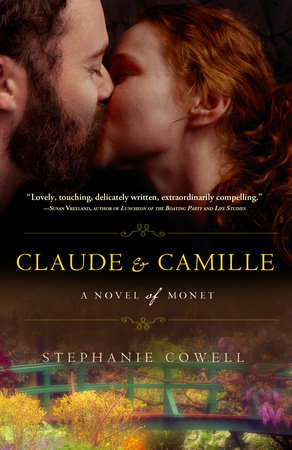

Claude & Camille
By Stephanie Cowell
By Stephanie Cowell
By Stephanie Cowell
By Stephanie Cowell
By Stephanie Cowell
Read by Christopher Cazenove
By Stephanie Cowell
Read by Christopher Cazenove
Category: Historical Fiction | Literary Fiction | Historical Romance
Category: Historical Fiction | Literary Fiction | Historical Romance
Category: Historical Fiction | Literary Fiction | Historical Romance | Audiobooks
-
$15.00
Apr 05, 2011 | ISBN 9780307463227
-
Apr 06, 2010 | ISBN 9780307463234
-
Apr 06, 2010 | ISBN 9780307712431
622 Minutes
Buy the Audiobook Download:

YOU MAY ALSO LIKE
 QUICK VIEW

The Dressmaker’s War
QUICK VIEW

In the Name of the Family
QUICK VIEW

The Kitchen Boy
QUICK VIEW

Girl in a Blue Dress
QUICK VIEW
The Shadow Queen
QUICK VIEW

Royal Road to Fotheringhay
QUICK VIEW
Murder Most Royal
QUICK VIEW

Dancing for Degas
QUICK VIEW
The Lost Carousel of Provence
QUICK VIEW
I Always Loved You
Praise
“Once again the acclaimed novelist Stephanie Cowell deftly takes us into the world of the classical arts with her well researched and beautifully written novel of historical fiction, Claude & Camille.”–LA Times Book Examiner 5 Stars (Examiner.com)
“Cowell is nothing short of masterful in writing about Claude Monet’s life and love….An enthralling story, beautifully told.”–The Boston Globe
“What a man! I am in awe before him. To be swept up by this novel which reveals the man and woman behind–no, in, the waterlily paintings, the seascapes and landscapes, is, and must be, a heartbreak. For me, reading Claude and Camille is like seeing old friends, learning them anew, from the inside, their passionate lives pulsing again by virtue of Stephanie Cowell’s sure pen. The story is lovely, touching, delicately written, extraordinarily compelling, and nearly all true. Read it with a book of Monet’s paintings by your side, and be prepared to marvel, and to weep.”–Susan Vreeland, author Luncheon of the Boating Party and Girl in Hyacinth Blue
“You’ll never look at Monet’s water lilies the same way after reading Cowell’s luminous biography of the artist and his muse” – Romantic Times (4 Stars)
“Rich and satisfying…Cowell seems poised on the cusp of very great things.” –January Magazine
“There’s more than one love triangle involved in this highly recommended tale. Don’t miss Claude & Camille.”–BookLoons
“Fleshing out the artist’s biographical outline with fresh imagery, well-paced dramatic scenes and carefully calculated dialogue, Cowell presents a vivid portrait of Monet’s remarkable career. She writes with intelligence and reverence for her subject matter, providing a rich exploration of the points at which life and art converged for one of history’s greatest painters.”–Booklist
“With elegant prose that blends color, light, and shadow to perfection, much as Monet did in his canvasses, Stephanie Cowell offers us a gorgeously rendered tale of love, genius, and haunting loss set against the dramatic backdrop of a world on the verge of inescapable change.”—C.W. Gortner, author of The Last Queen
“Stephanie Cowell ‘s Monet and his Camille are achingly real, and the miserable garrets of Paris where they struggle to survive are so sensitively portrayed you can almost smell the paint. Cowell sweeps the reader up into a story as dazzling and turbulent as the art whose creation she depicts.”—Laurel Corona, author of Four Seasons
“Claude & Camille is a wonderfully absorbing and romantic novel, the story of Claude Monet’s passion for his painting and his equally passionate love for a woman who is as elusive as the water lilies that he strove to capture on canvas. This elegant novel was hard to put down, and once I did, I rushed to view Monet’s paintings with a deeper understanding. Stephanie Cowell is a wonderful writer.”—Sandra Gulland, author of the Josephine B. trilogy and Mistress of the Sun
“An engaging, lyrical, and spirited work of fiction about the great love of Monet’s life. Cowell creates a vivid world here, of art, friendship, and ardent love within the Impressionist circle.”—Harriet Scott Chessman, author of Lydia Cassatt Reading the Morning Paper
“Stephanie Cowell’s new novel of art and love is focused on Claude Monet’s great passions: painting, friendship, and Camille Doncieux. With her uncanny ability to inhabit the hearts of historical characters, Cowell creates a wholly fascinating milieu as vividly as a film-maker. She has a special gift for rendering the scene–knowing which moments excite the reader, illuminate the characters, and create memorability. I was touched by the novel’s tenderness and compassion, and moved to immerse myself in my books of Impressionist paintings.”—Sandra Scofield, author of Opal on Dry Ground and Occasions of Sin
“Claude & Camille offers a fascinating look at nineteenth-century Paris, the bohemian lives of the Impressionists, and their struggle to create a new way of seeing the world. From Parisian ateliers to Giverny’s lush gardens, Stephanie Cowell paints an unforgettable portrait of Claude Monet and the two passions that framed his life: his beautiful, tragic wife, Camille, and his pursuit of art.”—Christi Phillips, author of The Devlin Diary
21 Books You’ve Been Meaning to Read
Buy Now


Just for joining you’ll get personalized recommendations on your dashboard daily and features only for members.
Find Out More Join Now Sign In