Excerpted from An Audience of Chairs by Joan Clark. Copyright © 2005 by Joan Clark. Excerpted by permission of Vintage Canada, a division of Random House, Inc. All rights reserved. No part of this excerpt may be reproduced or reprinted without permission in writing from the publisher.
When did you first realize you were a writer?
I was in my early thirties when the first fiction I wrote on a kitchen table was published simultaneously in the UK and Canada. When the book arrived in the mail, I read it with eager anticipation that quickly turned to dismay as the flaws began leaping off the page. I put the book down and never did finish reading it. Later, when I told my sister what was between the covers of the book really mattered to me, she said, “Well then, you're a writer.” Until then it hadn't occurred to me that I was a writer, or could be in time.
Can you tell us about your writing process? What is your favourite part of the process?
For me, there are two favourite parts in the writing process. The first occurs after I have a fairly good idea of where the story is going and as it grows, bit by bit, sending out shoots and runners that blossom in unexpected places, the elation of discovery keeps me on a high. The second favorite part occurs when the story is more or less in place and final revisions begin. This part of the process involves endless snipping, shifting, juggling, tucking, poking, patting, in short, fiddling. I love the preoccupation with words and sentences, the pickiness precision requires and I sometimes think I could happily revise forever.
Why did you choose to write about someone who has bipolar disorder? Did you conduct research into the disorder for the book?
I know a number of people who have varying degrees of bipolar disorder, a condition that I think is familiar to many, if not to most of us. The human psyche is subject to highs and lows and that fact, along with questioning what is sane and what is insane, has long fascinated me. Most of what I've learned about the disorder has come from observation, but I did read many books on the subject. The one that most influenced me was A Mind That Found Itself by Clifford Beers who in 1927 helped found the American Foundation for Mental Hygiene.
Is there a story about the writing of this novel that begs to be told?
If there is, it might be that I tried to write An Audience of Chairs twice before, roughly thirty and fifteen years ago and both times I backed off. Always vulnerable to the emotional weather of the characters in my novels, I didn't want to depress myself, which I did while working on Eiriksdottir, A Tale of Dreams and Luck, a novel about the difficult and often brutal life of the Norse who briefly lived in Newfoundland 1,000 years ago. Also, I didn't want to rattle the ghosts I rarely talked about; the death of my firstborn son and the suicide by drowning of my grandmother. All of which is to say that for me readiness is a huge dynamic in writing and that it is wise to wait until I have grown into a novel.
Did you travel in Moranna’s path (riding the ferries, Cape Breton and so on) when writing this book?
Well, part of my childhood was spent in Cape Breton and a large part of my imagination lives there; also living in Newfoundland I have often used the ferries. My father, Bill MacDonald, was a Cape Bretoner who was very proud of his Scottish heritage, as am I. (My mother on the other hand was Irish, a fact that inspired Latitudes of Melt, and I am proud of that heritage too.)
Despite Moranna’s illness, she is smart and very funny. Did you have fun creating her character?
I did. Because Moranna was reckless, impulsive and uninhibited, she gave me the opportunity to let go of my inhibitions and indulge my zany sense of humour.
Is there another character in the novel of whom you’re particularly fond? Why?
Although I am fond of Ian, Edwina, Murdoch, Lottie and Doris, I think that along with Moranna, I am most fond of Bun Clevet. I like his kindness and quiet, laid-back strength. A loner with a strong sense of himself, he has no axes to grind, no chip on his shoulder. There is nothing he needs to prove.
Are there any tips you would give a book club to better navigate their discussion of An Audience of Chairs?
One tip I would give readers is that the book be discussed as a novel and in no way presumes to be a case study of bipolarism. It is the story of one woman's life, full stop. Some readers are inclined to pass judgment on what this or that character should or should not do i.e. shouldn't she be taking her meds? This kind of thinking gets in the way of accepting a character like Moranna as she is. It is significant that at the end of the novel Moranna finally accepts this fact herself. Having said that, after I publish a book and it's ‘out there,’ in a sense it is no longer mine. As a writer I am fascinated by the different ways readers respond to what was once my baby.
Do you have a favourite story to tell about being interviewed about this book?
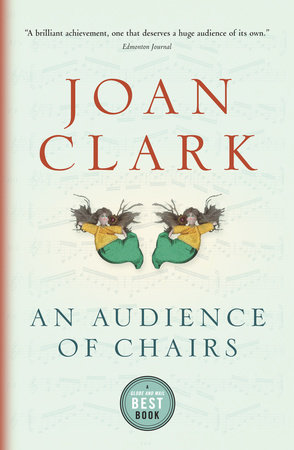
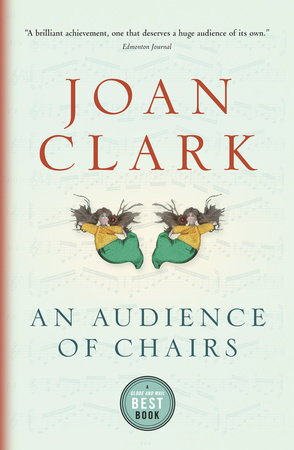
From the beginning, I imagined Moranna playing the piano and acting out the ambition of being a concert pianist on a piano board. But the subconscious inhabiting the depths that it does, it wasn't until I saw the piano on Scott Richardson's wonderful cover that I realized that I had been using the piano as a metaphor for the highs and lows we all experience. Most of us hope to play our lives on Middle C, but depending on our emotional makeup and what is happening or not happening to us, we find ourselves playing on either side of Middle C. Moranna of course was playing an entire octave on either side.
Is there anything critics and reviewers have overlooked in this book, that you wish they would notice?
I enjoy the fact that many critics and reviewers picked up on the humour. For me this is not a dark novel. Sad, yes, because it's about what Moranna lost and what her life might have been. But in other ways, her life was rich. Moranna was adept at entertaining herself.
What do you do when you’re not writing?
Spend time with my family and friends. Read, walk and in summer, swim. Travel, and when I get the chance, go to the theatre and to concerts.
1. An Audience of Chairs opens as Moranna is in middle age, looking back on the pivotal moments in her life, and anticipating what she hopes will be a positive reunion with her daughters. Discuss Clark’s use of flashbacks scattered throughout the chronological narrative – how did they affect the experience of the novel’s unfolding for you?
2. Moranna agrees to marry Duncan, at least in part because she wants to leave her job at the Big Barn theatre. She feels thrilled that “by executing a perfect exit, she had embraced her destiny and was about to begin the following act” (p. 88). There are many other examples in the novel in which Moranna thinks of her life in terms of the theatre. How do you think this relates to her illness?
3. Discuss the significance of the title, An Audience of Chairs. How do audiences figure in Moranna’s life? What other audiences does she have? Why are the chairs empty? Could they have been filled with flesh-and-blood people, had things gone differently in Moranna’s life?
4. What do you think of the actions of Moranna’s family when they intervene after the children are left on the island? Did they have any other choice? What would you have done?
5. Speaking with her neighbour and friend Lottie, Moranna quotes William Cowper’s line, “There is a pleasure in madness” (p. 60). What do you think of this statement, given what happens in Moranna’s life? Does Moranna find pleasure in her madness? Does it outweigh the pain?
6. Though they may not acknowledge they have much in common, Moranna and Bun are both scarred by the loss of a parent. How do you think the absence – or larger-than-life status – of these role models affected their individual developments? How do you think it has affected the way they relate as a couple? Who else in the novel has been affected by an absent parent?
7. The wooden people Moranna carves represent her ancestors, with detailed life stories for each. What do you think of the truth of these stories? What do you suppose makes the wooden people so significant to Moranna?
8. Moranna works hard to ensure that her inner reality overshadows the outer world in her life, however she often finds herself “distracted” by world events. What impact does the outer world have on her mental state?
9. An Audience of Chairs is deeply rooted in its Maritimes setting, however Moranna has had her share of travels. Discuss the sense of place in the novel.
10. In one scene in which Moranna plays Chopin on the silent piano board, she “feels she’s searching for an antidote to the immense sadness that is at the heart of his work, and her life” (p. 119). Will she ever find her antidote? Does it exist? What happens when she finally plays a working piano again?
11. Though there is much sadness in this novel, it also has some deeply funny moments. Discuss what you found humorous in the novel, and why.
12. Moranna resists the label “biopolar,” instead preferring to describe her mental illness using the metaphor of extreme weather. “She also rejects the idea that her emotional weather might have been passed on to her by her mother, because to admit it opens the possibility that she might have passed the same weather on to her daughters, who reside in her memory as perfect and unassailable children” (p. 116). What do you think of this denial? Note her eldest daughter Bonnie’s eventual career. Do you think Moranna’s mother’s sad legacy will persist?
13. The novel is told via a third person omniscient narrative, often delving into the thoughts not only of Moranna, but into those of the people in her life. How do you think this choice of narrative perspective impacts the telling of the story? Could it have been told any other way, for example as a first person narrative, in Moranna’s voice? How would this have changed the story? Who else could have been the narrator?
14. Costumes figure prominently in Moranna’s life. Discuss some of her costume choices throughout the novel and how they reflect her various moods and mental states. At the novel’s close, she removes a costume. What is the significance of this stripping down?
15. Moranna is deeply flawed, but she is undeniably brilliant and funny. Would you have her as a friend? What about as a dinner guest? Have you ever had anyone like Moranna in your life?