Author Q&A
A Conversation with Margaret Cezair-Thompson
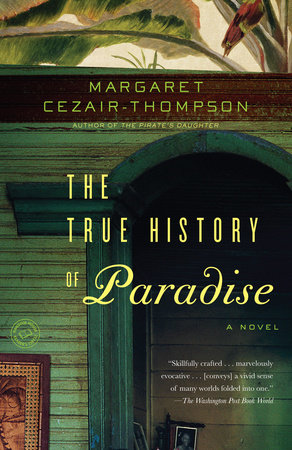
Random House Readers Circle: How did this story come to you? Did you experience any of the political upheaval in Jamaica? How did your family deal with it?
Margaret Cezair-Thompson: The disturbing changes in the country began during my teens, and I was especially aware of this because my father was a member of the government. I left for college in the United States as the violence began escalating, and it was there while I was an undergraduate that I first attempted writing a short story about the four characters: Lana, her sister, her mother, and Paul. The story focused on Lana’s mental instability and her death. At that time, I didn’t fully grasp what I was writing about. In Finding the Center, the Trinidadian writer V. S. Naipaul talks about how long it took for him as a young aspiring writer to discover his real subject. And that was true for me too. Over the years, I kept going back to the story, trying to revise it, until I finally realized that the short story form wasn’t right for this material. By then a lot had happened in Jamaica, to me, and to those close to me.
There had been so much violence. Many Jamaicans had left the island because they found the situation unbearable. I felt torn because as unbearable as things were, the country was still for me a place of extraordinary beauty and wonderful memories. Time, distance, and experience–all widened my perspective. I realized what I was writing was a much bigger story: It was about a place, it was multi-generational, and it required more than one voice to tell it.
RHRC: Was it hard for you to write about a Jamaican leaving her homeland? When did you leave, and how would you characterize the experience?
MCT: I became a U.S. resident officially in 1981, around the time in which the novel is set. Novels are often about “What if?” or “What if I hadn’t?” Unlike Jean, I was here in the United States during some of the worst years of Jamaica’s violence (though I had family there and went back often). In creating the protagonist, Jean, I was in some sense glancing back at what might have been if I hadn’t left when I did.
I didn’t really feel that I was writing about someone leaving her homeland, but rather about someone torn between going and staying. It’s also about a woman coming to terms with history–her family history and national history–and discovering her own voice and beliefs in the midst of swirling violence and family troubles. Kafka said that a book should be like an axe breaking the frozen sea inside us. I think that in as much as I identified with Jean, I was able to answer a lot of my own personal questions, face some troubling things (including my own panic and helplessness), and also show love for things and people I care about.
RHRC: When Rebecca Landing sees what the devastating earthquake did to her family’s plantation, she says, “I had thought till then that rivers outlived men.” Why do you think that Jamaica is prone to such hardship and disaster?
MCT: We’re in the tropical, not the temperate, zone. That might explain part of it. The same can be said of certain places in the United States where devastating things have happened, New Orleans for instance. It also has to do with a history that involves conquest, slavery, and colonialism. Rebecca’s words show her continuing passion for the land. Jamaica is her home. The earthquake divides and breaks up the land, separating rivers and sinking and obliterating the entire town of Port Royal. It is from this point on that Rebecca too is divided, exiled in an emotional and physical sense, foreshadowing the main character’s dilemma. Jean Landing experiences a similar type of anguish centuries later.
RHRC: Do you think Jamaica can continue to outlive the violence and stormy political strife that revisits it on a regular basis? What holds it together?
MCT: I’m not sure what holds us together. Maybe it’s what Roy Landing describes as “some wayward, mixed-up, and mixing spirit.” It is remarkable, I think, that we have a coherent history and identity as a people despite the upheavals, losses, and different ethnicities that are our inheritance: small place, big history. The land is resilient and so are the people. A tree gets split in half during a hurricane and a year later you see new branches and flowers growing on that same tree. All through the dreadful years of violence, Bob Marley and other Jamaican musicians created great music that touched people all over the world. We’re survivors.
RHRC: In The True History of Paradise, so many foreigners seem to really find their place in Jamaica, yet citizens must pick such politically polarized sides. Why do you think Jamaica is so inclusive and exclusive at the same time?
MCT: By foreigners, do you mean the people who settle there and become Jamaican, be they originally Scottish, Chinese, Indian, or so on? They become as Jamaican as anyone else, and also get caught up in the political polarization. But the sad thing about the polarization is that the victims are, for the most part, the poor.
RHRC: Have you ever heard the voices of your ancestors? Do you believe in egun iponri?
MCT: “Ancestors coming and going, living in and around a person” is how I describe egun iponri in the book. This is a difficult question to answer. I don’t hear them the way Jean does in the book. But I live with an awareness of those who came before, their mistakes and their triumphs. Their accumulated experiences amount to something and guide us. Many of us have internalized the voices of our parents, for instance; their words come to us sometimes about something quite trivial, at other times when we’re confused or in distress.
But the other answer to this question has to do with being a writer: Writers tend to be earnest listeners. Members of my family are often astonished that I know about things that happened when I was very young or before I was born, things that happened to distant or deceased relatives. Anecdotes, bits of conversation from the past–they all stay with me. But I want to add that the voices of the living are more important to me–in general and in the particular sense of my living here, outside of Jamaica. I continue to write about Jamaica, and so listening to Jamaicans here, or back home, or wherever they might be, is vital to me. It keeps me in touch and inspired.





 QUICK VIEW