



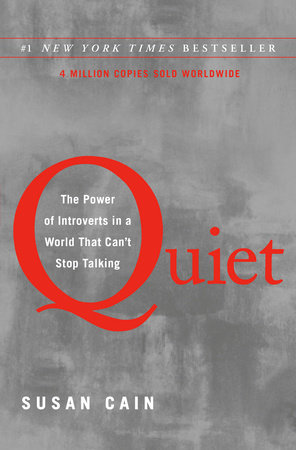

Quiet
By Susan Cain
By Susan Cain
By Susan Cain
By Susan Cain
By Susan Cain
By Susan Cain
By Susan Cain
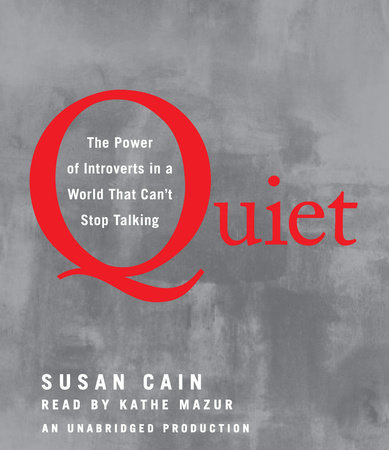
Read by Kathe Mazur
By Susan Cain
Read by Kathe Mazur
Category: Psychology | Self-Improvement & Inspiration | Leadership
Category: Psychology | Self-Improvement & Inspiration | Leadership
Category: Psychology | Self-Improvement & Inspiration | Leadership
Category: Psychology | Self-Improvement & Inspiration | Audiobooks
-
$18.99
Jan 29, 2013 | ISBN 9780307352156
-
$30.00
Jan 24, 2012 | ISBN 9780307352149
-
Jan 24, 2012 | ISBN 9780307452207
-
Jan 24, 2012 | ISBN 9781415959138
640 Minutes
Buy the Audiobook Download:
YOU MAY ALSO LIKE
 QUICK VIEW
The Gifts of Imperfection: 10th Anniversary Edition
QUICK VIEW

Atlas of the Heart
QUICK VIEW

She Has Her Mother’s Laugh
QUICK VIEW
The Comfort Book
QUICK VIEW
The Body
QUICK VIEW
Find Your People
QUICK VIEW
A Short History of Nearly Everything
QUICK VIEW

The Second Mountain
QUICK VIEW

Ikigai
QUICK VIEW
Braving the Wilderness
Praise
“An important book that should embolden anyone who’s ever been told, ‘Speak up!’”—People
“Cain offers a wealth of useful advice for teachers and parents of introverts. . . . Quiet should interest anyone who cares about how people think, work, and get along, or wonders why the guy in the next cubicle acts that way. It should be required reading for introverts (or their parents) who could use a boost to their self-esteem.”—Fortune
“A rich, intelligent book . . . enlightening.”—The Wall Street Journal
“Charm and charisma may be one beau ideal, but backed by first-rate research and her usual savvy, Cain makes a convincing case for the benefits of reserve.”—Harper’s Bazaar
“A smart, lively book about the value of silence and solitude that makes you want to shout from the rooftops. Quiet is an engaging and insightful look into the hearts and minds of those who change the world instead of tweeting about it.”—Daniel Gilbert, professor of psychology, Harvard University, author of Stumbling on Happiness
“As an introvert often called upon to behave like an extrovert, I found the information in this book revealing and helpful. Drawing on neuroscientific research and many case reports, Susan Cain explains the advantages and potentials of introversion and of being quiet in a noisy world.”—Andrew Weil, author of Healthy Aging and Spontaneous Happiness
“Those who value a quiet, reflective life will feel a burden lifting from their shoulders as they read Susan Cain’s eloquent and well documented paean to introversion—and will no longer feel guilty or inferior for having made the better choice!”—Mihaly Csikszentmihalyi, author of Flow and Distinguished Professor of Psychology and Management, Claremont Graduate University
“Susan Cain has done a superb job of sifting through decades of complex research on introversion, extroversion, and sensitivity—this book will be a boon for the many highly sensitive people who are also introverts.”—Elaine Aron, author of The Highly Sensitive Person
“Quiet legitimizes and even celebrates the ‘niche’ that represents half the people in the world.”—Guy Kawasaki, author of Enchantment: The Art of Changing Hearts, Minds, and Actions
“Susan Cain is the definer of a new and valuable paradigm. In this moving and original argument, she makes the case that we are losing immense reserves of talent and vision because of our culture’s overvaluation of extroversion. A startling, important, and readable page-turner that will make quiet people see themselves in a whole new light.”—Naomi Wolf, author of The Beauty Myth
“Quiet elevates the conversation about introverts in our outwardly-oriented society to new heights. I think that many introverts will discover that, even though they didn’t know it, they have been waiting for this book all their lives.”—Adam S. McHugh, author of Introverts in the Church
“Gentle is powerful . . . Solitude is socially productive . . . These important counter-intuitive ideas are among the many reasons to take Quiet to a quiet corner and absorb its brilliant, thought-provoking message.”—Rosabeth Moss Kanter, Harvard Business School professor, author of Think Outside the Building
“Memo to all you glad-handing, back-slapping, brainstorming masters of the universe out there: Stop networking and talking for a minute and read this book. In Quiet, Susan Cain does an eloquent and powerful job of extolling the virtues of the listeners and the thinkers—the reflective introverts of the world who appreciate that hard problems demand careful thought and who understand that it’s a good idea to know what you want to say before you open your mouth.”—Barry Schwartz, author of The Paradox of Choice
“An intriguing and potentially life-altering examination of the human psyche that is sure to benefit both introverts and extroverts alike.”—Kirkus Reviews (starred review)
“Cain gives excellent portraits of a number of introverts and shatters misconceptions. Cain consistently holds the reader’s interest by presenting individual profiles, looking at places dominated by extroverts (Harvard Business School) and introverts (a West Coast retreat center), and reporting on the latest studies. Her diligence, research, and passion for this important topic has richly paid off.”—Publishers Weekly
“This book is a pleasure to read and will make introverts and extroverts alike think twice about the best ways to be themselves and interact with differing personality types.”—Library Journal
“An intelligent and often surprising look at what makes us who we are.”—Booklist
Awards
Goodreads.com Readers Choice Award for Best Debut Author and Best Nonfiction Book of the Year WINNER 2012
Books for a Better Life Book Award FINALIST 2012
Carnegie Medal FINALIST 2013
Table Of Contents
Author’s Note |
INTRODUCTION: The North and South of Temperament |
PART ONE: THE EXTROVERT IDEAL
1. THE RISE OF THE “MIGHTY LIKEABLE FELLOW”: How
Extroversion Became the Cultural Ideal |
2. THE MYTH OF CHARISMATIC LEADERSHIP: The
Culture of Personality, a Hundred Years Later |
3. WHEN COLLABORATION KILLS CREATIVITY:
The Rise of the New Groupthink and the Power of
Working Alone |
PART TWO: YOUR BIOLOGY, YOUR SELF?
4. IS TEMPERAMENT DESTINY?: Nature, Nurture, and the
Orchid Hypothesis |
5. BEYOND TEMPERAMENT: The Role of Free Will (and the
Secret of Public Speaking for Introverts) |
6. “FRANKLIN WAS A POLITICIAN,
BUT ELEANOR SPOKE OUT OF CONSCIENCE”:
Why Cool Is Overrated |
7. WHY DID WALL STREET CRASH AND WARREN
BUFFETT PROSPER?: How Introverts and Extroverts Think
(and Process Dopamine) Differently |
PART THREE: DO ALL CULTURES HAVE
AN EXTROVERT IDEAL?
8. SOFT POWER: Asian-Americans and the Extrovert
Ideal |
PART FOUR: HOW TO LOVE, HOW TO WORK
9. WHEN SHOULD YOU ACT MORE EXTROVERTED
THAN YOU REALLY ARE? |
10. THE COMMUNICATION GAP: How to Talk to
Members of the Opposite Type |
11. ON COBBLERS AND GENERALS: How to Cultivate
Quiet Kids in a World That Can’t Hear Them |
CONCLUSION: Wonderland |
A Note on the Dedication |
A Note on the Words Introvert and Extrovert |
Acknowledgments |
Notes |
Index |
21 Books You’ve Been Meaning to Read
Buy Now


Just for joining you’ll get personalized recommendations on your dashboard daily and features only for members.
Find Out More Join Now Sign In