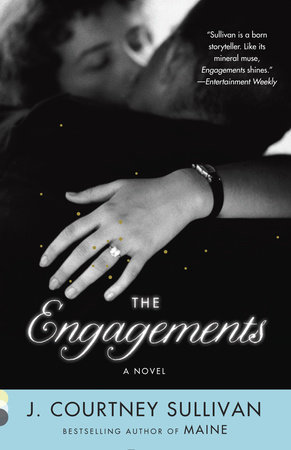
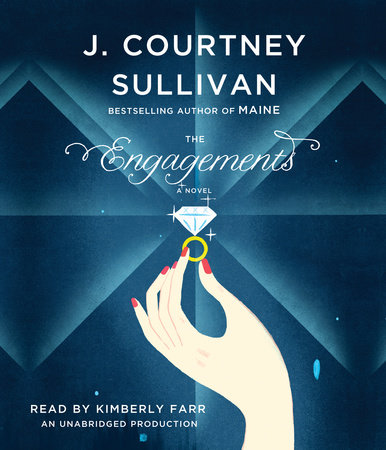
From the New York Times best-selling author of Commencement and Maine comes a gorgeous, sprawling novel about marriage—about those who marry in a white heat of passion, those who marry for partnership and comfort, and those who live together, love each other, and have absolutely no intention of ruining it all with a wedding.
Evelyn has been married to her husband for forty years—forty years since he slipped off her first wedding ring and put his own in its place. Delphine has seen both sides of love—the ecstatic, glorious highs of seduction, and the bitter, spiteful fury that descends when it’s over. James, a paramedic who works the night shift, knows his wife’s family thinks she could have done better; while Kate, partnered with Dan for a decade, has seen every kind of wedding—beach weddings, backyard weddings, castle weddings—and has vowed never, ever, to have one of her own.
As these lives and marriages unfold in surprising ways, we meet Frances Gerety, a young advertising copywriter in 1947. Frances is working on the De Beers campaign and she needs a signature line, so, one night before bed, she scribbles a phrase on a scrap of paper: “A Diamond Is Forever.” And that line changes everything.
A rich, layered, exhilarating novel spanning nearly a hundred years, The Engagements captures four wholly unique marriages, while tracing the story of diamonds in America, and the way—for better or for worse—these glittering stones have come to symbolize our deepest hopes for everlasting love.
Excerpted from The Engagements by J. Courtney Sullivan. Copyright © 2013 by J. Courtney Sullivan. Excerpted by permission of Knopf, a division of Random House, Inc. All rights reserved. No part of this excerpt may be reproduced or reprinted without permission in writing from the publisher.
Q: What inspired you to write THE ENGAGEMENTS?
I knew I wanted to write about marriage in all its complexity and at various stages. About why we choose the mates we do, and what happens next. A few of the characters had been floating around in my head for a while. I had this idea of a couple who have been married for decades, and came together in the first place because of a mutual loss. They turned into Evelyn and Gerald. And I kept thinking about paramedics—what was it like for them to go into the homes of strangers, whose only common trait was the fact that they weren’t expecting to need an ambulance that day? And so James came into being. Delphine started as an image: A beautiful French woman trashing the apartment of a man who had wronged her.
The cast of characters allowed me to explore marriage from every angle: James married his high school sweetheart and they’re in that frenzied period when kids are young, money is short, and there’s very little time for each other. While Evelyn and Gerald are retired, long married, but struggling with their son’s divorce. Delphine tells a story of marital infidelity. And Kate resists the very idea of marriage.
Q: A character you feature, Frances Gerety, was an actual ad writer in the 1940’s who wrote the line “A Diamond is Forever”. Why did you choose to include a real-life character, Frances specifically?
I started off with the other four main characters. But I felt like there was someone missing. I always thought I might include diamonds, because while the stories are really about the everyday, nitty gritty parts of marriage, diamonds represent a sort of perfection and hopefulness. And they’ve been a symbol of marriage for so long. I was reading Tom Zoellner’s wonderful book, “The Heartless Stone” and there was one sentence about Frances Gerety in it. It said she had written the line “A Diamond Is Forever” in 1947 and that she herself never married. I knew right away that I had to write about her. (I actually wrote “Put her in the book!!!!” in the margins.)
I wanted to be as true to who Frances was as I possibly could. She passed away in 1999, but I feel I’ve gotten to know her. I’ve interviewed several of her former co-workers, neighbors and friends. I’ve stood in the rooms of her house, read her correspondence, and made a photo album of her pictures, which includes a four page spread of her dog, Blazer. I am tremendously fond of Frances. She was a sharp, bold, tough woman with a great sense of humor, who often defied convention. I wrote this book with her photograph hanging over my desk. Now that I’m on to other projects, I still haven’t taken it down.
Q: What can you tell us about the internal N. W. Ayer diamond memos you quote from?
In 1982, Edward Jay Epstein wrote an incredible article for the Atlantic Monthly called “Have You Ever Tried to Sell a Diamond?” It chronicles the ways in which the advertising agency N.W. Ayer (where Frances Gerety worked) helped De Beers create the American obsession with diamond engagement rings. There are many different kinds of marriage depicted in the book, and I’d say one of them is the marriage between N.W. Ayer and De Beers. In the Atlantic article, Epstein quotes from confidential annual reports that Ayer presented to De Beers. The quotes are fascinating and I wanted to include the reports in the book. But it was important to me that I see the original reports with my own eyes. For two years I searched, following leads that took me to the archives at Boston University and the Smithsonian Institution, among other places, without luck. Days before I had to hand in the novel, I went to Frances Gerety’s former house at the invitation of its current owner. She gave me several boxes to take home. They contained the only things Frances left behind when she moved: Hundreds of photographs and, to my amazement, the annual reports!
Q: You feature a paramedic, a successful classical musician, and an advertising gal of the 1940’s, amongst others. Quite a diverse group! What can you tell us about your research for the book?
This was my first novel that wasn’t rooted in a world that I knew well. I wanted to get it right, so I did extensive research for every character and I had a tremendous amount of fun doing it. If there were no such thing as deadlines, I’d still be researching this book. I started off by reading a hundred years’ worth of newspaper articles to get a sense of what was happening in the world around the characters at any given time. And then I went to the experts.
Frances Gerety’s co-workers provided insight into the business of advertising in general and N.W. Ayer in particular. The Cambridge, Massachusetts paramedics took me on ambulance ride-alongs and answered hundreds of questions. I was lucky enough to convince the violin virtuoso Anne Akiko Meyers to let me interview her multiple times, and I wrote P.J. (the virtuoso in the book) with her music playing in the background. To get the character of Delphine right, I interviewed women who had moved from Paris to New York, and I traveled to Paris, where I spent time walking the steps that Delphine would walk every day. I picked a location for her shop on a quiet street in Montmartre, and for her home on a little private road just around the corner.
Q: THE ENGAGEMENTS is set in 5 different time periods, from 1947 to 2012. Why did you choose to structure it this way?
Each character tells the story of a marriage, and together their stories span a century. I was most concerned with their individual journeys, but at some point I realized that taken as a whole, they presented an interesting picture of how marriage has changed (and stayed the same) over the past hundred years. In Evelyn’s childhood, divorce was rare and rather shocking, while Kate grew up at a time when more of her friends had divorced parents than married ones. In Evelyn’s present day, Americans are only starting to get their heads around interracial marriage, while Kate has just seen the laws change in New York in favor of same sex marriage. Each character reflects on his or her childhood, which I thought was essential given how strongly our parents’ marriages can influence our own.
Q: You are getting married in June. What was it like for you to write about marriage in the midst of planning for your own wedding?
When you write a novel, people often ask which character is based on you. I always find that two wildly different characters can represent parts of the way I see an issue. And so it was with The Engagements. I wasn’t yet engaged when I started writing it. If you asked me then what I thought about weddings, I would have put myself closest to Kate, who can’t understand why her beloved cousin Jeff is so wedding obsessed. I never thought I’d have a wedding or wear a big flouffy white dress, or any of that nonsense.
One of the first chapters I wrote from Kate’s point of view included the passage: “Everything about weddings made her skin crawl, nothing more so than the brides who wanted to be different somehow—‘I’m not like other brides!’ all her friends had declared, before promptly acting like every other bride in the history of brides.” I may as well have been writing about myself, because once I got engaged, all my wedding resistance went out the window, although I continued to feel weird about it. It was sort of an out-of-body experience.
Another line of Kate’s, when she’s critiquing her cousin’s crazy behavior: “Entire days were lost to TheKnot.com.” Guilty as charged. But the great thing was, I could spend hours bingeing on wedding nonsense and really get into Jeff’s head that way, and afterward I would write about how ridiculous it was from Kate’s point of view.
1. The Engagements’s epigraph refers to diamonds as “nothing more than an empty cage for our dreams—blank surfaces upon which the shifting desires of the heart could be written.” What does this tell us about the novel we’re about to discuss?
2. Feminism and the role of women is a recurring theme in The Engagements. Which character’s attitude did you relate to the most, and why?
3. Two of the novel’s major characters are anti-marriage, with story lines that are decades apart. How does time change society’s attitude toward intentionally unmarried women?
4. On page 27, Evelyn thinks, “Men made mistakes and when they asked forgiveness, women forgave. It happened every day.” Does this prove true throughout the novel, with other characters?
5. Did you know that Frances Gerety was a real person? How does that change your feelings about the character?
6.
Why do you think Frances is the only character whose story moves through time?
7.
On page 100, in a section set in 1972, Evelyn thinks, “Since she and Gerald were young, what it meant to be an American had changed. There was so much emphasis on the self now—self over country, self over family, self over all else. Her son was a shining example of the consequences.” How does this play out in more contemporary sections of the novel and with other story lines?
8.
While the novel is clearly about marriage, parental relationships also play a major role. Discuss and compare the parenting styles of Evelyn, James, and Kate.
9.
How does Delphine’s bond with her late father influence her romantic life?
10.
In the novel, a Stradivarius violin and a diamond ring are each cherished heirlooms. Which do you think has more value? Which does the author value more?
11.
What did you think about Delphine’s reaction to P.J.’s betrayal?
12.
On page 175, Meg says to Frances, “Sometimes it just feels like we can’t tell what we’ve given up until it’s too late.” What other characters could have uttered that line?
13.
Sullivan paints Kate as principled yet judgmental. Does Sullivan want us to like her?
14.
On page 275, May says to Kate, “It’s very rare to find anyone who’s absolutely certain that she chose the right ring.” What metaphor is at work here?
15.
Late in the novel, on page 344, Gerald says to Evelyn, “No one has the right to comment on the way anyone else falls in love.” He says that in 1972. How does it apply in other decades?
16.
What did you think when you learned how James was connected to the other stories?
17.
What point do you think Sullivan is making about the ethics of diamonds? Did reading this novel change your feelings about them?
18. Which story line did you enjoy the most? Whose story would you like to keep reading?