



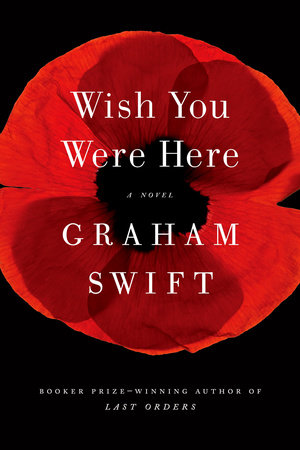

Wish You Were Here
By Graham Swift
By Graham Swift
By Graham Swift
By Graham Swift
Part of Vintage International
Part of Vintage International
Category: Literary Fiction | Suspense & Thriller
Category: Literary Fiction | Suspense & Thriller
-
$16.95
Jan 22, 2013 | ISBN 9780307744395
-
Apr 17, 2012 | ISBN 9780307957665
YOU MAY ALSO LIKE
 QUICK VIEW
The Syringa Tree
QUICK VIEW
And After Many Days
QUICK VIEW
Loose Ends
QUICK VIEW
The Company Car
QUICK VIEW
O, Africa!
QUICK VIEW
Roads of the Heart
QUICK VIEW
Sylvan Street
QUICK VIEW
Forgive Me
QUICK VIEW
The Family Tree
QUICK VIEW
Tropical Fish
Praise
“An extraordinary novel, the work of an artist with profound insight into human nature and the mature talent to deliver it.” —The Washington Post
“Exquisite. . . . Beautifully made…[an] abundance of subtlety, tenderness and fluid prose.” —The New York Times Book Review
“Vivid, emotionally raw . . . Swift is a writer who clearly revels in dialogue and nuance. . . . Thoughtful and sensitive.” —The Boston Globe
“Mr. Swift’s writing is as strong as ever, recalling the descriptive beauty of his highly acclaimed Waterland and Booker Award-winning Last Orders.” —Pittsburgh Post-Gazette
“As every truly great novelist does, in this new book, [Swift] demonstrates that perfect coordination between style and story. . . . [A] honed and driven story. Honestly, I can’t remember when I cared so passionately about how a novel might end.” —Ron Charles, The Washington Post
“Jamesian in sensibility and to some degree in style, [Swift] finds tragedy in the most ordinary conversation. . . . . You forget how piercing this sort of thing can be until you see Swift doing it so well, and with such patience. The depth of field in a Swift novel, thematically and emotionally, is vast. At his best, he suggests that looking intently at the smallest, most mundane thing can yield a glimpse into the meaning of life.” —The New York Times Book Review
“A rich, stereoscopic portrait of the book’s hero, Jack Luxton. . . . Swift knows that in reality we occupy a wealth of experiences, past and present, mundane and memorable. His strength in this fine novel is showing how all those experiences inescapably collide within us. As he puts it, “the place known as ‘away from it all’ simply doesn’t exist.” —Minneapolis Star-Tribune
“Heart-wrenching and gripping, Swift’s novel takes one man’s grief and uses it as a prism for the suffering of an entire nation.” —Mail on Sunday
“Part ghost story, part whodunit, part tour d’horizon of a nation that seems to have lost faith in tradition and history, it is also a deeply human tale about a man driven to the edge. Praise be for a serious novel that dares to look current affairs in the face.” —The Times (London)
“One of Swift’s most accomplished works yet. . . . A writerly novel that pushes us deep into the writer’s craft. . . . That Swift should be considered among the ranks of the literary greats is surely no longer in doubt.” —Culture Mob
“Magnificent . . . This is a substantial work, but not a sentence too long . . . Unafraid of emotion, though without a moment of sentimentality, Swift brilliantly conveys the confusion of a man and wife trapped by their unspoken fears.” —Sunday Herald (Scotland)
“With unmistakable echoes of Thomas Hardy and E.M. Forster. . . . He exercises a compelling mastery of tone and trajectory. . . . Emotionally gripping.” —The Times Literary Supplement
21 Books You’ve Been Meaning to Read
Buy Now


Just for joining you’ll get personalized recommendations on your dashboard daily and features only for members.
Find Out More Join Now Sign In