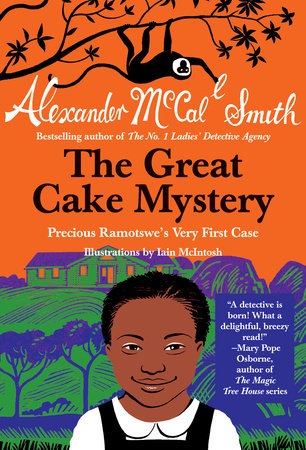
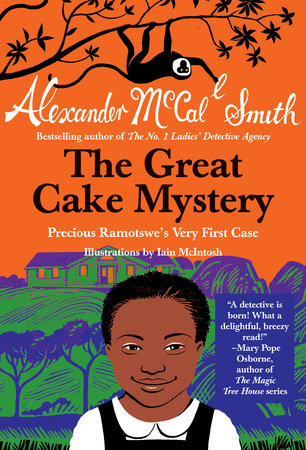
Excerpted from The Great Cake Mystery: Precious Ramotswe's Very First Case by Alexander McCall Smith. Copyright © 2012 by Alexander McCall Smith. Excerpted by permission of Anchor, a division of Random House, Inc. All rights reserved. No part of this excerpt may be reproduced or reprinted without permission in writing from the publisher.
Alexander McCall Smith is the author of the beloved, bestselling No. 1 Ladies’ Detective Agency series, the Isabel Dalhousie series, the Portuguese Irregular Verbs series, the 44 Scotland Street series, and the Corduroy Mansions series. He is also the author of numerous children’s books. He is professor emeritus of medical law at the University of Edinburgh and has served with many national and international organizations concerned with bioethics. He was born in what is now known as Zimbabwe and taught law at the University of Botswana. He lives in Scotland. Visit his website at www.alexandermccallsmith.com.
An Author Note, Character Guide, and Index to the Geography and People of Botswana
A NOTE FROM ALEXANDER McCALL SMITH
Dear Reader,
There are some stories that an author feels he or she just has to write, and for me this story of the early life of my Botswana heroine, Precious Ramotswe, is one.
Over the decade or so since the No. 1 Ladies’ Detective Agency books have been widely available, I have been struck by the number of young people who have engaged with the story of this rather amiable African woman who starts a tiny detective agency and who devotes herself to helping people with their personal problems. I have also been struck by the extent to which the books were shared within families; it not being uncommon for grandparents, parents, and children all to take turns in reading the latest installment of Mma Ramotswe’s story. This pleased me greatly, as reading the same book is a good way of binding generations together. At the same time, even if a young child is a strong reader, these books could pose a bit of a challenge—hence the idea of writing something that could be appreciated by readers under ten, while at the same time being, I hope, an entertaining read for all ages. I know I have a lot of fans who are teachers and librarians and hope that the book will also appeal to them as one they can share and use with younger readers.
It also seemed to me that it would be an intriguing and enjoyable thing to imagine the life of Precious when she was a young girl. If it is true that we often manifest at a very early age those qualities and interests that will determine what we do in later life, then it is reasonable to think that the young Precious Ramotswe was a bit of a detective all along. So the story emerged of Precious dealing with a mystery that arises in her class at school. And of course the issues that arise in that context are the same as those that arise in an adult mystery: honesty and dishonesty, friendship, suspicion, and so on. But, I hope that this book is able to do a little bit more. I hope that it gives the young reader something of the flavor of Africa and will inspire them to read more about that wonderful continent and its remarkable people.
—Alexander McCall Smith
CHARACTER GUIDE
Precious Ramotswe (RAM-OTS-WE)
She smiles a lot and is one of the nicest girls in Botswana. Precious asks a lot of questions and can always tell when people are making things up.
Obed Ramotswe
Precious’s father, he is a kind man who tells great stories. Obed was almost eaten by a lion when he was young.
Tapiwa (TAP-EE-WAH)
A girl who is Precious’s classmate. She is the first to realize that there is a thief at their school.
Sepo
One of Precious’s classmates whom everyone likes and has a habit of saying funny things.
Big Mrs. Molipi (MO-LEE-PEE)
The school cook, a very large lady who seems to only know one recipe.
Not-so-Big Mrs. Molipi
Big Mrs. Molipi’s assistant and cousin. She is much smaller than her cousin.
Poloko (PO-LOW-KO)
A rather round boy who is Precious’s classmate. He walks around with sweets in his pockets and everyone thinks he is the cake thief.
GEOGRAPHY AND THE PEOPLE OF BOTSWANA
Botswana is located towards the bottom of Africa and is roughly the size of Texas. It is a wide dry land with lots of amazing things to see. The capital is Gaborone. Pronounced Ha-bo-ro-nee.
The Bush is the rural, undeveloped land of Botswana, which is far from civilization.
The Kalahari is a semi-desert, which occupies the central and western parts of Botswana. It is a great stretch of dry grass and thorn trees where very few people live.
Mma is the term used to address a woman, and may be placed before her name. It is pronounced “ma” (with a long a). This is what Precious and her classmates call their teacher.
Okavango is the great river in the north that flows the wrong way—instead of flowing from land to sea, the water goes from the ocean to the heart of Africa where it is absorbed into the sands of the Kalahari.
Setswana is the language spoken in most of Botswana. Most people also speak English and newspapers, for example, will be in both languages.
Wildlife Botswana has a wide variety of wild animals, including lions, elephants, zebras, buffalo, leopards, hippos, hyenas, baboons, snakes, monkeys, and many more.
“A detective is born! What a delightful, breezy read!"
—Mary Pope Osborne, bestselling author of The Magic Tree House series
“Told with an innocence that will captivate young readers, The Great Cake Mystery is a kind-hearted, feel-good story for all. Loved it!”
—Graham Salisbury, author of Under the Blood-Red Sun and the Calvin Coconut series
“Kids will love this kind and clever new detective. They’ll love the mystery, and they might even love the thieves. I look forward to more!”
—Patricia Reilly Giff, award-winning author of Wild Girl and other books
“Stunning artwork. . . . A compelling plot and interesting secondary characters, especially classmates who are quick to make unfounded accusations and their teacher, who provides wisdom just when it is needed, will leave readers wanting more. One case where an adaptation from an adult book is as much fun to read as the original.”
—Kirkus Reviews, starred review
“This mini mystery and its jaw-dropping illustrations will please proto-detectives, both large and small. . . . What [McCall Smith]’s done with The Great Cake Mystery is unique. . . . His fans will pluck it up like so many of his other books. . . . A really fun read.”
—School Library Journal
"Bold and striking, McIntosh’s chunky, two-color woodcutlike pictures present evocative images of the African setting. This is a story, and a heroine, with impressive dimension."
- Publishers Weekly, starred review
A: DISCUSSION QUESTIONS
1. Do you agree with the author’s statement that detectives are “born that way”?
2. Why does the author stress that Precious is a “nice” person? What personality traits do you think a nice person should possess?
3. Discuss the significance of Obed’s story about the lion. What does it tell Precious about her father? Why does she like to hear the story over and over?
4. How does Precious know which parts of the lion story are true and which parts are stretching the truth? Why is this important?
5. Why does Tapiwa tell Precious about the cake thief? Why does she assume that the thief is someone in the school?
6. Precious wonders if people who grow up to steal were thieves when they were children or if they became thieves later on. This question is not answered in the book. What do you think?
7. Why does everyone like Sepo? What qualities does he have that make him popular with the other students?
8. Why do Sepo and Tapiwa believe that Poloko is the thief? What evidence do they have? Why are the other children so quick to believe that Poloko is the thief?
9. How does Poloko feel when the others accuse him of stealing the food? How would you feel if you were accused of something that you didn’t do? Why is it so hard for Poloko to defend himself?
10. Why does Precious believe Poloko is innocent? Why does she tell him she will be his friend when everyone else believes the worst about him?
11. How do Precious and Poloko discover the real thieves? If they had not walked home from school together, taking their time, would they have solved the mystery?
12. Solving the mystery is one thing, but the real challenge is proving it to the others. How does Precious convince the other children and the teacher of the truth? How does her dream help her trap the real thieves?
B: POST-READING ACTIVITY
1. Discuss the theme of honesty in this story. What does honesty mean to you? Can you think of other ways that Precious might have proven to the class that Poloko was innocent?
2. Discuss the theme of friendship in this story. Who acted as a true friend? What qualities do you look for in a friend? How can you tell when someone is a true friend?
3. Discuss the theme of stereotypes and what it means to judge people based on preconceived notions rather than evidence. Discuss the need to hear all sides of a story before you accuse a person of wrongdoing.
C: CIRRICULUM QUESTIONS
1. Geography:
Draw a map of Africa and highlight the country of Botswana on the map. Locate the countries that are near Botswana on the map. What more do you want to know about Botswana after reading The Great Cake Mystery? http://www.botswanatourism.co.bw/
2. Science/Biology—The Animal Kingdom:
Find information about the indigenous monkeys in Botswana. How does this information help you understand the story better? http://www.wildlife-pictures-online.com/vervet-monkey-information.html
3. Language Arts:
Write a character sketch of your favorite character in the story. What do you think that character does in his or her spare time? What is your character’s family like? Write a story of your own that includes the character you have chosen. Look up information about the author of The Great Cake Mystery: http://www.randomhouse.com/features/mccallsmith/main.php
4. Social Studies:
In the American judicial system, an accused person is “innocent until proven guilty.” Discuss the meaning of this phrase. Research the history of the American Bill of Rights and how it came to be adopted by our Congress: http://www.americaslibrary.gov/jb/nation/jb_nation_bofright_1.html
How do the laws of Botswana compare to the American system?