Random House: Bringing You the Best in Fiction, Nonfiction, and Children's Books
Follow Us On TwitterFan Us On Facebook
Authors
Books
Features
Newletters and Alerts

Buy now from Random House

  • A Partial History of Lost Causes
  • Written by Jennifer DuBois
  • Format: Hardcover | ISBN: 9781400069774
  • Our Price: $26.00
  • Quantity:
See more online stores - A Partial History of Lost Causes

Buy now from Random House

  • A Partial History of Lost Causes
  • Written by Jennifer DuBois
  • Format: eBook | ISBN: 9780679604747
  • Our Price: $12.99
  • Quantity:
See more online stores - A Partial History of Lost Causes

Buy now from Random House

See more online stores - A Partial History of Lost Causes

Buy now from Random House

See more online stores - A Partial History of Lost Causes

Buy now from Random House

  • A Partial History of Lost Causes
  • Written by Jennifer DuBois
  • Format: Trade Paperback | ISBN: 9780812982176
  • Our Price: $16.00
  • Quantity:
See more online stores - A Partial History of Lost Causes

A Partial History of Lost Causes

    Select a Format:
  • Book
  • eBook
  • Audiobook

A Novel

Written by Jennifer DuBoisAuthor Alerts:  Random House will alert you to new works by Jennifer DuBois


eBook

List Price: $12.99

eBook

On Sale: March 20, 2012
Pages: 400 | ISBN: 978-0-679-60474-7
Published by : The Dial Press Random House Group

Audio Editions

$45.00

Published by: Random House Audio

Read by Kathe Mazur and Stephen Hoye
On Sale: March 20, 2012
ISBN: 978-0-307-96928-6
More Info...

Read by Kathe Mazur and Stephen Hoye
On Sale: March 20, 2012
ISBN: 978-0-307-96929-3
More Info...
Listen to an excerpt
Visit RANDOM HOUSE AUDIO to learn more about audiobooks.


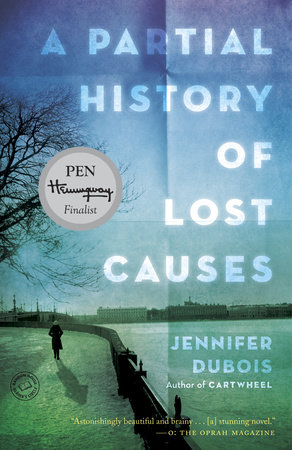
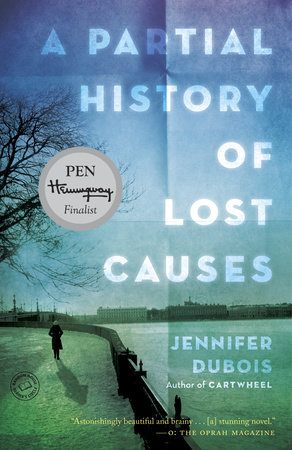
A Partial History of Lost Causes Cover

Bookmark,
Share & Shelve:

  • Add This - A Partial History of Lost Causes
  • Email this page - A Partial History of Lost Causes
  • Print this page - A Partial History of Lost Causes
ABOUT THE BOOK ABOUT THE BOOK
ABOUT THE AUTHOR ABOUT THE AUTHOR
PRAISE PRAISE
READER'S GUIDE READER'S GUIDE
Synopsis

Synopsis

“[An] astonishingly beautiful and brainy debut . . . [a] stunning novel.”—O: The Oprah Magazine

“In Jennifer duBois’ gorgeous novel,
A Partial History of Lost Causes, the personal, theoretical, and political are braided together into a seamless whole. . . . Moving yet startlingly funny—full of bravado, insight, and clarity. A Partial History of Lost Causes is a thrilling debut by a young writer who evidently shares the uncanny brilliance of her protagonists.”—Elle

In Jennifer duBois’s mesmerizing and exquisitely rendered debut novel, a long-lost letter links two disparate characters, each searching for meaning against seemingly insurmountable odds.

In St. Petersburg, Russia, world chess champion Aleksandr Bezetov begins a quixotic quest. With his renowned Cold War–era tournaments behind him, Aleksandr has turned to politics, launching a dissident presidential campaign against Vladimir Putin. He knows he will not win—and that he is risking his life in the process—but a deeper conviction propels him forward. And in the same way that he cannot abandon his aims, he cannot erase the memory of a mysterious woman he loved in his youth.

In Cambridge, Massachusetts, thirty-year-old English lecturer Irina Ellison is on an improbable quest of her own. Certain she has inherited Huntington’s disease—the same cruel illness that ended her father’s life—she struggles with a sense of purpose. When Irina finds an old, photocopied letter her father had written to the young Aleksandr Bezetov, she makes a fateful decision. Her father had asked the Soviet chess prodigy a profound question—How does one proceed against a lost cause?—but never received an adequate reply. Leaving everything behind, Irina travels to Russia to find Bezetov and get an answer for her father, and for herself.

Spanning two continents and the dramatic sweep of history, A Partial History of Lost Causes reveals the stubbornness and splendor of the human will even in the most trying times. With uncommon perception and wit, Jennifer duBois explores the power of memory, the depths of human courage, and the endurance of love.
Jennifer DuBois

About Jennifer DuBois

Jennifer DuBois - A Partial History of Lost Causes

Photo © Ilana Panich-Linsman

Jennifer duBois is a recent graduate of the Iowa Writers’ Workshop and is currently completing a Wallace Stegner Fellowship at Stanford University. Originally from western Massachusetts, she lives in Northern California.
Praise

Praise

Advance praise for A Partial History of Lost Causes

“[An] astonishingly beautiful and brainy debut novel…Against the backdrop of Russia’s recent political past, duBois conjures the briefly intersecting lives of two intriguingly complex strangers—prickly, introspective, and achingly lonely—who are nevertheless kindred spirits.  Her prose is both apt and strikingly original…So how do we proceed when defeat is inevitable? The stunning novel suggests an answer: We just do. Perseverance, it seems, is its own kind of victory.” —O: The Oprah Magazine, April 2011

"Gorgeous...DuBois writes with haunting richness and fierce intelligence. She has an equal grasp of politics and history, the emotional nuances of her complex characters, and the intricacies of chess. Irina and Aleksandr are difficult people, prickly and formidable, but they’re also sympathetic and flawed, vulnerable and human. DuBois’ evocations of Russia are lush, and her swashbuckling descriptions, whether of chess games, a doomed political campaign, or the anticipation of death, are moving yet startlingly funny—full of bravado, insight, and clarity. A Partial History of Lost Causes is a thrilling debut by a young writer who evidently shares the uncanny brilliance of her protagonists." — Kate Christensen, Elle


“Hilarious and heartbreaking and a triumph of the imagination. Jennifer duBois is too young to be this talented.  I wish I were her.”—Gary Shteyngart

An amazing achievement—a braiding of historical, political, and personal, each strand illuminating the other. Wonderful characters, elusive glimpses of wisdom, and a gripping story that accelerates to just the right ending.”—Arthur Phillips
 
“Thrilling, thoughtful, strange, gorgeous, political, and deeply personal, Jennifer duBois’s A Partial History of Lost Causes is a terrific debut novel. In prose both brainy and beautiful, she follows her characters as they struggle to save each other. This is a book to get lost in.”—Elizabeth McCracken

“By what exquisite strategy did duBois settle on this championship permutation of literary moves? Her debut is a chess mystery with political, historical, philosophical, and emotional heft, a paean to the game and the humans who play it. DuBois probes questions of identity, death, art, and love with a piercing intelligence and a questing heart.”—Heidi Julavits
 
Terrific . . . In urgent fashion, duBois deftly evokes Russia’s political and social metamorphosis over the past thirty years through the prism of this particular and moving relationship.”—Publishers Weekly (starred review)
Discussion Questions

Discussion Guides

1. Are Irina’s actions ultimately courageous or cowardly? Do you see her ending as happy?
 
2. In some ways, Irina’s and Aleksandr’s situations are similar—and in many ways, they are very different. What do you think brings Aleksandr and Irina together as friends? What do you think they learn from each other?
 
3. The character of Misha challenges Aleksandr’s vision of Russia’s democratic future. Is there any merit to his argument about the pragmatism of slower change? How do recent events in the Arab world speak to this argument?
 
4. Irina treasures her intellect, and fears that she will not be herself anymore once she begins to lose it. What do you think makes you “you”? Do you feel there’s some essential quality that makes you who you are—and that, if you lost it, you wouldn’t be the same person?
 
5. Why are Aleksandr’s sections written in third person, while Irina’s sections are written in first? How does this decision inform your reaction to the book? Did you find you connected more with either Irina or Aleksandr?
 
6. What do you think would have become of Ivan if he’d lived?  
 
7. Irina can often be sardonic and fatalistic. Are there any examples of her behaving in ways that subvert this cynical pose?
 
8. Beyond Aleksandr’s political career and Irina’s disease, do you see other lost causes in the book? Have you been faced with a lost cause in your own life, and how did you react to it?
 
9. How does chess work as a metaphor in the book? Is the structure of the game itself mirrored in the structure of the book?
 
10. Do you think that Aleksandr’s chess brilliance ultimately made him a better or worse person?
 
11. What role does Irina play in the reunion between Elizabeta and Aleksandr? Do you that they might have reconnected if Irina had never come to Russia?
 
12. After Misha’s letter to the editor is published, Boris decides to abandon Aleksandr’s campaign, while Viktor decides to go with Irina to Perm. If you were Boris or Viktor, what decision do you think you would have made


Your E-Mail Address
send me a copy

Recipient's E-Mail Address
(multiple addresses may be separated by commas)

A personal message: