Author Q&A
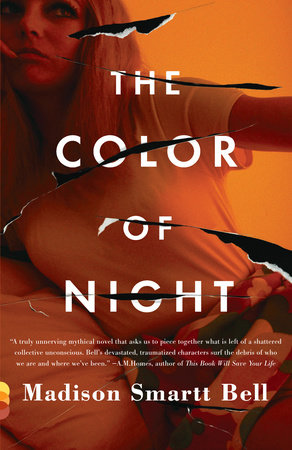
A Q&A with Madison Smartt Bell, author of The Color of Night
Q: Where did you find the inspiration for this book?
A: I started hearing the voices out of the ether while I was working my novel about Bedford Forrest, Devil’s Dream. And I jotted the first bits down in one of my shirt pocket notebooks — some structural ideas and a few actual sentences … and it went on from there.
I do take the word “inspiration” literally — that is, a spirit comes into you and instigates the writing — dictates it, even. Most of my books are written this way, but this one even more so….
Q: Mae’s story reflects some disturbing times in our nation’s history. How much is fact and how much fiction here?
A: As for the events of the 1960s, there’s a group that’s reminiscent of the Manson Family. That is, I’m writing about a Dionsysian cult that produces frenzies among its women, who in fact are maenads. I happen to think that the Manson Family did fit that paradigm, but that’s just my theory, for whatever it’s worth. For me the important thing for the book was to coax the elements of classical tragedy and the old mystery cults out of the situation.
These are fictional characters, especially Laurel and Mae. I wouldn’t have had enough freedom with them otherwise. The exact details of the Manson story are found in Vince Bugliosi’s Helter–Skelter — a very good book and a very scary one, even now.
The 9/11 coverage in the book is pretty general by comparison…. The specific effects on Laurel and Mae are all made up of course, and the rest is the kind of thing everyone knows.
Q: You tell Mae’s story clearly and powerfully. While she has a violent past, she can also be a sensitive narrator. What was it like writing in the voice of a woman? And getting so up close to evil?
A: Writing her voice was bewilderingly easy, though in earlier work I’d found it very hard to write from a woman’s point of view convincingly. (Since finishing this book it has seemed easier; I hope that’s not a delusion). It just fell out of me from somewhere onto the page. The whole thing was written quickly, composed directly on the keyboard for the most part, and with very little revision either. I felt like I was channeling the character, or possessed by her, which seemed to fit this particular story spookily well.
I’m inclined to think of Mae as “beyond good and evil,” to cop a headline from Nietzsche. Her own view that she’s immortal and in that way distinguished from and superior to most other people on the planet goes along with that. I once said she had the beauty of a snake and my agent said it was like watching a cat kill mice; that is, you don’t blame the cat for acting on its nature. Mae expresses her essence, dreadful as it is, in a very pure way, and there’s something attractive about that. Or at least compelling.
Q: What is the role of sexuality in the book? Of violence? Fear?
A: Funny you should ask. I just filed a review of a novel by Rikki Ducornet that does the eros/thanatos equation very powerfully, though not at all the way I’ve done it here (although her book is every bit as scary, in its own way). Violence and fear, in judicious doses, can whet sexual appetite to a very keen edge. Of course Laurel and Mae go for injudicious doses. If the French call orgasm la petite mort, well, these two are actually killing people in the course of the act sometimes, but then in Mae’s view of the world she and Laurel are immortal beings, while the people they kill are “disposable.” In spite of all that, I want to say that this book is a love story, though a very twisted one … that the love between Laural and Mae is quite real and the main motor of the whole thing.
Q: Mae has a violent past — as a victim of violence and perpetrator. Do you think she seeks redemption? What is her motivation throughout the book? Is she a reliable narrator of events?
A: A conventional explanation of Mae would be that she is a victim/perpetrator in a cycle of abuse, and this option is available to the reader, but she doesn’t see herself that way, and I don’t either. In fact her refusal to think of herself as a victim has its admirable side.
I think Mae’s reliable for facts, by and large, trustworthy for the what and how of things. Her interpretations of events tend be extreme…. Undoubtedly, and from the very beginning, some readers will recoil from them.
Q: The Nevada desert plays a strong part in the book, with Mae often headed there to shoot. Is there symbolism in that?
A: I don’t think in terms of symbolism, really — too rigid for my taste (and for our times, in my opinion). Imagery strikes me as more organic and can be more flexibly put to one’s purposes. There were more desert scenes at one point (these will appear in the French edition) and then I thought of writing some more that never were written. I just saw her doing that, I don’t know — in the sense that all I really did was watch it, in the theater of my mind, and then describe it.
I have had a couple of tastes of that desert landscape, and saw it as a perfectly unwelcoming place for lonely gods to wander.
Q: You are known for your work on Haiti — how was this a departure for that subject material?
A: In almost every imaginable way. Size for a start. I didn’t want to do anything on the scale of the Haiti series any time soon. And I’d always admired a novel by Joan Didion called Play It As It Lays. I wanted to write a book that looked like that, where most chapters are no more than a double-page spread and every page can cut you.
My Haiti novels are intentionally epic and full of an unstoppable tropical overgrowth in every compartment. The Color of Night is the opposite, a book mostly made of white space.
Q: You are also a professor in the Creative Writing Program at Goucher College. How does teaching influence your writing?
A: I write at a very unconscious level, so teaching has made me better able to troubleshoot my own work, if there is trouble. To take a step back from it an analyze, when necessary — If it’s not necessary it can be harmful (and I try not to overdo it with my students’ work either). I spend more time than typical for such programs in one-on-one tutorials with students preparing their work for possible publication, and in the course of that I’ve picked up editorial skills that can be used on my own stuff too, as needed.
Q: What is your writing regimen like?
A: Every morning I go out on the street and wait for the Number of the Beast to appear on the license plate of a passing car. (It can take weeks! — frustrating esp. if there is a deadline). Then, I enter my cabinet, dust the skulls and light the candles, then begin to compose using sticks of charcoal on one hundred percent rag sketch paper, while sipping warmed beef blood from a demi-tasse cup — no wait! It was Graham Greene did all that. Or some of it.
If I’m working on historical fiction I will often read some of the pertinent material the night before (even if I have already read it many times). I figure (yeah, this part’s serious) my unconscious mind will work on it during sleep. In the period between sleep and waking — twilight sleep — I’ll picture elements of the first scene to be written. That part’s a little like what’s called lucid dreaming. Then try to get to my desk with the minimum distraction possible and if that works I can usually go pretty quickly for two or three hours, around five pages, before quality begins to slip — and I quit before that point.
When I was younger I could go longer, five or six hours say, without a decline. Occasionally, I’d write a whole story overnight. But now I’m good for a shorter period, five mornings a week if I can protect that many. With experience I trust more that the thing won’t evaporate if I save some of it for a later session. Hemingway’s idea that you should quit before you write down the last sentence you have in your mind is still a good one for me. I usually start at my desk with a quick pencil polish of yesterday’s pages, also an adaptation of one of Hemingway’s ideas for putting yourself back where you were when you quit.
Q: What do you hope readers take from your story?
A: A good work of art has a mirror function, so what you get is a function of what’s there and what you bring.




 QUICK VIEW