Random House: Bringing You the Best in Fiction, Nonfiction, and Children's Books
Follow Us On TwitterFan Us On Facebook
Authors
Books
Features
Newletters and Alerts

Buy now from Random House

  • The Discovery of Jeanne Baret
  • Written by Glynis Ridley
  • Format: Trade Paperback | ISBN: 9780307463531
  • Our Price: $15.00
  • Quantity:
See more online stores - The Discovery of Jeanne Baret

Buy now from Random House

  • The Discovery of Jeanne Baret
  • Written by Glynis Ridley
  • Format: Hardcover | ISBN: 9780307463524
  • Our Price: $25.00
  • Quantity:
See more online stores - The Discovery of Jeanne Baret

Buy now from Random House

  • The Discovery of Jeanne Baret
  • Written by Glynis Ridley
  • Format: eBook | ISBN: 9780307463548
  • Our Price: $11.99
  • Quantity:
See more online stores - The Discovery of Jeanne Baret

The Discovery of Jeanne Baret

    Select a Format:
  • Book
  • eBook

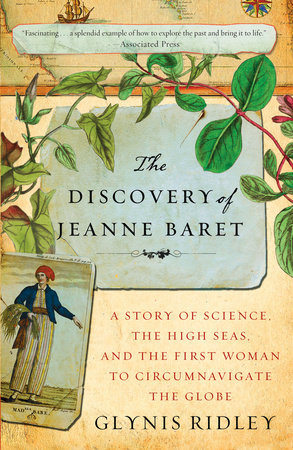
A Story of Science, the High Seas, and the First Woman to Circumnavigate the Globe

Written by Glynis RidleyAuthor Alerts:  Random House will alert you to new works by Glynis Ridley

eBook

List Price: $11.99

eBook

On Sale: December 28, 2010
Pages: 304 | ISBN: 978-0-307-46354-8
Published by : Broadway Crown Trade Group
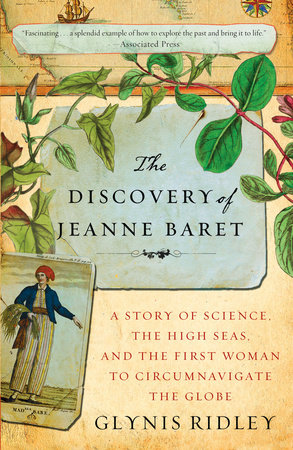
The Discovery of Jeanne Baret Cover

Bookmark,
Share & Shelve:

  • Add This - The Discovery of Jeanne Baret
  • Email this page - The Discovery of Jeanne Baret
  • Print this page - The Discovery of Jeanne Baret
ABOUT THE BOOK ABOUT THE BOOK
ABOUT THE AUTHOR ABOUT THE AUTHOR
PRAISE PRAISE
READER'S GUIDE READER'S GUIDE
Synopsis

Synopsis

The year was 1765. Eminent botanist Philibert Commerson had just been appointed to a grand new expedition: the first French circumnavigation of the world. As the ships’ official naturalist, Commerson would seek out resources—medicines, spices, timber, food—that could give the French an edge in the ever-accelerating race for empire.
 
Jeanne Baret, Commerson’s young mistress and collaborator, was desperate not to be left behind. She disguised herself as a teenage boy and signed on as his assistant. The journey made the twenty-six-year-old, known to her shipmates as “Jean” rather than “Jeanne,” the first woman to ever sail around the globe. Yet so little is known about this extraordinary woman, whose accomplishments were considered to be subversive, even impossible for someone of her sex and class.
           
When the ships made landfall and the secret lovers disembarked to explore, Baret carried heavy wooden field presses and bulky optical instruments over beaches and hills, impressing observers on the ships’ decks with her obvious strength and stamina. Less obvious were the strips of linen wound tight around her upper body and the months she had spent perfecting her masculine disguise in the streets and marketplaces of Paris.
           
Expedition commander Louis-Antoine de Bougainville recorded in his journal that curious Tahitian natives exposed Baret as a woman, eighteen months into the voyage. But the true story, it turns out, is more complicated.
 
In The Discovery of Jeanne Baret, Glynis Ridley unravels the conflicting accounts recorded by Baret’s crewmates to piece together the real story: how Baret’s identity was in fact widely suspected within just a couple of weeks of embarking, and the painful consequences of those suspicions; the newly discovered notebook, written in Baret’s own hand, that proves her scientific acumen; and the thousands of specimens she collected, most famously the showy vine bougainvillea.
 
Ridley also richly explores Baret’s awkward, sometimes dangerous interactions with the men on the ship, including Baret’s lover, the obsessive and sometimes prickly naturalist; a fashion-plate prince who, with his elaborate wigs and velvet garments, was often mistaken for a woman himself; the sour ship’s surgeon, who despised Baret and Commerson; even a Tahitian islander who joined the expedition and asked Baret to show him how to behave like a Frenchman.
 
But the central character of this true story is Jeanne Baret herself, a working-class woman whose scientific contributions were quietly dismissed and written out of history—until now. Anchored in impeccable original research and bursting with unforgettable characters and exotic settings, The Discovery of Jeanne Baret offers this forgotten heroine a chance to bloom at long last.


From the Hardcover edition.
Glynis Ridley

About Glynis Ridley

Glynis Ridley - The Discovery of Jeanne Baret

Photo © John Greene

GLYNIS RIDLEY is the author of Clara’s Grand Tour: Travels with a Rhinoceros in Eighteenth-Century Europe, which won the Institute of Historical Research (University of London) Prize. A British citizen, she is now a professor of English at the University of Louisville.


From the Hardcover edition.
Praise

Praise

“Thrilling and incensing…Woven throughout this gripping story are Ridley’s piquant insights into eighteenth-century exploration, botany, taxonomy, biopiracy, and sexism. Baret could not have asked for a more exacting and expressive champion. Ridley is incandescent in her passion for the truth.” Booklist (starred review)
 
“A mesmerizing read…The Discovery of Jeanne Baret, woven from impeccable research and keen detective work, introduces readers to a memorable eighteenth-century female scientist who deserves to be remembered for her contributions to botany, and for her extraordinary courage and perseverance. Readers will be pulling for Jeanne Baret as she circumnavigates the world, her pistol ever ready by her side. The world of eighteenth-century seafaring expeditions comes alive in this fine book.” —Robert Whitaker, author of The Mapmaker’s Wife
 
“Ridley quickly crushes modern romantic ideas of the golden age of exploration…Captures both the optimism that inspired Baret’s groundbreaking and courageous trip and the sordid reality she encountered.” Publishers Weekly
 
“A powerful story of a brave and intelligent woman who battled against the odds to live the life she wanted. Finally, Jeanne Baret’s contributions to botany and world exploration have been brought to light in this wonderful book.” —Amanda Foreman, author of Georgiana, Duchess of Devonshire
 
“Inquisitive biography of the first woman to circle the globe by sea…Ridley has definitely done her homework in recognizing Baret as an overlooked but important historical figure.” Kirkus Reviews
 
“Through skillful sleuthing and impressive research into the life of her eighteenth-century heroine, the courageous Jeanne Baret, Glynis Ridley has produced a gripping tale of romance, male prejudice, exploration, and scientific discovery. A great read—and all the better that it’s true!” Julia Fox, author of Jane Boleyn


From the Hardcover edition.
Reader's Guide|Discussion Questions|Teachers Guide

About the Book

The Discovery of Jeanne Baret tells the remarkable story of the first woman to circumnavigate the globe—who did so disguised as a man. In 1766, a French peasant named Jeanne Baret disguised herself as a teenage boy in order to work as principal assistant to the naturalist Philibert Commerson, royal appointee to the first French circumnavigation. The expedition commander, Louis-Antoine de Bougainville, had no idea that the two shared more than simply a passion for botany—they were in fact lovers. In his memoirs, Bougainville reported that Baret was finally exposed by the natives of Tahiti, who recognized a woman where her countrymen had not: a version of events that went largely unchallenged for more than two hundred years. But three members of Bougainville’s crew provide a very different version of Baret’s exposure. Their unpublished accounts suggest that the truth of what happened to her is more brutal than official chroniclers cared to admit.


This guide is intended as a starting point for your conversation about The Discovery of Jeanne Baret. You can join the discussion online at www.facebook.com/authorglynisridley.

Discussion Guides

1. Baret’s family, typical of eighteenth-century peasants, did not expect to travel further in their lifetimes than their nearest market town. Imagine that this was your experience. How would you feel about traveling in your own country? How would you feel about traveling overseas? What would ‘overseas’ mean to you? Without access to newspapers, books, or television, where would you get your ideas from?

2. How many herbs, or plants of any kind, can you identify in their natural, growing state? Would you trust your ability to recognize different medicinal plant species if your life depended on it?

3. One of the epigraphs to the book is an excerpt from a poem by Susan Donnelly that reimagines the Biblical account of the naming of creation from Eve’s perspective. Why do you think Ridley chose to begin her book with this quotation?

4. If you were an eighteenth-century middle- or upper-class woman, what obstacles would hinder your pursuit of an interest in science? Why might you try to overcome those obstacles? Do you find it surprising that the first woman to complete a journey around the world was not wealthy, but rather was a peasant of limited means? Why or why not?

5. Do you find it hard to understand why Baret gave her son to the Paris Foundling Hospital? How did you feel about her choice at this point in the book? Do you think this experience affected her later choices, and if so, how?

6. If La Giraudais, captain of the Étoile, had not offered Commerson and Baret his cabin, do you think that Baret would have jumped ship at Aix? Why or why not?

7. Measure out the size of the Étoile – approximately 100 feet by 30 feet – and compare it to the size of your reading group’s regular meeting place. If you were one of 116 men living in that space, how quickly do you think you would recognize something different about Baret?

8. Vivès was first sent to sea when he was 7 and apprenticed a ship’s surgeon at age 12. How do you think this helped shape his character, social skills, and particularly his relationship with Commerson?

9. The brutal ceremonies surrounding Crossing the Line seem to have an equivalent in modern hazing practices practiced everywhere from fraternities to the military. Why do these practices continue, and are they impossible to eradicate? Do your answers help you to understand what went on when the Étoile crossed the equator? How so?

10. Supporting characters in the book include Aotourou, Bougainville, Nassau-Siegen, Véron, and Vivès. Which one of these men interests you most and why?

11. Sailing the Pacific, expedition members frequently went weeks without sight of land. The ships were therefore self-contained floating worlds. Modern research has shown that men press ganged (that is, tricked or forced) into naval service were in the minority. The majority of the ‘ratings’ (or ordinary seamen) were volunteers.

 What factors do you think motivated most of the crew to sign on for a circumnavigation of the globe, entailing at least three years away from home? How much do you think Baret’s motivations resembled or differed from the men’s motivations? In your view, do any jobs exist today to fulfill the needs of people in similar situations, with similar motivations? If so, what are they?

12. Were you surprised that a group of men finally raped Baret on New Ireland or did you have a horrible feeling that this was likely? What influenced your expectations of how her life on board ship might conclude? Do you think that this possibility entered the minds of Commerson and Bougainville, and if so, should they have done more to discourage her from participating in the expedition?

13. Are there any reasons to believe that Baret’s marriage to Dubernat was anything other than a marriage of convenience? What might he have offered her that would be appealing after her experiences and past relationship?

14. When she returned to France in 1775, Baret had been away for nearly a decade. What do you imagine were the biggest readjustments Baret had to make to life back in her native country?

15. Out of all the places that Baret went ashore and visited happily (Rio de Janeiro, the shores of the Strait of Magellan, Tahiti, Mauritius, Madagascar) which one would you most like to go to and why?

Teacher's Guide


NOTE TO TEACHERS

Academic reading guide for The Discovery of Jeanne Baret by Glynis Ridley
 
About the book:
The Discovery of Jeanne Baret tells the remarkable story of the first woman to circumnavigate the globe—who did so disguised as a man. In 1766, a French peasant named Jeanne Baret disguised herself as a teenage boy in order to work as principal assistant to the naturalist Philibert Commerson, royal appointee to the first French circumnavigation. The expedition commander, Louis-Antoine de Bougainville, had no idea that the two shared more than simply a passion for botany—they were in fact lovers. In his memoirs, Bougainville reported that Baret was finally exposed by the natives of Tahiti, who recognized a woman where her countrymen had not: a version of events that went largely unchallenged for more than two hundred years. But three members of Bougainville’s crew provide a very different version of Baret’s exposure. Their unpublished accounts suggest that the truth of what happened to her is more brutal than official chroniclers cared to admit.
 
About the author:
Glynis Ridley is a professor of English at the University of Louisville. A British citizen, she holds degrees from the universities of Edinburgh and Oxford, where she specialized in eighteenth-century studies. Her last book, Clara’s Grand Tour. Travels with a Rhinoceros in Eighteenth-Century Europe won the Institute of Historical Research (University of London) Prize.
 
 
Instructor guide: The questions in this guide address issues in cultural studies, eighteenth-century history, gender studies, and post-colonial studies. Some questions can be answered with reference to a section of the book, while others require students to have read the whole in order to make comparisons between various episodes. Questions 9,10, 12, 13 and 14 are perhaps best undertaken online as small group projects in advance of class.
 
History and Cultural Studies
 
1. How often, and in what ways, did eighteenth-century perceptions of gender and class constrain people in Baret’s world?
 
2. Measure out the size of the Étoile – approximately 100 feet by 30 feet – and compare it to the size of your seminar room or lecture theater. If you were one of 116 men living in that space, how quickly do you think you would recognize something different about Baret?
 
3. In one of the epigraphs to the book, the poet Susan Donnelly has staged what may be referred to as a narrative intervention – a reimagining of a story from an alternative point of view. Donnelly invites us to see the Biblical account of Adam’s naming of creation from Eve’s perspective. Narrative intervention has many uses. For example, healthcare and counseling professionals may use it to explore the limits of an individual’s ability to empathize with alternative points of view. As a pedagogical tool, it allows readers to see what might be gained and what might be lost in a text by changing its narrator.
 
With reference to a single episode in the book (for example, the ceremony of Crossing the Line or the ships’ arrival at Tahiti) imagine events from the perspective of someone other than Baret or Commerson. Whose point of view interests you most and why? What do historians gain from trying to imagine how things might have appeared to someone other than one of the main protagonists?
 
4. Baret and Commerson believed in the efficacy of her bougainvillea poultice for curing Commerson’s leg ulcers. If you go to youtube.com/watch?v=fFyEfXHCZgc you will find a seven-minute video about Henry VIII’s medical complaints. Just over 6 minutes into the clip, medical historian Steve Bacon recreates Henry’s recipe for “The King’s Majesty’s Own Plaster”: a red-colored paste Henry concocted for treating his varicose ulcers. Though Henry’s recipe derives its color from a chemical compound popularly known in Tudor times as ‘dragon’s blood’, the same color could be derived from bougainvillea bracts. Using this clip as your starting point, consider the usefulness of this cultural studies approach to the study of history. In what ways might this book be seen as illustrating a cultural studies approach?
 
5. Mikhail Bakhtin’s theory of the carnivalesque impulse might be examined in relation to events around Crossing the Line, and the ships’ landfall on Tahiti. But in an essay entitled “Between Stalin and Dionysus” (1989), critic Boris Groys says of Bakhtin’s conception of carnival that  “one should not speak of democracy here: no one is given the democratic right to shirk carnival”. Groys ultimately characterizes the spirit of carnival as a “totalitarian” one, precisely because those who try to resist or who stand outside the group are victimized. How can Baret’s experience be described in relation to the viewpoints of Bakhtin and Groys?
 
 
Gender Studies
 
6. According to John Berger “Men look at women. Women watch themselves being looked at. This determines not only most relations between men and women but also the relation of women to themselves” (Ways of Seeing, 1972). This phenomenon has been termed “the male gaze” and its effect has been studied by researchers in a variety of disciplines, from art history to film studies. How many times, and in what ways, are women subject to “the male gaze” in the book?
 
7. What do you think it would do to Baret’s state of mind to perform a male part every day? (You might want to find out what happened to journalist Norah Vincent after her Self-Made Man project ended.) To what extent do we all perform gender every day?
 
8. On Tahiti, women of all ages offered themselves to Bougainville’s crew. Feminist scholars might claim that the women were coerced into this – or expected to do this – by the men in their community. How many instances of real – and potential – patriarchal dominance are there in the book?
 
 
9. In advance of class, see how much information you can find on female botanical illustrators such as Maria Sibylla Merian, Mary Delany,  Marianne North, or pre-twentieth century women travellers, such as Lady Mary Wortley Montagu or Lady Hester Stanhope. How much information is available about these women? Why do you think these women are not better known?
 
10. Baret’s female scientific contemporaries in France and Britain included Emilie du Châtelet, who translated Newton’s Principia Mathematica into French, and Caroline Herschel, who spent her life assisting her brother, William, the discoverer of Uranus. Emilie du Châtelet died from complications arising from the birth of a daughter; Caroline Herschel never married. Research these women’s lives. What difficulties did they face in pursuing their passionate interest in mathematics and science? In what ways has the position of women in science changed or improved today?
 
Post-Colonial Studies
 
11. From Patagonia to Tahiti, the expedition encountered a range of native peoples. How many Others are encountered in the book and how could these encounters be viewed in terms of post-colonial theory?
 
12. What was the extent of the French and British global empires in the eighteenth century? Approximately how many people came under the rule of each? How many of those people were colonizers and how many were colonized? What goods, luxury and otherwise, flowed from the periphery of empire to its centers? If you were in the government of either France or Britain at the time, what would be your major concerns about your country’s empire and how would you seek to address them?
 
13. Shortly after Aotourou returned with Bougainville to Paris, his fellow Tahitian Omai agreed to journey to London as part of Captain James Cook’s second Pacific expedition. Though no portraits of Aotourou are known, Omai sat for one of the most famous painters in Europe: Sir Joshua Reynolds. Find a copy of Reynolds’s portrait of Omai from 1776. (There are many available online.) What do you notice about the painting? What does it suggest about the way that Europeans viewed non-European peoples at the time? And why do you think that no similar portraits of Aotourou exist?
 
14. In 1766 when the expedition set sail, Australia did not appear as a separate continent on any map. It was not until Flinders circumnavigated the continent from 1801-03 that its size and position were finally demonstrated. In advance of class, research what the eighteenth-century world looked like when Bougainville’s expedition set out in 1766. How much – or how little – was known about the interiors of Africa and North America? When did the Arctic and Antarctica first appear on maps in something resembling their modern form? Do you think it is possible to separate exploration from colonization?

TEACHERS: for solution guide contact rhacademic@randomhouse.com


Your E-Mail Address
send me a copy

Recipient's E-Mail Address
(multiple addresses may be separated by commas)

A personal message: