



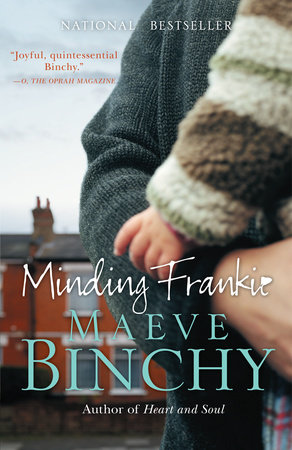

Minding Frankie
By Maeve Binchy
By Maeve Binchy
By Maeve Binchy
By Maeve Binchy
By Maeve Binchy
Read by Sile Bermingham
By Maeve Binchy
Read by Sile Bermingham
By Maeve Binchy
Read by Sile Bermingham
By Maeve Binchy
Read by Sile Bermingham
Category: Women's Fiction
Category: Women's Fiction
Category: Women's Fiction | Audiobooks
Category: Women's Fiction | Audiobooks
-
$17.00
May 01, 2012 | ISBN 9780307475480
-
Mar 01, 2011 | ISBN 9780307595164
-
Mar 01, 2011 | ISBN 9780307713681
800 Minutes
-
Mar 01, 2011 | ISBN 9780307713612
365 Minutes
Buy the Audiobook Download:


YOU MAY ALSO LIKE
 QUICK VIEW
The Real Liddy James
QUICK VIEW
South of Broad
QUICK VIEW
Looking for Me
QUICK VIEW
Light a Penny Candle
QUICK VIEW

The Return Journey
QUICK VIEW
The Copper Beech
QUICK VIEW
Evening Class
QUICK VIEW
The Sound of Glass
QUICK VIEW
Maeve’s Times
QUICK VIEW
Untethered
Praise
“Joyful, quintessential Binchy.” —O, The Oprah Magazine
“All across America, Maeve Binchy fans will be kicking off their shoes, making a nice cup of tea, and curling up on the couch as they re-enter Binchy’s cozy world.” —The Seattle Times
“Binchy’s worldview is a large, benevolent one, and the reader is happier for it. . . . Bless her big Irish heart.” —Minneapolis Star Tribune
“One of Binchy’s best works. She harmoniously handles a diverse group of characters, the good deeds that characterize life in Ireland are believable, and the ending is sweet.” —Newark Star-Ledger
“A comforting experience. . . . Warmhearted.” —The Denver Post
“In Minding Frankie Binchy proves again why she’s the master of the intelligent comfort novel.” —The Plain Dealer
“Maeve Binchy has done it again [with] yet another warm tale of individual growth and human community, [in which] she assembles a large cast of characters and deploys them with her characteristic playfulness . . . Binchy specializes in exploring human foibles without spelling them out in tiresome detail . . . There’s a good chance that many readers, like this one, will consider Minding Frankie one of Binchy’s best novels yet.” —BookPage
“Solid, reliable, and comforting in its familiarity, delivering to Binchy fans what they have come to expect from her novels. . . . A reminder of the author’s savvy ability to deliver what her loyal following has come to expect.” —The Irish Times
“Absorbing. . . . Teems with colorful characters whose concerns and connections are depicted with heart and humor. . . . New readers of Binchy will succumb to the appeal of the heartwarming tradition longtime fans love to love.” —The Free-Lance Star (Fredericksburg, VA)
“All across America, Maeve Binchy fans will be kicking off their shoes, making a nice cup of tea, and curling up on the couch as they re-enter Binchy’s cozy world. The Irish author returns here to a charming Dublin milieu of favorite characters from past novels, with some important new ones.” —The Seattle Times
Acclaim for Maeve Binchy:
“A remarkably gifted writer and a wonderful student of human nature.” —The New York Times Book Review
“A modern-day women’s writer in the Jane Austen sense.” —Standard-Times (New Bedford, MA)
“Binchy makes you laugh, cry, and care. Her warmth and sympathy render the daily struggles of ordinary people heroic and turn storytelling into art.” —The San Francisco Chronicle
“An author of exceptional grace [with] a wickedly subtle sense of humor and a great deal of kindness.” —The Boston Globe
“Maeve Binchy is a benevolent god of a novelist. . . . She can channel Irish voices with the best of them, and each of these voices has its own twisting story to tell. . . . often with verve and humor.” —The Columbus Dispatch
“Binchy is a grand storyteller in the finest Irish tradition. [She] has a true gift of creating characters we either know or wish we knew. . . . A perfect escape.” —Cleveland Plain Dealer
“Only a curmudgeon could resist this master of cheerful, read-by-fire comfort.” —Kirkus Reviews
“Reading one of Maeve Binchy’s novels is like coming home.” —The Washington Post
21 Books You’ve Been Meaning to Read
Buy Now


Just for joining you’ll get personalized recommendations on your dashboard daily and features only for members.
Find Out More Join Now Sign In