Random House: Bringing You the Best in Fiction, Nonfiction, and Children's Books
Authors
Books
Features
Newletters and Alerts

Buy now from Random House

  • The Night Counter
  • Written by Alia Yunis
  • Format: Trade Paperback | ISBN: 9780307453631
  • Our Price: $14.00
  • Quantity:
See more online stores - The Night Counter

Buy now from Random House

  • The Night Counter
  • Written by Alia Yunis
  • Format: Hardcover | ISBN: 9780307453624
  • Our Price: $24.00
  • Quantity:
See more online stores - The Night Counter

Buy now from Random House

  • The Night Counter
  • Written by Alia Yunis
  • Format: eBook | ISBN: 9780307453648
  • Our Price: $9.99
  • Quantity:
See more online stores - The Night Counter

The Night Counter

    Select a Format:
  • Book
  • eBook

A Novel

Written by Alia YunisAuthor Alerts:  Random House will alert you to new works by Alia Yunis

eBook

List Price: $9.99

eBook

On Sale: July 14, 2009
Pages: | ISBN: 978-0-307-45364-8
Published by : Broadway Books Crown Trade Group
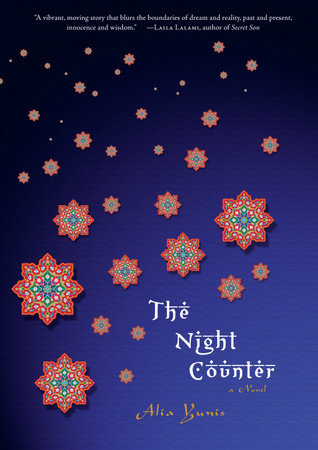
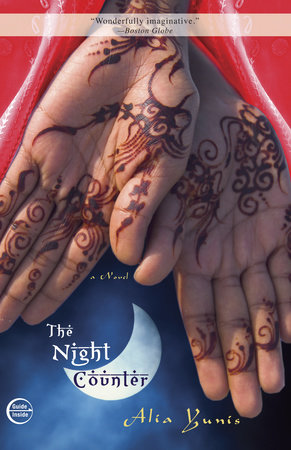
The Night Counter Cover

Bookmark,
Share & Shelve:

  • Add This - The Night Counter
  • Email this page - The Night Counter
  • Print this page - The Night Counter
ABOUT THE BOOK ABOUT THE BOOK
ABOUT THE AUTHOR ABOUT THE AUTHOR
PRAISE PRAISE
READER'S GUIDE READER'S GUIDE
This book has no tags.
You can add some at Library Thing.
Synopsis

Synopsis

After 85 long years, Fatimah Abdullah is dying, and she knows when her time will come. In fact, it should come just nine days from tonight, the 992nd nightly visit of Scheherazade, the beautiful and immortal storyteller from the epic The Arabian Nights.

Just as Scheherazade spun magical stories for 1,001 nights to save her own life, Fatima has spent each night telling Scheherazade her life stories, all the while knowing that on the 1,001st night, her storytelling will end forever. But between tonight and night 1,001, Fatima has a few loose ends to tie up. She must find a wife for her openly gay grandson, teach Arabic (and birth control) to her 17-year-old great-granddaughter, make amends with her estranged husband, and decide which of her troublesome children should inherit her family's home in Lebanon--a house she herself has not seen in nearly 70 years. All this while under the surveillance of two bumbling FBI agents eager to uncover Al Qaeda in Los Angeles.

But Fatima’s children are wrapped up in their own chaotic lives and disinterested in their mother or their inheritances. As Fatima weaves the stories of her husband, children, and grandchildren, we meet a visionless psychic, a conflicted U.S. soldier, a gynecologist who has a daughter with a love of shoplifting and a tendency to get unexpectedly pregnant, a Harvard-educated alcoholic cab driver edging towards his fifth marriage, a lovelorn matchmaker, and a Texas homecoming queen. Taken in parts, Fatima’s relations are capricious and steadfast, affectionate and smothering, connected yet terribly alone. Taken all together, they present a striking and surprising tapestry of modern Arab American life.

Shifting between the U.S. and Lebanon over the last hundred years, Alia Yunis crafts a bewitching novel imbued with great humanity, imagination, and a touch of magic realism. Be prepared to be utterly charmed.


From the Hardcover edition.
Alia Yunis|Author Q&A

About Alia Yunis

Alia Yunis - The Night Counter

Photo © Gabe Medway

Raised in Chicago, ALIA YUNIS has worked as a journalist and filmmaker in Los Angeles and the Middle East. Currently a professor of communications at Zayed University in Abu Dhabi, Yunis is a PEN Emerging Voices fellow. This is her first novel.

Author Q&A

1. In The Night Counter, the description of the sights and smells of Lebanon are so evocative, the reader feels transported to the Middle East. What sounds, tastes, smells, etc. make you feel transported to that region?
For every season of the year and for every season of my life, thereare smells and sounds and pictures I associate with the Middle East. But there is always the smell of jasmine, the calming, time-settingsound of the call to prayer, and the sad sight of overflowing garbage bins. Within the region, your senses let you know that now you’re in Jordan, now you’re in Egypt, now you’re in the Persian Gulf. Lebanon, whose beauty is literally Biblical, is blessed with spectacular mountains and seascapes, like a petite, delicate, somewhat fragile California. It is where I fell in love with the sea, and ever since, I have not been comfortable living far from the sound of waves.

2. At heart, this is a novel about the meaning of family. How did your family shape the story and the writing process? How do they feel about the book?
As a result of the “troubles” in Lebanon and Palestine, my extended family lives around the world, and I have first cousins I have never even met. So in many cases our commonality is limited aside from a shared love and passion for those places. Some are more liberal than me, others more conservative, depending on the topic being discussed. I think some of them will find certain things in the book offensive or not tasteful, while others will relate to those very things. In fact, I imagine most would have both reactions, depending on what part of the book I was referring to. For example, Amir’s homosexuality would make some of my relatives cringe, or in some cases even stop reading, whereas my parents would just shrug and say, “Oh, yet another gay man in her life.” On the other hand, my parents would be so offended by the “foul language” Bassam uses and probably wouldn’t read that part.

3. How much of the novel is based on personal experience?
I don’t think anything we write, no matter how researched and factbased, whether fiction or nonfiction, takes its shape without going through the prism of our personal experiences. This is a work of fiction, and I can’t honestly point to any character and say “that’s my best friend” or “that’s my grandmother.” But I know the people in my book very well just the way they came out of my head, and they wouldn’t come out my head if they weren’t a conglomeration (subconscious and/or conscious) of my reality.

4. The oral storytelling tradition is strong in Lebanon, and the power of myth, fable, and story are evident in the shape of the novel. Did you think about these cultural touchstones as you were writing? If so, which ones?
My mother is a voracious reader—self-help, religion, politics—but she considers reading fiction a waste of time and takes no joy in the unraveling and revelation of characters and their worlds, which makes fiction so great to me. This is highly ironic as I recently realized after meeting a distant cousin for the first time that my mother is the biggest storyteller in my life. That cousin knew almost nothing about me. However, I knew so many stories about him. When my mother came to the United States in her twenties, she had no relatives in North America, and like Fatima, she longed for them. And I think to make up for that longing, she would tell me stories about them, long stories that went off in scores of tangents and involved people who over the years I came to know quite well although I hadn’t yet met them. Often the stories were stories her mother had told her about her parents. She was my first Scheherazade, but I have known many in the Middle East, as there has been so much loss and change there in recent generations, and with little recorded history, oral stories are what sustain the memories.

5. What aspect/character/moment in your book do you think book groups and other readers will talk about the most?
This is hard for me to say. At this point, I’m too close to everyone in the book to pick a favorite character or event. I’d be more curious in people telling me what aspects and moments they found interesting.


From the Hardcover edition.

Praise

Praise

"Wonderfully imaginative…poignant, hilarious…The branches of this family tree support four generations of achievement, assimilation, disappointment, and dysfunction…Their stories form an affectionate, amusing, intensely human portrait of one family."
Boston Globe

"The Abdullahs are anything but a Norman Rockwell painting, but in their own way, they are a very typical American family. They may have their differences but they also have their stories. And, as Scheherazade points out, in the end, that's what holds a family (much like a nation) together."
Christian Science Monitor

"THE NIGHT COUNTER, Alia Yunis' first novel, mixes equal parts of magical realism, social commentary, family drama and lighthearted humor to create a delicious and intriguing indulgence worth savoring."
Minneapolis Star Tribune

"Yunis, a Chicago-born professor living in Abu Dhabi, weaves a colorful tapestry…rich in character and spirit."
Entertainment Weekly

"Little pigs and lost siblings make for decent bedtime story fodder. But the life and times of Fatima Abdullah, the madcap matriarch of Alia Yunis's charming debut, THE NIGHT COUNTER, is even better."
–Daily Candy

"In this captivating debut, Yunis takes readers on a magic carpet ride….[A] sometimes serious, sometimes funny, but always touching tale of a Middle Eastern family putting down deep roots on U.S. soil."
Publishers Weekly

"Yunis' book club-ready debut uses The Arabian Nights as a departure point for an immigrant-assimilation story....Emotionally rewarding reading that builds to a poignant and thoroughly satisfying climax."
Kirkus Reviews, starred review

"Yunis' debut is a magical, whimsical read with plenty of humor and heart."
Booklist

"A vibrant, moving story that blurs the boundaries of dream and reality, past and present, innocence and wisdom."
–Laila Lalami, author of Secret Son

"An enchanting debut that winks and glitters like the bangles that line Scheherazade's arms. THE NIGHT COUNTER is funny, sly, charming, delicious, madcap -- and a gorgeous celebration of the way stories weave and shape our lives."
–Carolyn Turgeon, author of Godmother

"A gracefully-written multi-generational tale--warm, wise, and often funny--that reveals the inevitable illusions that push families apart, and hold them together."
–Will North, author of Water, Stone, Heart and The Long Walk Home


From the Hardcover edition.
Reader's Guide|Discussion Questions

About the Book

Fatima Abdullah has exactly nine days left to live. For 992 nights, the eighty-five-year-old matriarch of a sprawling Arab American family has received nightly visits from the immortal Scheherazade, the bold and beautiful Persian queen who saved her own life with the spellbinding tales known as The Arabian Nights. Scheherazade has asked Fatima to share one story from her past on each visit. But on the 1,001st night, Fatima knows her storytelling—and her life—will come to an end. With time running out, Fatima still has many accounts to settle. She must find a wife for her openly gay grandson, teach Arabic to her wayward teenage great-granddaughter, make amends with her estranged husband, and most importantly, decide which imperfect family member deserves her ancestral home in Lebanon—a house she has not laid eyes on in seventy years. As Fatima deliberates about all of her children, two bumbling FBI agents spying on the Abdullah household in Los Angeles believe they’ve uncovered an Al Qaeda plot and may thwart Fatima’s dying wishes. Shifting between the U.S. and the Middle East, first-time novelist Alia Yunis pieces together four generations of family secrets in this hilarious, heartwarming debut that creates a vibrant mosaic of modern Arab American life.

Discussion Guides

1. The granddaughter of one of Lebanon’s greatest matchmakers, Fatima tries her hand at traditional matchmaking with disastrous results. How do Fatima’s methods compare to those of her grandson Zade, who runs a professional matchmaking service for Arabs? Is modern matchmaking any more of a business transaction than traditional matchmaking? Why are so many of the family members unable to find a match? Why does it prove difficult to find or recognize love? Is Ibrahim correct when he says, “It takes confidence to love a woman,”and how does that apply to the issues of identity in this novel?

2. On the surface, Fatima’s stories about the house in Lebanon are a way of passing on her heritage to the next generation. Is that their only function? In what ways do Fatima’s memories of the house serve as a hiding place or a coping mechanism? Why does Scheherazade push Fatima to stop talking about the house and instead tell a passionate love story?

3. How do Fatima’s descendents navigate their identities as Arab Americans? What impact do the terrorist attacks of 9/11 have on the members of the Abdullah family? Which characters present themselves as either more traditionally American or more traditionally Arab, depending on who they are trying to impress? Which characters are the most honest about who they are? How do you feel about Randa, who goes to the greatest lengths to assimilate? Do you feel her efforts to erase her Arab identity are any better or worse than Amir’s efforts to exploit his Arab identity by playing to stereotypes? What does it mean to be a normal or typical American?

4. From Scheherazade’s impudent banter to a cheeky matchmaking questionnaire to inept FBI agents reaching outlandish conclusions, the novel is loaded with humor. Why do you think the author decided to take a comedic approach to a novel about the Arab American experience? Does the use of humor help to defuse the stereotypes associated with Arab Americans? The author also deals with weighty issues including love, identity, and loss. Do you find the comedic element adds to the poignancy of these themes? Would the novel have the same emotional impact if the writing had been more solemn?

5. Were you familiar with Scheherazade as the narrator of The Arabian Nights before you read this book? How would you describe Scheherazade? Did the depiction of Scheherazade and other female characters change your impression of Arab and Arab American women? If yes, how so?

6. Scheherazade flies all over the United States and to the Middle East on her magic carpet in order to observe the members of the Abdullah clan. Why did the author choose this narrative technique? Would the novel have been as effective if the story had been told entirely from Fatima’s point of view?

7. Discuss the use of inshallah or “God willing.” Do you agree with Ibrahim when he says, “No need to regret the past. He could not have changed it even before it started”? How much control do you think we have over our own destinies?

8. The traditional dish kibbe brings the characters together in surprising ways. Think back on the scenes that involve kibbe. What role does food and the making of food play?

9. Why does Laila serve pork to her husband and his friends as a “secret revenge?” What point is she making about religion, faith, and her disease?

10. Even though Amir sends out an e-mail telling Fatima’s children that she spends her time attending funerals and talking to herself, none of them are concerned enough to visit until she cuts off her trademark purple hair. Why is this cause for alarm? What does the cutting of her hair represent?

11. What does the fig tree symbolize? What conditions allow the fig tree to bloom? Why does Fatima want to call Ibrahim to share the news that the tree has fruited?

12. Fatima can’t read, but her math is “never wrong.” Many of her offspring also have an affinity for numbers. What do they find comforting about numbers and math problems? When Decimal calculates that her baby will be “three-eighths more Arab than me and just three-eighths less Arab than you,” why does Fatima say “it just didn’t make her happy what it equaled her family to be”? What do numbers fail to take into account?

13. Fatima says her children “do not often tell the truth about anything but the weather.” Why do they talk so much about the weather? How does your understanding of all of the siblings change once you learn about the twins’ deaths? What secrets are being kept and why? Why do the Abdullahs feel compelled to protect each other from the truth? Would their lives have been different if they had told the truth and how?

14. Fatima learns two family secrets through letters. Why is it significant that hidden truths are revealed in letters? How are the letters and the larger theme of storytelling connected? What is the purpose of memories, according to Scheherazade? What does she mean when she says, “To deal with one’s stories alone would be too much for any soul”?

15. Inheritances are a central preoccupation of this novel. What legacies, passed down from generation to generation, tie the Abdullah family together? Discuss the keepsakes that Fatima sets aside for her children and the meaning behind them. Why is Hala the only child who is not assigned a keepsake? Does Hala receive another kind of gift?


Your E-Mail Address
send me a copy

Recipient's E-Mail Address
(multiple addresses may be separated by commas)

A personal message: