Author Q&A
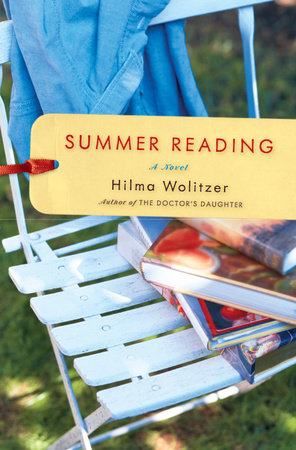
Interview with Hilma Wolitzer author of Summer Reading
Question:How did you come up with the list of books included in the summer book club, the Page Turners, that is at the heart of your new novel? Since so many of the plot elements of those books are paralleled or inverted or otherwise echoed in the events of Summer Reading, I wondered if you picked the books to suit the plot, or the plot to suit the books?
Hilma Wolitzer:I started re-reading several books I’d loved before I began writing Summer Reading, or even had any real notions about the plot, except that it would involve a book club. The characters had been gathering in my head, though, and when I imagined them reading the same books, given the circumstances of their various lives, their own stories evolved.
Q:With three main characters, and more strong secondary characters, Summer Reading features a large number of plot threads that weave in and out . . . yet never tangle. Did you plot everything out before sitting down to write, or did the novel’s plot take shape more organically, developing as you wrote?
HW:It seems sensible and less risky to plot out novels in advance, especially when they’re complex, but I’ve never done it, because I want to be surprised as I write, the way I am when I read.
Q:The novel made me think of that famous F. Scott Fitzgerald quote, “The rich are different from you and me.” It sometimes seems that the women in Summer Reading are not merely of different classes but almost of different species.
HW:I believe that all experience, from social class to education to family life, influences the person you become, but I also believe that everyone has an independent and complex interior life. That’s one of the reasons I write novels–to imagine being someone else.
Q:What do you think is behind the current popularity of reading groups, especially among women?
HW:People, especially women, have gathered together socially throughout history, for sewing bees and card games and potluck suppers. My friends and I have always discussed books we’ve enjoyed, urging them on one another, talking about the characters as if we know them; it’s one of the extended pleasures of reading. Book clubs are just a more organized, naturally evolving version of that pleasure.
Q:Tell us a little about the three main characters: Alyssa “Lissy” Snyder; Michelle Cutty; and Angela Graves–three very different women.
HW:I tend to be fond of and protective of my characters–I brought them into the world, in a way. But I have to resist that maternal impulse in order to fully reveal them, including the darker side of their personalities. Lissy sees the Page Turners as a way into East Hampton Society. Her longing for social status probably stems from her shaky status in her original family (absent father, rejecting mother), where everything begins. She’s pretty shallow, but also genuinely needy and not without deeper aspirations–she wants to be better. But her preoccupation with material wealth and her dyslexia impair her ability to get as much as the other women from the books she struggles to read. Michelle, who works as Lissy’s housecleaner, has the least economic advantages of the three protagonists, but the most self-confidence (or at least bravado), the strongest sense of humor, and the greatest propensity for change. Her relationship to her dogs rescues her from less satisfactory human dealings, and reading more directly affects her life than it does the members of the book group. Angela, the leader of the Page Turners, is the most isolated of the three women, the one who lives inside books as much as possible. Fictional heroines have as much presence for her as her neighbors. She thinks of herself as self-sufficient rather than lonely, but she, too, has yearnings and, of course, a personal history, one that she deeply regrets and wishes she could repair. The three women are very different from one another, and their lives might never have crossed without the existence of the book club.
Q:At one point, Angela tells her students that the reason to read literature is to learn how to live. Do you agree?
HW:Angela’s thoughts about literature reflect Henry James’s statement that “the purpose of fiction is to help the heart of man to know itself.” She also wonders at one point if life itself teaches you the same thing. I subscribe to both of these premises. Reading, that glimpse into someone else’s heart and head, definitely enhances our understanding of how we live, and characters make moral choices we can emulate (or not). But books aren’t a substitute for experience; they’re an integral part of it.
Q:Hank, Michelle’s long-time boyfriend, is probably the strongest male presence in the novel, yet even he is only a secondary character. Though the focus is on the women’s world in Summer Reading, it seems ironic that so much of that world revolves around men . . . men who are either physically or emotionally absent.
HW:Men and women inevitably inhabit the same world, in fiction and in life. Although my focus in Summer Reading is on the three main female characters, the men in their lives: fathers, lovers, husbands–present and absent–are a strong force, as they are in the novels the book club reads. The “authentic” lives the women strive to achieve include the men they might choose to share them with.
Q:The mother/daughter dynamic is also very central to the novel.
HW:Mothers and daughters have always interested me, maybe because both roles have been so central to my own life. Every woman I know reflects on the influence of her mother, that first and essential other. Lissy’s bad mother and Michelle’s good one play a large role in how their daughters feel about themselves, and how capable they become of mothering.
Q:The Harry Potter books make a fleeting appearance in the novel, but there is an older fairy-tale more explicitly mentioned: “The King of the Golden Mountain,” from which a somewhat chilling line is taken–“My business is with your father, not with you.”–that comes to have great importance for Angela and, indeed, to cast a shadow over the other characters as well. That made me recognize how many fairy tale motifs are present in this novel. Could you talk a little bit about this aspect of the book?
HW:You’ve found me out! I love fairy tales and had a favored blue book as a child. The Grimms’ Tales, with all their dark truths, provided an auxiliary moral landscape for me. Good invariably triumphed over evil, but the choices were never easy, and there was always lots of suspense, romance, and blood. Lissy remembers having fairy tales read to her by her beloved grandmother and nanny and associates those first stories with rare feelings of comfort and love. Angela reads them for the examples of redemption they provide.
Q:Your daughter, Meg, is a successful writer as well. Is there a genetic basis to writing, or was there something about your family culture that encouraged two writers to emerge?
HW:Meg and I probably share a “writing” gene. She says that I was a role model for her, typing away in the kitchen at night, but I believe her talent is innate; you can only teach writing to writers.
Q:Have the two of you ever collaborated, or considered collaboration?
HW:We’ve never collaborated on anything; writing really is a solitary and private occupation. Back in the 90’s, when we had novels out in the same month, we went on a mother/daughter book tour. Our relationship survived, and we even had fun (I had to promise not to sew mother-and-daughter reading outfits for us), but we finally agreed that it’s best to keep the public part of our lives separate. We read each other’s work in progress, though, and offer suggestions and support.
Q:What are you working on next?
HW:My next project is a novel about the possibilities of late love.




 QUICK VIEW