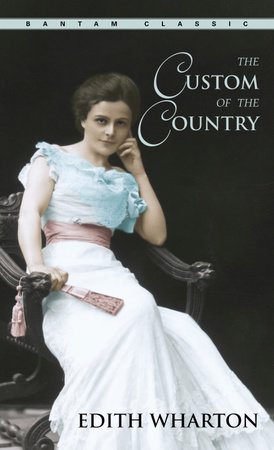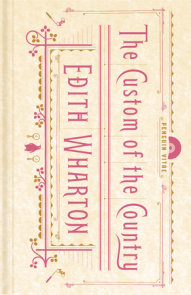
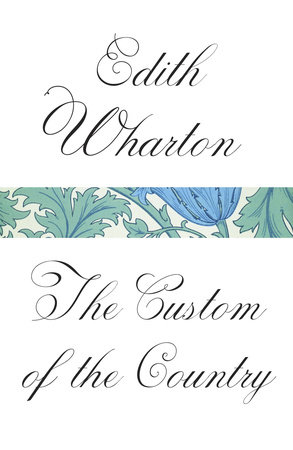
Edith Wharton’s lacerating satire on marriage and materialism in turn-of-the-century New York features her most selfish, ruthless, and irresistibly outrageous female character.
Undine Spragg is an exquisitely beautiful but ferociously acquisitive young woman from the Midwest who comes to New York to seek her fortune. She achieves her social ambitions—but only at the highest cost to her family, her admirers, and her several husbands. Wharton lavished on Undine an imaginative energy that suggests she was as fascinated as she was appalled by the alluring monster she had created. It is the complexity of her attitude that makes The Custom of the Country—with its rich social and emotional detail and its headlong narrative power—one of the most fully realized and resonant of her works.
Excerpted from The Custom of the Country by Edith Wharton. Copyright © 2001 by Edith Wharton. Excerpted by permission of Vintage, a division of Random House, Inc. All rights reserved. No part of this excerpt may be reproduced or reprinted without permission in writing from the publisher.
The upper stratum of New York society into which Edith Wharton was born in 1862 provided her with an abundance of material as a novelist but did not encourage her growth as an artist. Educated by tutors and governesses, she was raised for only one career: marriage. But her marriage, in 1885, to Edward Wharton was an emotional disappointment, if not a disaster. She suffered the first of a series of nervous breakdowns in 1894. In spite of the strain of her marriage, or perhaps because of it, she began to write fiction and published her first story in 1889.
Her first published book was a guide to interior decorating, but this was followed by several novels and story collections. They were written while the Whartons lived in Newport and New York, traveled in Europe, and built their grand home, The Mount, in Lenox, Massachusetts. In Europe, she met Henry James, who became her good friend, traveling companion, and the sternest but most careful critic of her fiction. The House of Mirth (1905) was both a resounding critical success and a bestseller, as was Ethan Frome (1911). In 1913 the Whartons were divorced, and Edith took up permanent residence in France. Her subject, however, remained America, especially the moneyed New York of her youth. Her great satiric novel, The Custom of the Country was published in 1913 and The Age of Innocence won her the Pulitzer Prize in 1921.
In her later years, she enjoyed the admiration of a new generation of writers, including Sinclair Lewis and F. Scott Fitzgerald. In all, she wrote some thirty books, including an autobiography. A Backwards Glance (1934). She died at her villa near Paris in 1937.
1. Some critics consider The Custom of the Country an epic tale, complete with a hero (in this case, a heroine) and various battles (that is, her marriages). Do you agree? What aspects make the novel epic? Which aspects refute this idea?
2. What do the novel’s descriptions of marriage and divorce tell us about Wharton’s views on the subject?
3. Are we to look at Undine as a sympathetic character? Consider women’s roles at the time of the novel. Was Undine forced to be the person she was?
4. In contrast to Wharton’s other New York—set novels, there is no dominant moral character in The Custom of the Country to oppose the selfish Undine. Why did Wharton let Undine go unchallenged? What is she saying about New York–and, by extension, American–society?
5. Wharton consistently presents Undine as monstrously acquisitive, yet Undine seems to get these characteristics from her father, who uses them in business. Does Wharton approve of these behaviors at all? What is she saying about the gender differences of the time? If Undine had been allowed to use these characteristics in business, would she be a different person in her personal life?
6. Do you think Wharton hates Undine? If she does, how does this affect the narrative?