Excerpt
Prologue
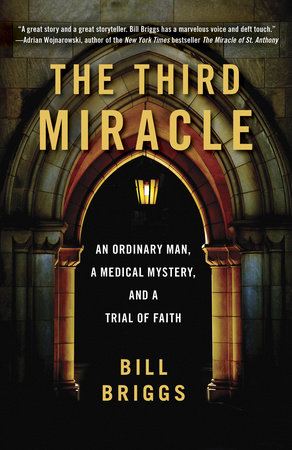
The convent’s caretaker was an ordinary man. Quiet and industrious. Good with his hands. Good with people. And while he rarely spoke of himself, if pressed, the caretaker would say he was diligent, clever, and careful about protecting precious things— such as his family and his planet. He wasn’t Catholic.
Of course, that never stopped the nuns from liking Phil McCord. He always fixed what was broken. In his fifty- plus years, the caretaker had pondered and solved many conundrums— like snarled plumbing and leaky roofs, like who he was and why he was here. But after his baffling overnight cure, McCord faced new questions. And some of those questions bothered him deeply.
Had he really deserved God’s help? Would he ever receive a bill for his divine favor? If that bill came due, how much would it cost him?
The caretaker was shaped by an endless appetite to see and to grasp the intricate machinery of this world and beyond. He peered past the obvious surface, past accepted explanations. He ripped apart riddles, busted them down to better comprehend their complexities. How did electricity work? How did a biomass furnace function? How much of our paths were forged by self- determination and how much by a higher power? By McCord’s estimation, people generally made their own choices and their own way in this life, and rarely— very rarely— did God step in. He compared his own vision of faith to the massive web of National Security Agency supercomputers that simultaneously eavesdropped on millions of e- mail chats and phone conversations.
“They listen to everything and occasionally they pick up one snippet of something. I look at it like that: God doesn’t micromanage but when something pops up, when there’s an opportunity to do something with meaning, there will be an intervention.”
That was one of the lessons he had learned after he beat the incalculable odds and suddenly got better.
In blue jeans and a gray beard, the caretaker mirrored his humble, homey surroundings. Indiana was his land, and the place had branded him with certain essential values: Earn your keep, mend your own problems, and hash out your big decisions at the supper table. That was where he spent the better part of each evening, sitting across from his wife. She once had been a farm girl. Now she was a nurse. A touch sarcastic, she had seen a lot of blood and a lot of death. She kept him grounded.
“I wonder what all this means?” he posed one night as they shared another steaming meal at the circular wooden table nestled just off their kitchen, next to a bay window. She usually just listened quietly for a while, letting him vent, letting him search.
“Was I just at the right place, at the right time? Am I worthy? How did this happen? How did that work? What caused it? It wasn’t like there was a bolt of lightning or something. I don’t understand.”
“I’ve seen people walk away from so much worse,” she finally answered. “It is what it is. Deal with it. It happens. I’ve seen it. In fact, I’ve seen a lot of it. Accept it.”
If only I could, he thought. If only it was that easy.
Looking back at his trial in 2003, he had done just as the priests had asked. He had told the truth. Yet long after he had watched the priests smile at his miraculous tale, the caretaker fought to find some context in which he could understand those facts, some universe in which that truth made sense.
Before his swift recovery, he had been so frightened. So anxious and desperate. At least now he was healthy. He had found new vision. But he had not yet found peace. He still could not answer his own immense questions. He still had not cracked the most perplexing mystery of all.
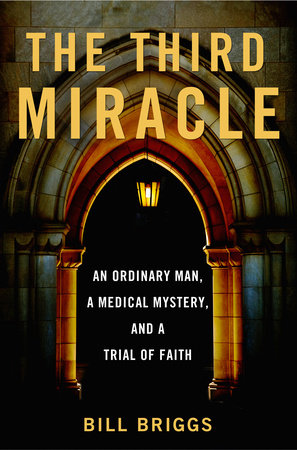
Excerpted from The Third Miracle by Bill Briggs. Copyright © 2012 by Bill Briggs. Excerpted by permission of Broadway Books, a division of Random House, Inc. All rights reserved. No part of this excerpt may be reproduced or reprinted without permission in writing from the publisher.