Author Q&A
A Conversation with Anne Tyler
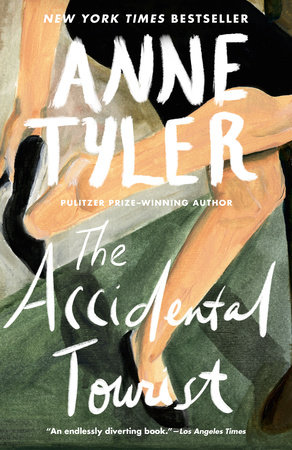
Q: Can Macon be described as an accidental tourist in his own life?
Can we all?
AT: Certainly Macon can, but I wouldn’t say that accidental tourism is
a universal condition. Some people seem to have very meticulous itineraries
for their lives.
Q: Ethan’s tragic death looms over all of the characters in this novel.
Why are so many characters angry, at–or at least disapproving of–
Macon for his manner of grieving?
AT: Because to someone not very perceptive, Macon’s manner of grieving
doesn’t really look like grief.
Q: Is it simply inertia that prevents Macon from dealing with Edward’s
misbehavior for so long? Why does he find the process of training
Edward to be so difficult and painful?
AT: While I was writing this book, I wondered the same thing. I asked
myself, Why do I seem to be going on and on about this ridiculous
dog, who has nothing to do with the main plot? Then when Muriel
asked Macon, "Do you want a dog who’s angry all the time?" (or
words to that effect), I thought, Oh! Of course! That’s exactly what he
wants! This dog is angry for him!
Q: Would you agree that Edward’s reactions to Muriel mirror Macon’s
to some degree?
AT: Oh, I think Edward is way ahead of Macon in his reactions.
Q: What does Singleton Street represent for Macon?
AT: Otherness. The opposite of his own narrow self.
Q: Macon, like many characters in this novel, feels trapped by other
people’s perceptions of him. Does Muriel see Macon as he truly is, or
as someone he wants to be?
AT: Neither, really. She sees the person she herself wants him to be; but
since she’s an accepting and non-judgmental type, who he really is
turns out to be all right with her.
Q: Macon’s friends and family are mostly disapproving of "that
Muriel person." Is it simply a matter of class prejudice?
AT: Class for the most part; but also personality style. To a family so
undemonstrative, Muriel would be a bit daunting.
Q: If not for Muriel’s persistence, would Macon have made a different
choice?
AT: Yes, certainly. Muriel is a pretty powerful force.
Q: In The Accidental Tourist, you write of Macon: "He began to think
that who you are when you’re with somebody may matter more than
whether you love her." Ultimately, does Macon love Muriel?
AT: I think he really does.
Q: Macon remembers finding a magazine quiz in which Sarah
answered that she loved her spouse more than he loved her. How accurate
was her answer? Was Sarah correct in writing that she loved
Macon more than he loved her?
AT: Her answer reflected her limited understanding of Macon, I
believe, more than the true situation.
Q: Is Macon being honest when he tells Sarah that Muriel’s young son
did not draw him to Muriel?
AT: I did mean that to be his honest answer. If anything, her son was a
negative quality–at least in the beginning.
Q: This novel explores the vexed nature of romantic relationships. Do
the couples that have formed over the course of this novel stand a
chance?
AT: Yes, of course they do. These are flawed relationships–as all
are–and they require compromise–as all do. But at least one member
of each couple has found a way to make those compromises.
Q: The Learys are at once remarkable comic figures and deeply human
characters. How difficult is it to achieve this delicate balance and neither
veer into parody nor a humorless character study?
AT: In early drafts, when I didn’t know the Learys all that well, I did
veer over one or the other edge from time to time. But the most
rewarding experience in writing a novel is the gradually deepening
understanding of its characters; and once I knew the Learys better, the
balance came naturally.
Q: Is the Leary siblings’ geographic dyslexia treatable?
AT: Speaking from personal experience, I would say absolutely not.
It’s biological.
Q: Will Rose and Julian’s relationship survive the transplant to the
Leary homestead?
AT: Yes, Julian will become a funny sort of quasi-Leary, purely out of
love for Rose, and a helpful liaison to the outside world.
Q: Is there any hope for Porter or Charles?
AT: Well, not much hope they’ll truly change, of course. But they seem
contented as they are.
Q: Do you have the narrative fairly well mapped out before you begin
writing a novel, or do you find yourself taking detours? For instance,
did you know all along how this novel would end?
AT: I map my books out in a very cursory way–say, about a page for
each novel–and I always think I know how they’ll end, but I’m
almost always wrong. In the case of The Accidental Tourist, I actually
began a chapter in which Macon stayed with Sarah. But it didn’t
work; something in the characters themselves persuaded me the ending
would have to be different.
Q: Do your characters ever surprise you?
AT: All the time.
Q: What do you most enjoy about your life as writer? And least?
AT: The best part about being a writer is the experience of learning,
gradually, what it is like to be a person completely different from me.
The hard part is that for years on end, I am working in a vacuum. Is
this a story anyone will believe? Anyone will care about? I won’t know
that until I’m finished.
Q: If you could invite any writer, living or dead, to attend a reading
group meeting to discuss their work, who would it be? What would
you most like to learn from her or him?
A: I would rather read the writer, not hear him or her talk. I know that
from being a writer myself: what I have to say, I have already said
through my stories.
Q: What are you reading right now?
AT: Lately, I have fallen in love with Ann Patchett’s Bel Canto. It’s a
mesmerizing novel, moving, amusing, and enlightening. And I am
telling everyone to watch for Mary Lawson’s Crow Lake, a soon-to-be-
published novel about a family of orphans in the northernmost
reaches of Canada.




 QUICK VIEW