Author Q&A
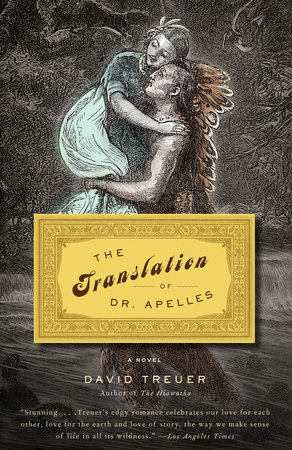
Q: How did you come up with the idea for this book? What attracted you to the idea of a document only one man can read?
A: The story (and the characters cursed/blessed to live it out) always comes first. In this case, Dr. Apelles-a special, unique, singular, rather quietly beautiful human being; terrified of the world, terrified of being “mis-known” and misunderstood-appeared as a person with a dilemma. Namely, how to let himself be known (as an individual and as a Native person) without sacrificing any part of his sovereign self and while dodging and ducking the stories that many (most?) people tell themselves about Indians. It seemed to him (and to me, his kindly father) that the best way to “become himself” was to dive into the very source of his problem: the romantic, lace-edged, valentine-hued, comforting, and often maudlin stories about his (and my) people. But in a way his problem is the problem that we all face. How do we let others know us? How do we tell our own stories that preserves our integrity and singularity to the people we want to love and who we want to love us? How do we all end up translating ourselves and with what languages?
Q: As a follow-up, do similar documents-ones written in languages dangerously close to being forgotten-exist in the real world? Why does language preservation matter?
A: The sad fact is: we will lose up to 90 percent of the linguistic diversity in the world over the next 100 years. We will all witness the extinction of nine out of ten languages in our lifetime. So if such documents don’t exist now, just wait a few election cycles.
Q: People have called Translation an “edgy” love story, a postmodern, “Escher-esque” tale, a literary satire, and a cultural statement. How would you categorize the book, if you had to?
A: I would call it: “the book everyone told me I shouldn’t write but I simply had to even though it doesn’t try to fit any category as much as it tries to transcend them all.” I would call it: “a metaphysical valentine written by a book and dedicated to another, sitting like an old couple that can’t stop touching one another on a bookshelf in a forgotten corner of the reader’s own heart.”
Q: Do you identify particularly strongly with any of the characters in the book?
A: No. I am much more personable and social than Apelles, not as beautiful as Campaspe, not as handsome as Bimaadiz, and not as self-reliant as Eta. And they all have a lot more sex than I do in many more pastoral and public places.
Q: Why did you decide to tell two intertwined love stories? How do they relate to one another? What is to be gained from their coexistence and relationship? How do they inform each other?
A: They help each other out. Apelles manages to spring clear of the valentine that seeks to trap him (springing like a heart from a pop-up book), while, at the same time, his life is informed by that valentine. Bimaadiz and Eta’s story is like a valentine: silly, ideal, a little purple around the edges, dented by the thumb in the supermarket of erotic romance, ready for picking. But, ultimately, Apelles and Compaspe have a more mature, “real world,” compelling, intricate, and soaring relationship than their bookish counterparts. But they all feed one another.
Q: You’ve drawn some fairly critical attention for your nonfiction book, Native American Fiction: A User’s Manual. To what extent do you think Native American identity shapes your-or anyone else’s-literary endeavors?
A: Well, charting the exact ratio of “identity” to “influence”-that is, the degree to which the author’s identity matters and the degree to which the books we’ve read, the people we know, the schools we’ve attended, the jobs we’ve had, the TV shows we like, the tragedies (communal and individual) we’ve endured, the hearts we’ve broken, the times our own hearts have been bruised matters-seems kind of pointless after a certain point. Obviously one’s personal identity (largely a fiction of our own making “drawn from life”) is hugely important . . . to the person. As for books, as for literary endeavors, well that’s the strange magic of books, isn’t it? They somehow exist inside us and outside us at the same time. They are of us, but they are always “of” other books, too. I think it would be tragic to only or even mostly interpret Hamlet as an expression of “English-ness” or of Shakespeare’s identity as an “English man.” It would rob Hamlet of its magic and wouldn’t help explain in any lasting way why the play is important and moving to many people. The same goes for Beloved. And The Magic Mountain. And A Boy’s Own Story. And The English Patient. But this is exactly what happens more often than not to Native American stories. The result: “red-faced minstrelsy.” Speaking of the book I am working on now: it is as much a mixture of my self, my love, my ambition, my people, my tastes-running from Thomas Mann to Christina Aguilera and back again-and my devotion to my craft as anything I’ve ever written.
Q: Who are some of your greatest literary influences?
A: Svevo, Calvino, Borges, Nabokov, Saramago, Antunes, Queroz, Ondaatje, Morrison, Mann, Proust, Nabokov, Woolf, Swift, Longus, Voltaire, Poe, Marvell, Yeats, Muldoon, Pamuk, Mary McCarthy, Edmund White, Peter Carey, any writer who writes as all writers should: that is, ecstatically, all-encompassingly, completely, bravely, going for the whole thing, and not playing it safe
Q: When did you know you wanted to be a writer? Was it a specific moment, or a gradual process?
A: Right now I can’t remember wanting to be a writer. Right now I’d much rather be inside one of my books rather than at my desk writing one! I think I’ll just slip between the covers . . .




 QUICK VIEW