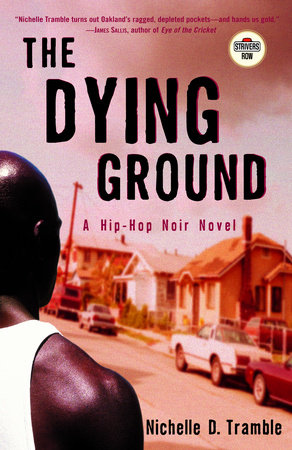
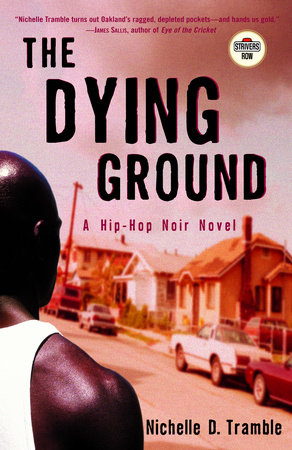
Excerpted from The Dying Ground by Nichelle D. Tramble. . Excerpted by permission of One World/Ballantine, a division of Random House, Inc. All rights reserved. No part of this excerpt may be reproduced or reprinted without permission in writing from the publisher.
Q: The death tally mentioned in the book—did that really happen?
A: I dramatized this a bit for the sake of the story but I didn't stray too far from the mark. There was a gleeful but gruesome fascination with the murder rate in 19 8 9. The drug wars at the time were ferocious. There were headlines that simply stated the murder rate as it escalated but there was not a daily countdown in The Oakland Tribune.
Q: Who are some of your favorite authors?
A: I enjoy a lot of contemporary authors, mostly women. I read first novels religiously, and I've come across quite a few in the past couple of years that just blew me away. Joy Nicholson wrote Tribes of Palos Verdes, which I thought was wonderful. Maureen Gibbon's Swimming Sweet Arrow, T. Greenwood's Breathing Water, Marchlands by Karla Kuban, The Fires by Rene Steinke, and Jumping the Green by Leslie Schwartz were a few I really loved. In general I like Ashley Warlick, Kristin McCloy, Susanna Moore, Alison Moore, John Gregory Brown, Sheila Bosworth, Pat Conroy, Marita Golden, James Lee Burke, Dennis Lehane, Walter Mosley, Michael Connelly, Anne Rivers Siddons, and David Payne. I could go on forever, because there's no way to avoid Toni Morrison, F. Scott Fitzgerald, James Baldwin, Gloria Naylor, Jamaica Kincaid, Milan Kundera, Isabel Allende, Amy Tan ...
Q: In some ways this book is a bittersweet love story of Oakland. Did you grow up there? How do you feel about the city?
A: No, I didn't grow up in Oakland, but my grandparents, for a time, lived in the house on Dover Street that I use in the book. I actually grew up in Alameda, an island that borders Oakland. My first love is definitely my hometown, but I've truly been charmed by Oakland the past few years. The city has an incredibly rich history, and you can't beat the diversity. The research I did - reading about the African-American migration from the South, the growth of the city, the people, the architecture—just made me fall in love. In reading and learning about Oakland, I also learned quite a bit about my own family history, and there's still so much to be explored in both areas. More than likely all the Macco books will be set in Oakland.
Q: What inspired you to write this novel? Is mystery your favorite genre?
A: Quite honestly, I never read mysteries outside of James Lee Burke and Walter Mosley, and that's not because of genre snobbery but because I went through a huge, all-encompassing Southern literature phase that ate up years of my reading time. I was initially drawn to Burke because of the Louisiana setting, and I got hooked from there. Now I read mysteries like a fiend, one after the other, sometimes the same book twice. I also have a few favorites I would never miss, like Dennis Lehane, Michael Connelly, Burke, and Mosley.
The inspiration for Maceo's story came from a coming of age I wanted to tell that felt very thin without the mystery element. My agent suggested that I heighten the mystery and make the coming of age the secondary story, which was a wonderful suggestion. I think my first draft basically fought the natural flow of the story.
Q: Is there another Maceo Redfield mystery in the worksP Will Black Jeff make an appearance?
A: I just completed an outline detailing what has happened to all the characters since the end of The Dying Ground. Some of them haven't fared so well, I had to be honest to the arena in which they lived, but Black Jeff is alive and well-prospering actually. He was such a minor character, but he really stuck with people, so we'll definitely see him again. The new book is set in 1991—no title yet—and it involves a dethroned NBA star who returns home to Oakland to lick his wounds after being chucked from the league. Of course, he knows Holly and Maceo, and his attempts to lie low in Oakland fail dramatically, which draws Maceo into another mystery. Macco, since we last saw him, is still trying to mend fences with his family and navigate the murky waters of his manhood. Honestly, I was a little surprised myself to learn where some of the characters ended up. I had to resist the urge to tie things in a neat bow and give everyone shiny new beginnings. It's a violent world these characters inhabit, and as a result there will definitely be more casualties.
Q: You have such a giftfor creating characters. Where did that come from?
A: I think just listening to people, really enjoying the stories, quirks, and habits of others. No matter where I am, it's really hard for me to have a truly bad time. If nothing else, if I'm at a horrible party or a bad movie, or on an awful date, I always have my imagination to rescue me from any given situation. My imagination has served me well. It's sprung me from boring situations, and helped me to create characters that feel as real as my own family.
From the Trade Paperback edition.
1. The Oakland of Daddy Al's youth is much different than that of his old age; the opportunity that drew him to the West has been replaced with a drug-fueled violence. Yet in some sense, the freedom and hope of old Oakland still exists in the illicit world of drugs. How does the younger generation appropriate and transform this spirit? What is the response of Daddy Al's generation to this change?
2. Like many places where the law ceases to have meaning, Oakland, and its young in particular, relies on an alternate, unspoken idea of morality and honor. Describe this code of ethics. What are the rules? Do they differ between the drug world and the larger community? What are the contradictions between these rules and the law?
3. When Daddy Al tells Maceo about the tragic life and death of his first wife, Elizabeth, what is he saying about his idea of justice? About its redemptive power? Is this a warning to Maceo?
4. Maceo's large, close-knit family nurtured him from birth and provided a substitute family for many of his friends. Despite the strength of this family relationship, the ghost of Maceo's mother and father seem to exert an equally strong influence on him. What is this legacy? How does it affect him? How are Holly and Felicia affected by the mistakes of their parents?
5. Maceo's vivid dreams haunt him throughout the book; they function as premonitions as well as expressions of his true fears. It seems as if Maceo is wrestling his demons in these dreams, and it is here that we encounter Maceo's father and Billy Crane. What do these dreams tell us about Maceo? About his fears? His guilt?
6. As outsiders and insiders to Oakland, Alixe and Felicia are near opposites, yet they represent Maceo's twin desires. "Alixe was what I wanted waiting for me on the other side, but I needed Felicia." What is Felicia's role in Maceo's life? What is Alixe's? How does Alixe view Maceo's world?
7. Despite the violence surrounding them, the residents of Oakland maintain a remarkable sense of community, as witnessed in Cutty's barbershop and during Billy Crane's funeral. Are these scenes realistic? Discuss how humor is used and expressed in this community.
8. Maceo and Holly view their participation in "the game" less as a choice than as a result of their personal history. Maceo claims he was "born in death," and both men carry the sins of their parents close to their hearts. It is as if their parents and surroundings have created a future in which they have little choice. Discuss this notion of fate. Is it valid? How does it shape their decisions? Does it cause them to disregard the consequences of their actions?
9. Scottie, Maceo, and Daddy Al represent three generations of Oakland males; both of the men play the role of father figure — Daddy Al to Maceo and Maceo to Scottie. How do these relationships work? Is there any disappointment within them? What is each man teaching the younger?
10. For most of the book we see Felicia only through the eyes of others; how does Maceo's characterization of her differ from reality? After she returns to Oakland to avenge Billy's death, Felicia's brother accuses her of following the horrifying example of their father. Do you think this is true? How does she arrive at her startling, heartrending solution to Billy's death? Are her actions justified?
11. The Dying Ground charts Maceo's journey from the fringes of violence to its very center. He struggles to make this transition on his own terms, trying to stay true to the disparate beliefs of his family and friends. Is he successful? Does his love for and allegiance to Felicia redeem him? What does the future hold for him?
12. "From memory my gut knew that it would all disappear one way or another, and it had, one by one.... Some of the loss was my own doing, I couldn't argue that, but it all stemmed from the same place ... drugs." Tramble writes with a sense of ambivalence toward the Oakland drug world; she acknowledges its devastating effects but respects its power. The character of Alixe best reflects this view. What is her assessment of Oakland? Are there any heroes in this story? Do we, as readers, come to understand them?
13. "When you will survive if you fight quickly and perish if you do not, this is called the dying ground' (Sun Tzu). Explain Tramble's use of this quote in her title. What does it say about Oakland and its future?
14. "When you will survive if you fight quickly and perish if you do not, this is called the dying ground' (Sun Tzu). Explain Tramble's use of this quote in her title. What does it say about Oakland and its future?