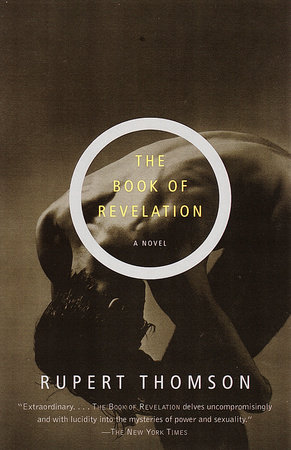
Excerpted from The Book of Revelation by Rupert Thomson. . Excerpted by permission of Vintage, a division of Random House, Inc. All rights reserved. No part of this excerpt may be reproduced or reprinted without permission in writing from the publisher.
Q: It's very unusual not to learn the name of a novel's main character. Why did you decide to keep your narrator anonymous? Is there any literary precedent for this?
A: Obviously, it's a conscious choice on the narrator's part not to reveal his name, the conceit being that he does not wish to be identified. If it's shameful and humiliating for a woman to admit that she's been raped, then how much more so for a man, that's the idea. Despite the title of the book, there are, in the end, certain things that he does not--will not--reveal.
Is there a literary precedent? I can only think of Max de Winter's second wife in Daphne du Maurier's Rebecca who refers to herself quite deliberately as Mrs. De Winter. Her true name is never revealed. I was not thinking of literary precedents at the time however. My mind doesn't work in that way. The character's anonymity was just something that developed naturally out of the material.
Q: How have women readers responded to the novel's reversal of gender roles or its placing of women in the positions of sexual power and the man as the object of their pleasure and humiliation?
A: So far women's reactions have spanned the entire spectrum, everything from accusations of misogyny to an absolute and emotional identification with the narrator's predicament. It was only recently that it occurred to me that female readers would be more equipped to identify with the narrator than most male readers. Interestingly, the only hostile reviews I've had have been from men. I think men are rendered more uneasy by the central preoccupations of the novel--i.e. the notion of being deprived of power and control, of being rendered ornamental. Simone de Beauvoir once said, "One is not born a woman, one becomes one." Could this now also be true of men?
Q: Why did you decide to switch from first to third person narration for the period of the narrator's captivity?
A: The third person narrative establishes distance. Once again, it's a device that conveys the extent of the narrator's trauma. He tells the story in the third person because that's as close as he can get; he is pretending that it happened not to him but to someone else, someone he will never meet, a stranger. Only when he is trying to reconcile himself to what has happened can he begin to use the first person. It was this aspect of the construction of the novel that made me realise that it was in some sense a distillation of everything I have written so far. Most of my previous novels use a dualistic approach, moving between two different voices, two different characters. In The Book of Revelation I also employ two different voices--but they both belong to the same character.
Q: Could you talk about the germination of the novel? Is it based in any way on real events? Did you begin with the intention of exploring the effects of sexual abuse?
A: A book usually lives in my head for quite some time before I start work on it. I leave it there, in the back of my head, and over a period of months, or even years sometimes, it begins to change, to grow--to mature. The process feels curiously organic. With The Book of Revelation none of that happened. There was no germination--at least not that I was aware of. The book was just suddenly there. In fact, the time that elapsed between knowing the book was there and starting work on it was less than twenty-four hours--and the first draft came very quickly. I started writing on October 1st 1995 and by October 29th I had finished it. One hundred and forty-three pages in 29 days. It was a curiously William Faulkner-like experience (he is supposed to have written As I Lay Dying in six weeks--except that he wrote the whole book in that time whereas it would take me another two years to complete The Book of Revelation).
Q: Which contemporary American writers do you read and admire? Do you find that American audiences react differently to your work than British audiences?
A: I admire the following contemporary American writers: Richard Ford, Toni Morrison, Tobias Wolff, William Vollman, Don DeLillo, Jayne Anne Phillips, Cormac McCarthy, and Barry Lopez. Dead American writers I admire would definitely include Paul Bowles, Flannery O'Connor and William Faulkner.
Q: So much of your novel seems to be about concealment and the limits of knowing. Why did you choose The Book of Revelation as your title? Do you want readers to make any specific connections with the biblical book of Revelation?
A: The title The Book of Revelation only presented itself while I was writing the final draft. It had previously been called The Book of Nakedness. I thought that title had a pleasing Milan Kundera feel to it until a friend told me it sounded pretentious. Then I noticed that the word "reveal" cropped up quite frequently in the text. It was almost woven into the tapestry of the novel. From there it was a short (but daring) jump to The Book of Revelation.
Q: The author biography on the book's jacket is very brief. What else can you reveal to us about your life thus far?
A: Like many writers, I started off with a rather elaborate bio (see any edition of my first novel, Dreams of Leaving). Inevitably, perhaps, journalists spent more time talking about my life than they did about the novel--or at least that's how it felt. I wanted to discourage that. The bio dwindled. Perhaps I've gone too far the other way, though--i.e., it's so short that it positively invites curiosity. So here, for the record, is a skeleton version of my life:
* Graduated from Cambridge University in 1976, aged 20.
* Traveled in America, Canada and Mexico. Moved to Athens, Greece, early 1977. Tried to write a novel. Failed.
* Moved to London 1978. Worked as a copywriter in various advertising agencies for the next four years. Retired 1982
* Moved to Italy autumn 1982. Started another novel. 1982-1986 lived in Berlin, New York, Tokyo. Worked intermittently on the novel and various short stories. Returned to London 1986. Completed the novel.
* Dreams of Leaving published June 1987.
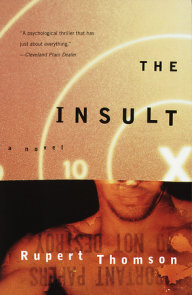
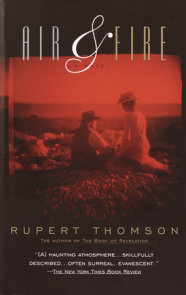
* Since 1987 I have lived in Sydney, Los Angeles, Zanzibar, Amsterdam, and Rome, and have published five more novels--The Five Gates of Hell (1991); Air and Fire (1993); The Insult (1996); Soft! (1998); and The Book of Revelation (1999).
1. The novel begins and ends with first person narration. Why do you think Thomson chooses to tell the story of the protagonist's imprisonment and sexual abuse in the third person? Did you find this narrative shift disorienting? How does this shift affect the emotional texture of the events that take place in the white room? How would these scenes be different if told from a first person, "I" perspective?
2. Thomson's story hinges on a startling reversal of roles, with women assuming the positions of power and reducing the male to an object for their sadistic pleasure. How did you react to this reversal? Did you find it believable? Disturbing? Why do you think Thomson cast his novel in this way?
3. The plot of The Book of Revelation takes off from an old joke: "He went out to get a pack of cigarettes and. . . ." When the narrator does not return, his girlfriend simply assumes that he's left her for another woman, even though he'd always been faithful. What might Thomson be saying about the real stories that lie beneath the conventional ones with which we try to explain the unexplainable?
4. When the narrator asks his captors why they have kidnapped him, one of them responds, "Because you're beautiful. . . . Because we love you" [p. 35]. Is this a serious or mocking response? What do you think their real motives are? Do you think the narrator is right in suggesting that they are acting out their own sexual abuse and taking revenge for the damage that had once been done to them? What can be inferred about the nature of that damage from their behavior towards the narrator? Why does Thomson keep their motivations concealed?
5. Towards the end of his captivity, the narrator reaches a point at which he feels "his fate was no more or less than he deserved. There was nothing random or accidental about what had happened to him. There was nothing unlucky about it" [pp. 90-91]. Why does the narrator see his situation in this way at this point in his captivity? Does this interpretation reveal anything about his character?
6. At one point, the narrator realizes the white room he's held captive in is a "kind of stage" and that he was being "asked to sustain a performance with no knowledge of how long it was supposed to last" [p. 47]. In what ways are the torments he suffers tailored specifically to the fact that he is a dancer? What kinds of performances is he forced to give? How does he try to gain some power over his captors?
7. Once he's free, why doesn't the narrator report his abduction to the police or try harder to convince Brigitte that his story is true? Why doesn't he tell anyone else what happened to him? Does his passivity seem psychologically accurate?
8. After he is released, the narrator's mind fills with "images from the room—the black steeples of the women's hoods, their cloaks swirling around me like unconsciousness itself. . . ." [p. 115]. Earlier, we're told that "when they moved toward him, passing through the sunlight, it was an eerie moment, almost supernatural, like watching ghosts walk through a wall. He felt as though the fabric of the world had been tampered with, which only added to his suspicion that the women were beyond all natural law" [p. 72]. What symbolic value do the women have? To what extent do you think they are projections of the narrator's subconscious? Does this indicate that Thomson wants readers to question whether the women—and therefore the narrator's experiences with them—are real?
9. In trying to find his abductors, the narrator has sex with 162 women in fourteen months. In what ways does he perpetuate the cycle of abuse, even while he is trying to free himself from it? How has he become like the women he is searching for? Is he right when he thinks, "Like vampires, they had turned me into another version of themselves" [p. 199]?
10. One of the women the narrator sleeps with tells him that she was abused by her father but that no one had ever believed her. It suddenly occurs to him that "there were others like me, people who were operating in a fourth dimension, a world that was parallel to this one, a kind of purgatory" [p. 186]. Why does he say that people who've been abused inhabit a "fourth dimension"? Why is it a kind of purgatory? In what ways does the narrator operate in a world that is parallel to but severed from the "real" world?
11. After he is released, the narrator spends three years traveling. What is he trying to achieve by staying in constant motion?
12. Why is the narrator attracted to the story Isabel tells him of Norwegian explorer William Barentz who was stranded on the polar island of Nora Zemba? What does the narrator's intention to create a dance about that story reveal about how art is made? About the way artists use existing stories to tell their own? About the relationship between a historical incident and personal history in a work of art?
13. When the narrator first sleeps with Juliette, he thinks, "In the darkness, naked, she looked so black. Like something I could disappear into" [p. 222]. Where else in the novel does he express this wish to disappear, hide, or dissolve? Why is this such a powerful feeling for him? Why is he so drawn to Juliette? Why does he trust and feel safe with her?
14. The Book of Revelation ends just as the narrator is about to tell his story--the story we have just finished reading—to detective Olsen, who asks him to "go back to the beginning" [p. 260]. Why do you think Thomson has given his narrative this circular form? What is the importance of the narrator finally being able to tell his story? What do think Olsen's response will be? What do you imagine will happen to the narrator from this point on?
15. The novel is preceded by an epigraph from Stefan Hertman: "Will there ever be anything other than the exterior and speculation in store for us? The skin, the surface—it is man's deepest secret." How would you relate this idea to the title of the novel, The Book of Revelation? What connections do you find between the novel and the biblical book of Revelation? How does the novel dramatize the problems of revealing and concealing? How is the narrator's life affected by these opposites? What is concealed from him? What does he conceal and reveal? What does the novel seem to imply about the limits of knowing?