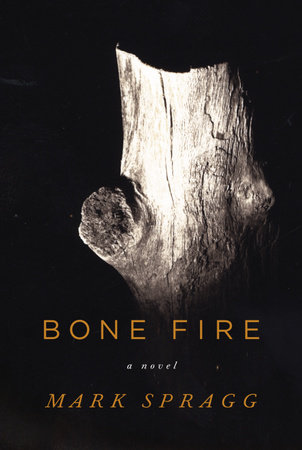
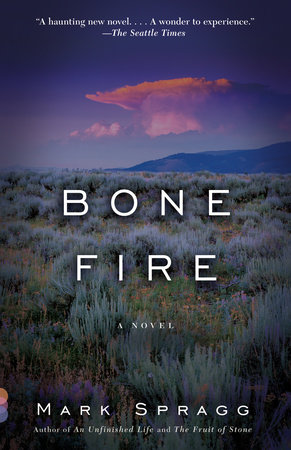
At eighty, Einar Gilkyson has lost his share of loved ones, but still finds his house full. His granddaughter, Griff, has dropped out of college to look after him, and his long-absent sister has returned home from Chicago. But Ishawooa, Wyoming is far from bucolic, and troubles begin to boil when the sheriff finds a man murdered in a meth lab. In this gripping story from the author of An Unfinished Life, harsh truths and difficult consolation come alongside moments of hilarity, surprise and beauty.
Excerpted from Bone Fire by Mark Spragg. Copyright © 2010 by Mark Spragg. Excerpted by permission of Vintage, a division of Random House, Inc. All rights reserved. No part of this excerpt may be reproduced or reprinted without permission in writing from the publisher.
Q: You’ve said that the genesis of Bone Fire started with a series of reoccurring daydreams of Einar Gilkyson tending a huge fire of bones and antlers. Where do you think this particular image came from?
A: I’d guess the image emerged from that part of my subconscious that yearns for a sense of completion and comfort and rest. Einar appeared very satisfied in my daydreams, calm in the firelight at the very end of his life but not at all disturbed by the idea of death. I believe it was because of Einar’s apparent ease that I began to wonder about all of the old men who must have -- through the centuries of human existence -- sat in the night warming themselves at a fire, perhaps reflecting about how they’d managed with their lives. It was his fearlessness that was initially attractive.
Q: Bone Fire takes place many years after An Unfinished Life. You’ve also said that you didn’t intend to write another novel set in Ishawooa, but found that you had to in order to satisfy your curiosities about these people. How did you know you weren’t finished with them? And how did you decide to revisit them at this particular moment in their lives?
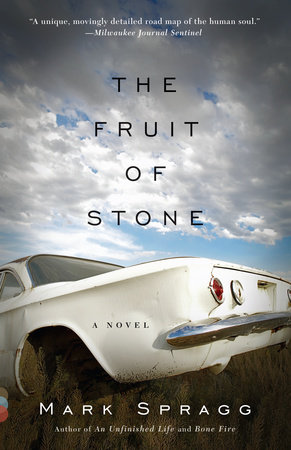
A: There was primarily the image of Einar at the fire, but then I became obsessed with Griff, the little girl in An Unfinished Life, wondering about what she might be like as a young woman, and then Paul, the little boy from The Fruit of Stone, wondering about the young man he had become. I was surprised every step of the way that I had so many unanswered questions about the characters from these previous two novels, and that their lives had become so linked together in my imagination.
Q: Many people have an idealized view of the West as a place that in many ways is frozen in time. Is this something you think about, trying to create a more accurate accounting of it in your work?
A: It’s very natural for me to set my books in the West because it’s where I grew up and have lived for most of my adult life. I care for the place enough to try, at the very least, to render it accurately. Idealizing anything -- a region, a religion, an individual -- strips it of its humanity, and one is left with only parody. So yes, I try my hardest to write the reality of what I know.
Q: Further to that point, early in this novel Crane Carlson, the sheriff, finds a teenager murdered in a meth lab, a crime he’ll continue to investigate throughout the book. Natural beauty and violence seem to intersect in your novels in surprising ways, each really shining a laser-sharp beam on the other. Is that contrast intentional?
A: The contrast may be more unavoidable than intentional. Certainly, there’s violence everywhere, but perhaps in a starker landscape -- one-half of Wyoming is owned by the Federal Government in the form of parks and national forests and wilderness areas, and there’s quite a lot of deeded land that remains undeveloped -- violence appears to be more shocking, strangely more personal.
Q: When Marin first comes across Griff’s ceramic figures she thinks, “It was as though the earth had thrown up an accumulation of its dead, rearranging parts into this resurrection of creatures,” and later tells Griff, “The figures you made, they made me feel like I was ready to pass on.” How do you see Griff’s art, what it means to her and also its place in the novel?
A: Griff’s assemblages have become for me a sort of statuary of inclusiveness. There’s very little in Griff’s worldview that’s identified as “other,” and her figures are representative of her hopefulness. Many of them are reaching upward, pleading for tolerance from a brutal world.
Q: Can you talk a little about the relationship between McEban and Kenneth, and where in your life or imagination that relationship comes from? Kenneth is the same age as Griff was in An Unfinished Life. Is it a coincidence that both novels feature a child around the age of ten? How does having a child’s perspective feel important to you?
A: I particularly love children at that age. They’re remarkably capable without owning the self-consciousness of adolescence, or the arrogance. They seem to me uncommonly brave and insightful, and even in very bad situations, at ten they still seem hopeful, believing that they might make a difference in the world. There was also the ten-year-old Paul in The Fruit of Stone. So, clearly this is an aspect of human relationship about which I am utterly fascinated.
Q: Kenneth is a boy in a world of men, much as Einar remembers being as a child. It’s a childhood filled with fun but also one very much about apprenticeship and learning how to become a man. When he’s taken out of this world and thrust into a more conventional childhood -- the one with ipods and channel surfing -- he’s miserable. Why did you decide to put him in this situation?
A: I believe children want to be useful. Further, I believe that each of us yearns to contribute to something grander than ourselves, to become part of a family, a community. This rather modern notion of childhood as an eighteen-year stretch of unfettered play and irresponsibility was not my experience.
Q: Of your own childhood, you’ve said: “My appetite for quietude, no doubt, has something to do with being raised on a National Forest just off the edge of the Yellowstone Plateau. We couldn’t get television or radio reception, and of course the Internet was years away. I was raised with the luck of silence.” Could you expand on that particular piece of luck?
A: More specifically I was raised without distraction. There were no electronic screens, however large or small, or supposedly informative and essential to my happiness, that I looked to for entertainment or information. There were the people around me, and the natural world, and I was required to be engaged. I was not allowed to be merely a spectator. There was nothing about my boyhood world that was virtual, and I suppose I miss being that completely undistracted in my day-to-day life.
Q: Both Crane and Einar are coming to terms with what one might call “the end.” When Crane gets a medical diagnosis he’s been both expecting and dreading, he rushes straight for the arms of his ex-wife, whom he hasn’t seen in twelve years. And Einar, in his late years, is suddenly visited by his sister, Marin, who hasn’t “come home” in decades. Why do people who’ve remained absent from their lives for so long come to play such pivotal roles?
A: I suppose it’s a way, for each of them, of trying to salve any regrets they might harbor about their lives, any longings which still beg for satisfaction. While they’ve come to accept their deaths, they’re still searching for miracles, even in the most unlikely of places.
Q: Griff is torn between pursuing a future that seems likely to take her elsewhere and the responsibility she feels to stay in her home town and take care of her grandfather, even though Einar urges her not to. Paul, too, is struggling with moving forward while feeling he can’t do so without betraying his own sense of duty. Can you talk about how this tension between past and future shapes your novel?
A: To some degree I feel this tension shapes all of us. How much of our lives do we owe to family and friends and social expectation? When does tending ones own dreams translate merely into selfishness, or in Griff’s case, does an artist only owe allegiance to her art? At the root of the question is each person’s definition of belonging. Do we belong to something greater than family? Do we describe family by blood or intention?
Q: What do you think Einar knows -- thanks to his long, long life and all the suffering and joy that has come with it -- that they’re only beginning to understand?
A: I think that Einar’s come to some sense of peace at the end of his life. Perhaps it is that he’s gotten old enough finally, and honest enough, not to regret the opportunities he’s missed, while mostly, the young are struggling not to miss a thing. A couple of lines from Frost’s After Apple Picking, might best illustrate what I’m thinking about with Einar: “… and there may be two or three/Apples I didn’t pick upon some bough./But I am done with apple-picking now.” And further: “For I have had too much/Of apple-picking: I am overtired/Of the great harvest I myself desired.”
Q: So, are these characters still visiting you in daydreams? In other words, can we expect to see any more of them in the future?
A: I sincerely hope to be done with them. I believe I’ve said everything I need to about them, and satisfied my curiosity about their lives. I could imagine some of them re-emerging perhaps in a short story, but certainly not a novel.
“[Bone Fire] once again lands us on the prairie-grass-covered ranchlands of Ishawooa, Wyoming, where locals know the roaming livestock, winding creeks and meandering constellations better than they know each other. . . . A wonder to experience.” —The Seattle Times
“A tale teeming with loss, redemption and personal crisis. . . . Spragg’s novel throbs with honest accounts of a Mountain West town . . . caught between past and present. . . . Bone Fire establishes as compelling a sense of time and place as any in contemporary fiction.” —The Denver Post
“Spragg conjures the West with style and gravity. He can burrow into the tightest chambers of the heart, and his belief in family is palpable and moving.” —The Boston Globe
“Beautiful. . . . Reading Bone Fire is probably a lot like spending some time with the folks in Wyoming: A serious pleasure.” —The Oregonian
“[Spragg] captures the unruly West, wrangles it onto the page somehow and holds it down with just the words.” —Los Angeles Times
“Bone Fire is that rare thing, a novel with all the literary virtues of skill and style and pitch that you hope for but also a book that makes you turn pages far into the night to find out what happens.” —Kent Haruf
“[A] big-sky slice of life. . . . As slow and shambling as a run-down pickup, but that allows the fine-tuned characters wide-open space to breathe and their grief to become palpable.” —Entertainment Weekly
“The strength of Bone Fire rests in Spragg’s ability to render lives in the contemporary American West with a keen eye for physical and emotional detail. Spragg understands how the landscape shapes the lives of the characters, as well as the way the modern world encroaches on the landscape. This is still the West of rodeos and pickup trucks, but it’s also the West of Google, Netflix, and GPS navigation.” —Kansas City Star
“It’s the author’s endearingly biting characters, not the slowly unpacking whodunit, that drives [Bone Fire]. You root for these people no matter how much dysfunction they leave in their wake, mostly because they’re always saying things you’d never have the guts to utter out loud.” —Outside
“[A] poignant modern Western. . . . Each member of [Spragg’s] cast is vibrant on the page, not because they resemble people one might know, but because they become intensely familiar and stay that way long after the book has been shelved.” —The Anniston Star
“Spragg is so spot on when it comes to describing small town life in the American West, his prose seems to leap off the printed page. . . . Spragg is a gifted writer.” —The Tucson Citizen
“A starkly beautiful portrait of the modern West. Spragg is an author with a keen eye for both the poetic splendors and ugly realities of this much-romanticized country.” —The Globe and Mail (Canada)
“As Spragg’s story slowly unfolds and gradually picks up speed, his Wyoming is as tangible as his characters’ yearning for connection.” —Curled Up With A Good Book
“Spragg writes . . . with the smoothness of a river stone as he weaves a tale of loss and compassion, loyalty and family, and ultimately, love. . . . Sure to bring a lump to the throat.” —Las Vegas Review-Journal
“Mark Spragg writes about ordinary people extraordinarily well. . . . Emotionally charged and well-written, Bone Fire is truly an exceptional story, with a main character everyone can relate to.” —Sacramento News & Review
1. The novel begins with Griff and her horse, and ends with Kenneth and Einar. Who would you say is the protagonist of Bone Fire?
2. Page 6 describes Griff “finding it impossible to admit that when she and Paul are making love it’s the grinding of their bones she hears, the clamor of one animal moving against another.” Why does Griff think of sex with Paul this way? How would you characterize Griff and Paul’s relationship?
3. Spragg often begins a chapter without making it clear which character is being discussed, preferring to use pronouns at first and reveal the character in question a few paragraphs into the chapter. Could you always tell which character was which? What purpose might this initial ambiguity serve in Spragg’s narrative?
4. At the scene of the murder, on page 20, Crane thinks nothing of taking a beer out of the victim’s fridge and drinking it. Later in the novel, he also smokes marijuana. How does the sheriff approach his job? Is he more concerned with justice than with the strict letter of the law? Is this an outdated mind-set?
5. On page 29, Paul tells Griff that he prefers Chicago to Wyoming because he can “go out for a beer and not have the rest of the bar waiting for Tonto to get drunk and piss his pants, or pull a knife and go to scalping, and you know goddamn well that’s how it can feel for me here.” Were you surprised by Paul’s frank description of racism in the West?
6. When Crane starts to suspect there is something wrong with his health, he doesn’t tell his wife. He even lies to her about his neurologist’s visit—on page 37, we learn that “he told Jean he had to escort a prisoner to Billings and drove by himself to the clinic.” In fact, Jean doesn’t find out about Crane’s ALS until Helen tells her on page 201. Why does Crane keep his diagnosis from his wife? What does it tell us about their relationship?
7. Why, on pages 67–69, does Einar decide to dig a hole and burn “all the letters he’d written Ella from Korea, most of the family photographs, wedding rings, birth and death certificates, marriage licenses, everything he could put his hands on that authenticated his eighty years of using up a body”? Does his justification—that he doesn’t want Griff “to have to deal with anything but the disposal of his body”—ring true to you? Is the act really one of concern for Griff, or is it a sign of dementia?
8. On page 77, Marin tells Einar she thought maybe they had fallen out of touch because Einar didn’t like the fact that she lived with a woman—to which he responds, “I wouldn’t know anything about that.” Later, on page 159, Kenneth debates his own sexuality, and McEban tells him, “You’re just fine either way.” How does Bone Fire deal with the topic of homosexuality? Did you find it to be sensitive? Realistic?
9. One of the most striking aspects of Bone Fire is the way in which it juxtaposes old-fashioned Western scenes, like horseback riding and tending to the ranch, with contemporary technology and culture—for example, the iPod Kenneth receives from Claire (page 111), the text-messaging slang Starla uses with Crane (page 114), or the TV shows Jean watches (page 118). How fluidly do Spragg’s characters move between their old-world sensibilities and their new-world lives? Do you think Spragg is making a statement about American culture? What might it be?
10. When Kenneth is about to run away from Rodney and Claire’s house, he remembers that “his mother had told him once that it wasn’t lying if you told people what they wanted to hear” (page 145). What does this tell the reader about Kenneth’s mother? Why is it so easy for her to manipulate Rodney and McEban? Later in the same paragraph, Kenneth tries to anticipate the questions that might come up, but “didn’t kid himself about them not being lies.” Is Kenneth more mature than his mother? If so, how did he come to be that way?
11. Why does Kenneth choose to leave? What does his life with McEban offer that Rodney and Claire can’t?
12. Bone Fire might seem at first like a traditional mystery novel—Crane discovers someone murdered just twenty pages in, and spends much of the novel on the case. However, the novel doesn’t function as a whodunit: McEban doesn’t gather clues, the murderer doesn’t turn out to be any of the characters we get to know, and it would be impossible for the reader to guess what had happened. In fact, on pages 151–157, Janey Schilling offers a full confession that explains all the circumstances of the murder. If Bone Fire is not a mystery, what role does JC Tylerson’s death play in the story?
13. One connecting thread between many of the characters in the story is a person the reader never meets: Griffin, who is Einar’s son, Griff’s father, and Jean’s ex. How does the memory of Griffin influence the narrative?
14. Why does Griff kick Paul out of her clay firing on page 189?
15. On page 221, McEban comes across a car accident. Were you surprised that it turned out to be Jean’s accident? Did Jean need to be fatally wounded in order to realize that she actually loved Crane? Do you believe they truly loved each other?
16. Does Paul make the right choice in deciding not to go to Uganda after all? Will he and Griff be happy together in Chicago? Will Einar and Marin be happy in Wyoming?
17. What did you make of Brady and Crane’s final confrontation on pages 230–232? When Brady pleads, “Can’t you just fucking do this? Pretend I’m on fire,” what does he mean? Is justice served?
18. Spragg describes Griff’s bone sculptures to some extent, but also leaves them open to interpretation—what did you imagine they looked like? Why does Griff choose to leave them with Einar?
19. There are many fires throughout the novel; what is the significance of the last fire that McEban, Einar and Kenneth build in the final chapter?
(For a complete list of available reading group guides, and to sign up for the Reading Group Center e-newsletter, visit www.readinggroupcenter.com.)