Author Q&A
In conversation with Hampton Sides, author of BLOOD AND THUNDER
How did you come to this story?
I never in a million years thought I’d write a Western! But five years ago, I went to the national cemetery here in Santa Fe where I live. It’s a mini-Arlington, with those immaculate white gravestones of veterans who fought in Vietnam, Korea, World War II, and on back. In the oldest and least visited part of the cemetery, you find men who died fighting “the savages.” Just rows upon rows of soldiers who perished in the Indian Wars. And I thought, these men probably had the same good qualities we celebrate in other soldiers from other wars. They were brave. They did their duty. But they fought in a war we now consider immoral. I stood there wondering, who were they? And how should we honor their sacrifice? I decided to write about the early Indian wars of the western frontier, in what I call the “pre-West.” It was an interesting time when the Western clichés had not yet solidified. There were no stage coaches or Stetson hats, no Colt six-shooters or cattle drives. America was just beginning to make its imprint.
How did you get from there to your central character, Kit Carson?
That was easy–all narrative roads led to this one man, the ultimate “pre-Westerner.” Out here in the West, Carson is like a jack-in-the box. Towns, rivers, and forests are named after him–not to mention dry cleaners, RV parks, and don’t-tell motels. The capital of Nevada, Carson City, bears his name. I had thought of him as a fictional character, a fabled gunslinger, or a stage character in a Wild West show. Little did I realize, the real Carson was far more interesting and far more important. This guy got around! He did everything there was to do in the West, and knew everybody. He was a fur trapper, buffalo hunter, scout, explorer, tracker, transcontinental courier, rancher, soldier, Indian agent–and finally a general. He did it all.
Why should we care about Kit Carson now?
Carson is one of those pivotal folk figures who invite reexamination. He was the “field agent” of Manifest Destiny, the guy who more than any other individual personified the American expansion into the West. Throughout most of the 1900s, historians who wrote about Carson and his times were emotionally invested in the idea that the western conquest was a glorious adventure led by a generation of mythically self-reliant pioneers. Then, by the 1960s, the pendulum had swung in the other direction. Dee Brown’s Bury My Heart At Wounded Knee and other histories painted the western expansion as a thoroughly shameful episode. All white pioneers were murderous land thieves; all Indians were noble environmentalists shrouded in golden mist. Now the pendulum has swung back to the middle, I think, and it’s possible for us to see the life of a controversial figure like Carson with the clarity of some dispassion.
Carson is the main character of Blood and Thunder, but is he the villain or the hero?
Both. By most classical definitions, Carson was heroic. He trekked unimaginable distances into dangerous wildernesses. He was modest about his exploits. Time and time again, he rescued people without expecting pay or recognition. He had physical grace and a sense of chivalry. He pulled stuff off you wouldn’t believe. Like some medieval knight, he was repeatedly called upon to slay dragons for the kingdom. The problem was, those “dragons” were often Native Americans. Carson played a key role in some of the more unfortunate collisions between the United States and the American Indian. Many Native Americans think of Carson as a genocidal maniac, right up there with Custer and Sheridan. A Navajo friend of mine told me, “We think of Kit Carson the way Jews think of Hitler.”
Was he really as bad as that?
I understand why the Navajos hate the man who conquered their nation. But for his day, Carson was quite enlightened on the subject of Indian policy. Back then, even sophisticated thinkers like Mark Twain were calling for their extermination. Carson had lived among Indians his whole life. He spoke seven Indian languages. His first wife was Arapaho. He knew first-hand that exposure to the white man was wiping the Indians off the map. And so he came to believe that the only alternative to their demise was to create reservations where formerly nomadic tribes could learn to live self-sufficiently without contamination from whites. Although it was tragically mishandled and horribly patronizing in its premise, that’s what Carson’s final campaign was about: To move the Navajos to a place where they could be “civilized” as an alternative to their own extinction.
If Carson isn’t the villain of Blood and Thunder, who is?
Brigadier General James Henry Carleton, Carson’s superior. He was the real architect of the Navajo campaign and just an absolutely insufferable prig. A stout New England Calvinist, he believed the Navajos had to become Christian farmers overnight. Carleton insisted that a Navajo reservation would not work anywhere on Navajo land–the entire tribe had to be rounded up and force-marched 400 miles to a place he had personally selected on the windswept plains near Texas. The Navajos called the resulting forced relocation “The Long Walk” and still talk about it as though it happened yesterday. Their migration was on a scale second only to the Trail of Tears of the Cherokee Indians. More than one-third of the Navajo people died in exile at this horrible place. If anyone was responsible for this tragedy, it was General Carleton.
Do you see resonances between Carson’s times and today?
In grade school we were taught the USA “never invaded a foreign country for land.” That’s just nonsense. The Mexican War, our first war of foreign intervention, resulted in an unbelievable expansion of our national domain. In 1846, an American army, guided by Kit Carson, marched across the continent and took most of the American West–just plain stole it! Suddenly we found ourselves nation-building in a mountainous desert, trying to make sense of this complicated patchwork of cultures and religions. We justified the conquest by saying we were spreading democracy to a benighted place. We believed our new subjects would welcome us as deliverers. It was all going to so easy! But we soon realized that we had no understanding of how intricate the cultures were. It was a cauldron of conflict, and yet we had pledged ourselves to the dangerous and expensive task of bringing it all under control. We were intensely naïve and intensely brutal. All of this seems very familiar to me.
Another fascinating resonance, for me, has to do with the current controversy over illegal immigration from Mexico. I think it’s interesting that the frontline states in this debate–California, Arizona, New Mexico, and Texas–are the very states we stole from Mexico. The people who get so bent out of shape about the Hispanicization of America conveniently forget that we crossed their borders long before they crossed ours. We forfeited our right to get worked up over this issue. Conquerors can’t be outraged!
Why did you choose to focus on the Navajos?
The Navajos are the largest tribe in the United States, living on the largest reservation. Yet most Americans know next to nothing about their relationship with the U.S. government. The popular conception of the Indian wars tends to focus on the Plains Tribes, particularly the Sioux. I thought this story begged for greater attention. Not only that, but Carson’s war against the Navajos–and their linguistic cousins, the Apaches–was couched in ways very similar to today’s war on terrorism. The Navajos and Apaches were often described as “terrorizing’ the countryside. They were successful raiders who stole women and children and livestock. And yet they were hard to catch. They lived in the shadows, in remote desert country riddled with canyons and caves. They were everywhere and nowhere–and they drove the military crazy.
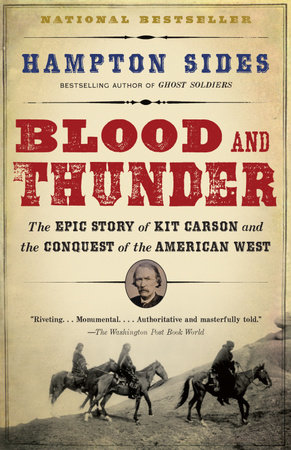
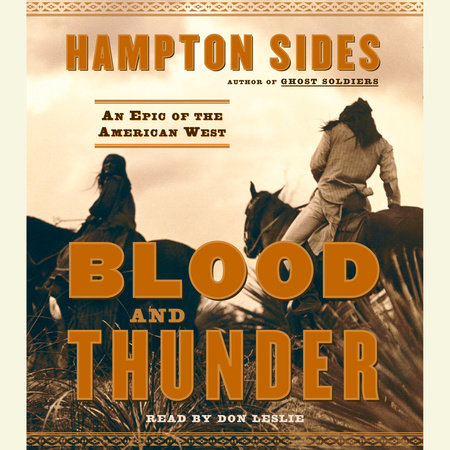
What’s the image on the cover?
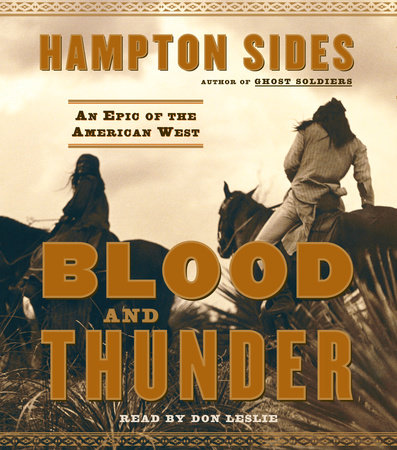
It’s a photogravure plate taken a hundred years ago by the famous photographer, Edward S. Curtis. Entitled “Before the Storm,” it’s a sepia-tone of Apaches on horseback in the mountains of the Southwest. Curtis was an extraordinary man who went around the West making pictures of Native Americans–the “vanishing race,” he called them. He was wrong about that of course–Indians have endured–but the traditions and lifeways he captured on film have changed dramatically.
Blood and Thunder also concerns the Civil War. How did you manage that in a Western?
It’s a little-known fact, but there were two extremely fierce Civil War battles out west, both of them fought in New Mexico. Kit Carson was there as usual, right in the middle of the action. He fought valiantly on the side of the Union. A rebel army of more than 3,000 soldiers had come up the Rio Grande from Texas, with an eye on seizing the goldfields of Colorado and eventually re-conquering most of the West for the Confederacy. It seemed like a quixotic mission, but the Texans actually succeeded in taking Santa Fe and hoisting the Rebel flag over the capital before they were finally repulsed. It was an important campaign. History would have played out very differently if the Texans had succeeded.
Are there similarities between Blood and Thunder and your last history, Ghost Soldiers?
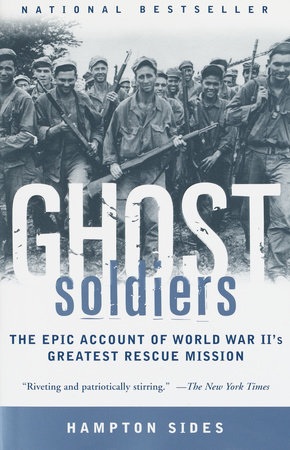
When I finished Ghost Soldiers, people kept suggesting other World War II stories for me to write. But I was done with that war. I wanted to try another history that was radically different in place and time. Oddly enough, though, as I started this book, I found there was a compelling similarity in the story arc. As with Ghost Soldiers, the story of the Navajo conquest takes the form of a brutal siege, a surrender, a forced march, and a long captivity that ends in a bittersweet return home. As for stylistic similarities, much like Ghost Soldiers, I’ve tried to be inventive with the narrative structure, employing as much scene-painting and cross-cutting as possible, with different time-lines that inch closer together and finally intersect. And I’m afraid the “gross-out factor” is similarly high. The story of the “winning” of the West is every bit as brutal as Bataan–it’s violence on a Hobbesian scale. And so instead of samurai-style beheadings and tropical diseases, you have scalpings, corpse mutilations, Indian massacres, and extremely disgusting diets. People who liked the more gothic aspects of Ghost Soldiers will not be disappointed here.
How did you research this book?
It was an adventure keeping up with Kit Carson. I tried to go most everywhere he went, and that means pretty much the entire west. I drove the Santa Fe and Oregon Trails. I spent a lot of time on the Navajo Reservation, and in Taos, Carson’s home. I bounced around to a lot of old frontier forts– Bent’s Fort, Sutter’s Fort, Ft. Leavenworth. And of course, there was a lot of archival work to do–from Yale University to the Huntington Library. It kept me busy for five years.
Where does the title come from?
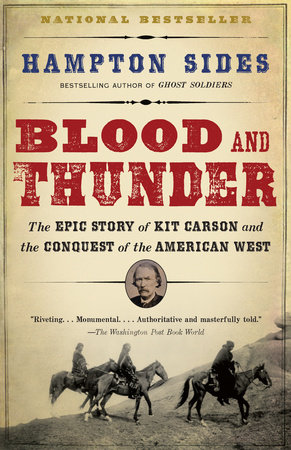
The first “Westerns” were cheaply produced pulp novels, almost like comic books, called “blood-and-thunders.” Starting in the late 1840s, Kit Carson appeared as the hero in many dozens of these blood-and-thunders. The publishers used his name and fictionalized his exploits without his permission and without paying him a cent. And ironically, because he was illiterate, Carson couldn’t even read these atrocious books that bore his name. He hated them, both for their wild inaccuracies and for the cheesy celebrity status they conferred on him without his consent. In his own lifetime, he became a kind of action figure hero. These hyperbolic books raised expectations that he spent the rest of his life trying to live down. I chose it as a title, because at its essence, this book examines the tension between the glorious myth and the brutal reality of Carson’s West.




 QUICK VIEW