Author Q&A
A Conversation with Louise Shaffer
Laurel Selene leads the author Louise Shaffer into the office of the
Charles Valley Gazetteer for an interview that will run in the paper
sometime in 2004. As they make their way to the back where Laurel’s
desk is, Shaffer looks around in awe.
Louise Shaffer: Wow! This place looks exactly the way I
pictured it.
Laurel Selene: I imagine that’ll be true for just about anyplace
you go in Charles Valley.
Louise: You mean because I—well, “created it” sounds kind
of grand. You know, like singers calling themselves artists,
which always makes me antsy, because I think you should wait
for someone else to say it. I mean, maybe you aren’t really.
Maybe you’re just someone who’ll be forgotten in ten years.
Mozart was an artist, but I’m not sure the boy group du jour
is. (pause) What were we talking about?
Laurel: You have a tendency to wander, don’t you?
Louise: Usually. But before we start, there is something I
want to ask you.
Laurel: Shoot.
Louise: How weird is it for you to be interviewing me when
I’m the one who, you know . . .
Laurel: Created me? (Shaffer nods.) Probably about as weird as
it is for you to be interviewed by me.
Louise: Okay. Glad we got that out of the way. We can start
now.
Laurel: Thanks. I did some research on you, and I found out
that writing wasn’t your first career. You started out as an actress,
and—
Louise: (breaking in) Anyone who read my book jacket knows
that.
Laurel: Maybe we need to set some ground rules here. You
may be the creator, but I’m the interviewer, okay?
Louise: Sorry. Yeah, I was an actress. I did Broadway, repertory
theater, prime-time TV, commercials. I toured the country
in a rock musical which, for a woman who thought vocal
music ended with Puccini and had no sense of rhythm, was
kind of a stretch.
Laurel: And you acted in the soaps. Or do you prefer to call
it “daytime drama”?
Louise: Not really. That dates back to a time when we were
trying to be Serious Culture, but it never really stuck. Which
isn’t to say that I don’t have total respect for the soaps, because
I do. We did the same amount of work in one day that nighttime
television did in a week or ten days and we . . . I’m wandering
again, right?
Laurel: All over hell and creation. So you won an Emmy and
three nominations for acting on a soap opera called Ryan’s
Hope. Then you were nominated for the writing Emmy six
times for your work on As the World Turns and Ryan’s Hope—
have I got that right?
Louise: Actually one of the nominations was for All My
Children, but I like the way you managed to slip that in. Very
slick.
Laurel: I try. So with all that why did you decide to start
writing novels?
Louise: I’m not sure I actually did decide to do any of it. For
one thing, I’d always written. When I was a kid I wrote plays,
short stories, even some really bad poetry. But then I discovered
acting and it was so much easier, and there was applause
as soon as you finished, which was really nice for someone
who, as you pointed out, has a short attention span. Because
you have to wait a couple of years to find out if people like a
book you’ve written.
Laurel: Sounds like approval is important to you.
Louise: Are you kidding? I’m an approval junkie.
Laurel: And you really think acting is easier than writing?
Louise: Maybe it isn’t easier, but writing means more responsibility.
It’s your ideas and your story on those pages. But I
think they’re different sides of the same kind of work. It’s
about the characters, after all. I use all my acting techniques to
write my characters. For instance, I tell each piece of the story
from one character’s point of view. So it always has a personal
component and bias.
Laurel: Could you explain that, please?
Louise: Let me relate it to acting. If you’re playing Lady
Macbeth, you don’t see yourself as a shrew who married a man
with the IQ of an artichoke and drove him to commit murder;
you see yourself as a loving wife trying to help your husband
reach his full potential. That’s your point of view.
Laurel: Okay. Any other—um, techniques?
Louise: Keep it motivated. When I was acting I never did
anything unless I understood why I was doing it and could justify
it in terms of my character’s past and what she wants in the
present. As a writer I make sure that happens with all of my
characters. Except, sometimes I need a character to do something
for the sake of the plot that isn’t right for her. When I
was acting, I’d just say, “I’m sorry, this isn’t something my
character would do.” And then it was up to the writer to fix
the problem. Now I’m the writer and the “problem-fixer.” I
spend a lot of time talking to myself. Well, yelling at myself
really.
Laurel: So how did you start writing again?
Louise: Actually it was the Emmy that did it. And an earthquake.
Three months after I won the Emmy I was fired. And I
couldn’t get any more work because I was over forty. As a producer
friend of mine (who is no longer a friend) said to me,
“Sweetie, you’re just not sexually viable anymore.”
Laurel: Did you hit him?
Louise: Nah. I was an actor, I was used to taking abuse. Besides,
he was a producer, and as an actor you’re always thinking
that maybe someday he’ll have a part for you and you’ll get to
make a comeback. I mean, look at Gloria Stuart. (pause) I
think we’re both wandering now.
Laurel: It’s catching. So how did an earthquake make you
start writing novels?
Louise: First, I need to back up and tell you I married a
southern boy, which was the smartest thing I ever did in my
life.
Laurel: If you say so.
Louise: I know you’ve had a hard time finding what we used
to call in the soaps a romantic interest here in Charles Valley.
But trust me, this place is a walk in the park compared to the
dating scene in Manhattan. Especially if you work in show
business. The statistics alone are—
Laurel: (interrupting) Okay, okay. I watch Sex and the City,
too. About novel writing . . . ?
Louise: Like I said, I married a southerner, which meant I
had a wonderful southern mother-in-law. My husband and I
and his two kids were out in Los Angeles trying to revive my
dying acting career when this huge earthquake hit. A freewaysshifting-
under-the-cars-and-whitecaps-on-the-swimmingpool-
size earthquake. Three people got through on the phone
to L.A. that day, and one of them was my mother-in-law, Clara.
She wanted to know when her son was going to stop dragging
her grandbabies all over the place and come back home where
he belonged.
Laurel: Home being the South.
Louise: Also known as God’s Country. I’m still not quite sure
how it happened, but the next thing I knew, I was living in an
old farmhouse in this beautiful town in rural Georgia. At first
I thought my life was over. I’m a big-city person and here I was
surrounded by nature. But then everything started coming together.
Like I said, I’d always played around with writing, but
I never had a story to tell. Well, I started making friends, because
in a small town in the South you just do. I know you
can’t make generalizations about people, but it seems to me
that there is a certain breed of woman in the South. They’re
smart and strong and they accomplish the most incredible
things, but they still remember last Thursday was your birthday
and get you the card on time. And even if they haven’t seen
you in months they ask how your mama is doing after that hip
surgery. They just blow me away.
Laurel: The Steel Magnolias thing.
Louise: And it goes deeper than that. I met women who
were so strong in their beliefs. We’re talking heavy-duty moral
compass. I come from a mindset where you’d die before you’d
make a value judgment. But these women were totally convinced
they knew what was right and what was wrong. And in
one case, I felt she’d take responsibility for that—even break
the law if she thought it was necessary—to right a wrong or
protect someone who was vulnerable. And she’d live with the
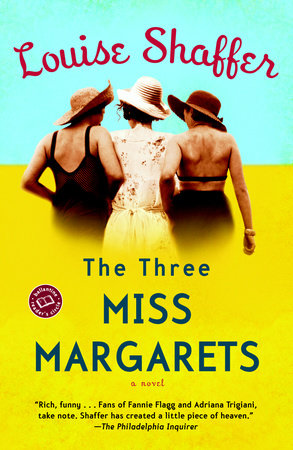
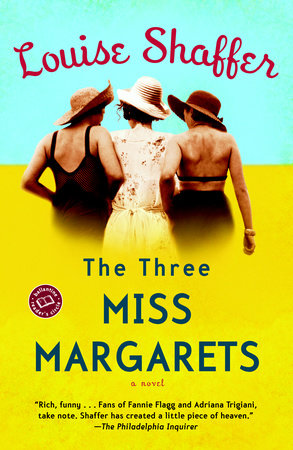
consequences. That was what gave me the core idea for The
Three Miss Margarets.
Laurel: That kind of answers my next question, which was
going to be, Why did a woman from Connecticut want to
write about the South? I don’t know how you could not want to write about
could not want to write about the South, or paint it, or something. It’s so full. The food is so rich and good, and the music, and the flowers. There’s nothing
like the way Georgia explodes in the spring. And there’s a
sense of history—more than that really, it’s a sense of legacy.
That’s one of my favorite themes. I love any book that explores
the impact of the past on the present. That said, one of
the things I worried about was making sure I kept the book
true to the South. So my husband read every page as I was
writing it, and if he thought I’d slipped he’d say, “You’re talking
Yankee-speak here.”
Laurel: So it was the move to Georgia that started your career
as a novelist.
Louise: I was too scared to take it on right away, so I wrote
for the soaps first. Writing is very lonely and acting is total col-
laboration, and I needed to ease into the isolation, I think. On
the soaps, I was a staff writer, which kind of split the difference.
But eventually I got to a place where I’d had the story for
The Three Miss Margarets in my head for so long that I had to
see if I could put it on paper.
Laurel: And the title of your book? Did you know three
women named Margaret who were good friends?
Louise: Not exactly. But I did know of three women who all
had the same name and were behind-the-scenes powerhouses.
They were older, they came from money (although that was
never mentioned), they counted their kin by the dozens and
the time their families had been in the town by generations.
They weren’t friends who hung out on the porch together like
my three Miss Margarets, but they did keep tabs on one another.
Kind of like rival queens. And then there was a woman
I adored who had a childhood nickname, and when she grew
up everyone just attached Miss to it, like Miss Li’l Bit.
Laurel: So what’s up for you next? Working on anything
new?
Louise: Right now I’m writing a sequel to The Three Miss
Margarets.
Laurel: Really? What’s it about?
Louise: A character who only got mentioned in the first
book, someone named Myrtis Garrison.
Laurel: Grady’s mother.
Louise: And you.
Laurel: Oh.
Louise: So I really can’t tell you anything more.
Laurel: No, I can see how that would be—
Louise: —too weird.
Laurel: Yes. Well, I want to thank you for your time.
Louise: Is that it? You don’t need anything more from me?
Laurel: Not unless there’s something else you want to say.
You are the creator.
Louise: But you’re the interviewer.
Laurel: Yeah. (pause) So, that’s it.




 QUICK VIEW