Author Q&A
Mary Doria Russell is Interviewed by Lt. Colonel Roger C. Thompson, Professor of English at the Virginia Military Institute, in Lexington, Virginia.
Roger C. Thompson: Mary, your career as a writer is hard to classify because your books don’t fit very neatly into any particular genre box. Why is that?
Mary Doria Russell: Honestly? I didn’t know any better. Maybe if I’d studied writing instead of anthropology, I’d be more sensible. You know–pick a genre, follow the rules, stay in the box–but let’s face it. Sensible people don’t major in anthropology.
On the other hand, in film, it’s normal to change genres. Ridley Scott made Blade Runner, Gladiator, and Thelma & Louise. The Coen Brothers take on one genre after another– Raising Arizona; Fargo; The Big Lebowski; O Brother, Where Art Thou? Johnny Depp and Meryl Streep are celebrated for disappearing into an amazing range of roles.
RCT: But novelists are expected to obey genre boundaries and stay with one style!
MDR: I know! Isn’t that weird? But thinking about why I don’t . . . I guess my real commitment is to the main character, and that’s why each novel is different.
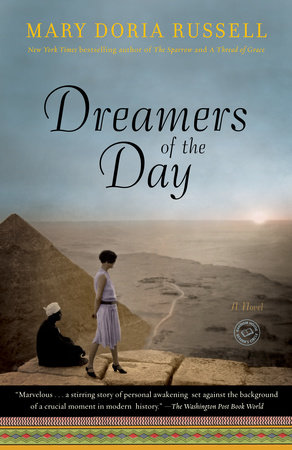
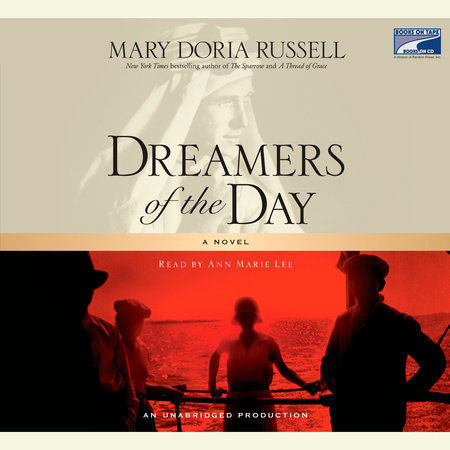
In Dreamers, for example, Agnes Shanklin wanted to speak directly. Mumma told her what to think and say and do all those years, and Agnes wasn’t having any more of that. This was her story, she was going to tell it, and I was politely told to get out of her way.
Problem was, Agnes was forty when she went to Egypt in 1921. That would’ve made her 127 when Dreamers was published, but the record for human longevity is 121. So rather than deny Agnes her voice or introduce a biological impossibility, I wound up writing a novel with a dead narrator.
It’s not like I thought, Hey! Magical realism might be a good career move after a Holocaust novel. The style and genre were dictated by the main character. As Agnes said, "If ghosts are good enough for Shakespeare and Garcia Marquez, they’re good enough for the likes of you, Mary."
RCT: Your novels always deal with one culture coming in contact with another. Your first two describe contact with an alien world. A Thread of Grace explores the Italian population coming into contact with Jewish refugees. How would you describe the cultural contacts in Dreamers of the Day?
MDR: Inept, arrogant, and destructive!
I wasn’t aware of this until just this moment–in the other novels, people are trying to do the right thing. They make mistakes, their good intentions may have tragic outcomes, but they’re trying to be decent.
The diplomats at the Cairo Conference weren’t trying to be moral or ethical–or courteous, even! Their goal was undisputed imperial domination of resource-rich colonies, guarded by military might and fueled by oil. You can see how well that worked out for everyone.
RCT: The Prelude in A Thread of Grace describes the unremarkable death of a woman under the care of a Jewish doctor, but that the woman’s child was Adolf Hitler. Dreamers of the Day also seems to be the unraveling of a similarly ordinary event that changed the course of our history.
MDR: Yes! I never thought of that, but you’re right. President Wilson came down with the flu, just like 55 million other people did, but he got sick the night before the Versailles Peace Conference was convened.
Now, maybe his Fourteen Points wouldn’t have passed anyway, but if he’d been healthy, Wilson might’ve negotiated a fairer conclusion of the Great War. We’ll never know, but there’s consensus among historians that the humiliating, vindictive terms of the Versailles Treaty led directly to World War II.
And the Cairo Conference was supposed to tidy up a few problems left over at Versailles. Eight decades later, Osama bin Laden said that the attacks on 9/11 were in part "to avenge the catastrophe of eighty years ago"–the 1921 Cairo Conference! So there’s a direct line between Wilson’s flu and the fact that my nephew, Lt. Tim Riemann, was commanding a platoon of Marines in Iraq’s Al Anbar Province when Dreamers of the Day was published.
Around the world, today’s headlines are rooted in nineteenth-century colonialism.
RCT: One day, historians may call the conflict that began in 1914 another Hundred Years’ War.
MDR: Yes, and this one may go on even longer. It certainly involves more people and vastly greater tragedy than the original.
RCT: All of your novels draw on detailed research into historical eras and other cultures–even The Sparrow, whose background is centuries of Jesuit exploration and research. Have you considered writing nonfiction?
MDR: Oh, honey, I did! Let’s see. . . . There was "A Reconsideration of the Evidence for Cannibalism at the Krapina Neandertal Site." That was a big hit. And who could ever forget "Cutmarks on the Engis II Calvarium"? Then there was "Browridge Development as a Function of Bending Stress in the Supraorbital Region." I got tons of reprint requests for that one. Trust me. Fiction is better.
RCT: In a previous interview, you discuss T. E. Lawrence’s influence on you as a writer and researcher. Was Dreamers of the Day an opportunity to pay homage to his influence on your life?
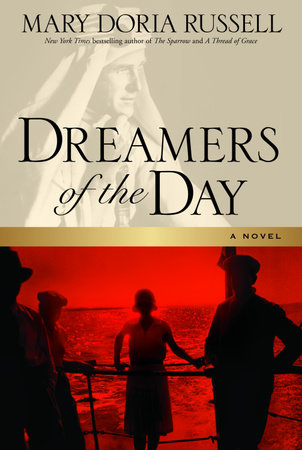
MDR: Oh, yes. Like so many boomers, I saw Lawrence of Arabia in 1962 when it was first released and when we were young teenagers. I’m not quite sure why–I really wish some psychologist would explain this–but that movie had a tremendous effect on many of us. I read Seven Pillars of Wisdom when I was too young to understand it, really, and all the biographies.
Lawrence became a sort of third parent during my adolescence. My mother was steel. My father was heart. Lawrence was scholarship. He widened my world and made it seem like a good idea to study foreign languages and get outside my own culture. Heady stuff for a girl growing up in Lombard, Illinois.
Lawrence was a working archaeologist in his early twenties, and that sparked my interest in the field I got my doctorate in. I ended up as a paleoanthropologist, though–I interpreted material that archaeologists dug up. It was indoor work, with no heavy lifting.
And the languages–what an impact that influence had! For one thing, while I was working on the Krapina Neandertal collection in Zagreb, my husband and I were permitted to adopt our son, Daniel, in part because I had studied Croatian. So Lawrence even made me a mom!
Yes, it was lovely making friends with Neddy–even fictionally!
RCT: You did significant historical research for this novel and A Thread of Grace, and your work in anthropology required rigorous research methods. How do you go about research for fiction?
MDR: I start with biographies. Well, actually–dialogue comes first. A character’s sense of humor or lack of it, the cleverness or stolidity of expression . . . I hear characters long before I see or understand them.
But then, to understand a character–real or imagined–I need biographies. I need to know about that person’s parents, too, and to understand the parents, I have to dig into their historical context as well. Time depth is crucial. So I try to study at least forty years of history prior to the novel’s period.
Each generation of adolescents has at least two historical events that color its responses to whatever happens next. My son’s generational events were the attacks on 9/11 and the wars in Afghanistan and Iraq. My generation’s were that awful series of assassinations–John F. Kennedy, Martin Luther King, Jr., and Robert F. Kennedy–and the Vietnam War. My parents’ events were the attack on Pearl Harbor and World War II. Before that, the Great War and the Great Depression.
War. Always war! The drumbeat of history, all the way back to Troy.
RCT: You have had remarkable success as a writer, winning awards as both an academic and a novelist. Has that changed your writing process?
MDR: It provided validation, and encouragement to follow my interests and curiosity wherever they lead, and I do that with a certain amount of conÞdence in the outcome and the response.
Look, if you start out by writing a novel that can be described as "Jesuits in space" and it works and gets a bunch of awards and keeps on selling year after year . . . Well, you can pretty much get away with anything after that!
RCT: When you finish a novel, do you miss the daily interaction with any of the characters, or are you glad to have them out of your hair?
MDR: You know, I was just thinking about this! The characters I’m most emotionally involved with are like friends you leave behind when you move away. You don’t see them regularly anymore, but you still love them and keep in touch. For example, Emilio Sandoz made a baseball fan out of me. Every summer we get in touch, if only to commiserate about how awful the season is this year!
Right now, I’m working on a murder mystery set in Dodge City in 1878 when the unlikely yet enduring friendship between Wyatt Earp and Doc Holliday began. It’s about risk, racism, and horse racing.
RCT: Wait–a murder mystery Western? Talk about not staying in the genre box!
MDR: I know, I know. Anyway, Doc is my new best friend. I am totally infatuated–but he’s dead, so it’s okay with my husband.
Doc played piano, and he’s introduced me to nineteenth-century piano concerti. And he got me to study Homer and Virgil. I can’t read the classics in Greek and Latin, which Doc did, but I was able to use T. E. Lawrence’s translation of The Iliad. It’s very good, and it was an opportunity to get back in touch with another old friend!
My characters always teach me things, and they remain a part of my life even when I move on.
Doc just breaks my heart. It’s so different, having a real person as a main character! I did terrible things to Emilio Sandoz, but I could give him a daughter and a grandson and the fictional prospect of a contented old age at the end of Children of God.
Nothing I write can change Doc’s fate. That poor soul is going to die of tuberculosis, destitute and alone and in misery. At thirty-six, he’ll be buried in an unmarked pauper’s grave, fifteen hundred miles from home, and I can’t do anything for him–except maybe win him some of the respect and compassion I think he deserves.
RCT: Thanks, Mary.
MDR: It was a pleasure, hon. Always fun to talk with you!




 QUICK VIEW