



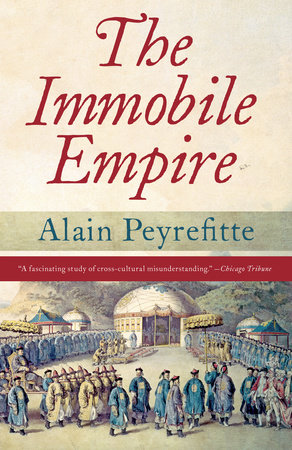

The Immobile Empire
By Alain Peyrefitte
By Alain Peyrefitte
By Alain Peyrefitte
By Alain Peyrefitte
Category: Asian World History | European World History | Domestic Politics | World Politics
Category: Asian World History | European World History | Domestic Politics | World Politics
-
$25.00
May 21, 2013 | ISBN 9780345803955
-
May 21, 2013 | ISBN 9780345803948
YOU MAY ALSO LIKE
 QUICK VIEW

Journey to the Vanished City
QUICK VIEW
A Brief History of the Caribbean
QUICK VIEW

The Battle For History
QUICK VIEW

Playing with Fire
QUICK VIEW
Roosevelt and Stalin
QUICK VIEW
The Enigma of Japanese Power
QUICK VIEW

All Elevations Unknown
QUICK VIEW
The Lost Art of Drawing the Line
QUICK VIEW

The Seduction of Place
QUICK VIEW

Yearning for the Land
Praise
Praise for Alain Peyrefitte’s The Immobile Empire:
“A fascinating study of cross-cultural misunderstanding.”
—The Chicago Tribune
“A rollicking good story with obvious and immediate parallels for today.”
—The American Spectator
“Extraordinary . . . at once a marvelous adventure tale, a dramatic reenactment of a decisive confrontation between East and West and a revealing comparative study of two cultures, each believing itself the world’s most civilized.”
—Publishers Weekly
“An elegant, illuminating and delightful book.”
—South Florida Sun-Sentinel
“Painstakingly researched, gracefully written. . . . A smooth translation. . . . Peyrefitte’s nearly day-by-day account will fascinate Sinologists and students of East-West affairs.”
—Kirkus Reviews
21 Books You’ve Been Meaning to Read
Buy Now


Just for joining you’ll get personalized recommendations on your dashboard daily and features only for members.
Find Out More Join Now Sign In