Author Q&A
Q: Tell us about the title, SWIM BACK TO ME.
A: The phrase “Swim Back to Me” appears as a title of a song in one of the stories, “Molten,” in which a mother grieves the loss of her teenage son by listening to his music. I wrote this story in the late nineties, during a period in my life when I was rediscovering the world of rock and roll through the mix tapes a writing student of mine was making for me. It had been a decade or so since I’d paid attention to much music beyond Raffi’s songs for children, and when I began listening to the Pixies and Pavement and Superchunk, I was overwhelmed by the power of the songs and the enchantment I felt listening to them. I wrote the story under the influence of that enchantment, using a mother’s loss as the emotional setting to explore the transformative power of an intense aesthetic experience.
Fast forward ten or eleven years, and I was finishing the book and needed a title. I wanted to avoid naming the book after one of the individual pieces, since that would have emphasized a part over the whole, and I wanted something that worked thematically for the entire book. I was really at a loss, casting about, picking the brains of friends, when the idea of using the phrase Swim Back to Me suddenly popped into my mind. As with many ideas that later become important, I can remember exactly where I was when I had the thought—on a highway in Auburn, CA, researching the setting of another of the stories, “Dwell Time”—and what made the phrase so powerful was the combination of darkness and light that it contained: the addressee is gone but is capable of returning. For me, that spoke to the book’s themes, and in particular to the idea that new connections and ties can only be made with an eye to what’s come before.
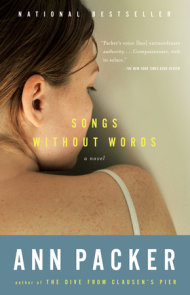
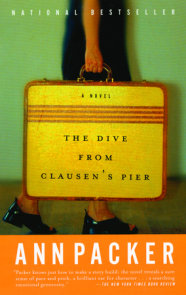
Q: Let’s talk about some of those themes. Unlike your last two books, bestselling novels The Dive from Clausen’s Pier and Songs Without Words, this one isn’t unified by a single plot. What sensibility joins these six shorter works?
A: I’m drawn to writing about people who find themselves in situations that challenge their assumptions about who they are and how they can and do live their lives. Richard, the narrator of “Walk for Mankind,” the novella that opens the book, is living the somewhat isolated life of a young teenager trying to make sense of his family’s disintegration and the ways in which it has changed his life. The novella is about what happens when, through a new family, he discovers a different world, more vibrant than any he’s known, and he has the opportunity and the task of figuring out if he wants to give it a try. In “Her Firstborn,” the impending birth of a baby unfolds against the aftermath of another child’s death.
Loss is obviously a big theme for me, and in these stories my characters deal both with loss of the actual—divorce, the deaths of loved ones—and also loss of their dreams, by which I mean the stories they’ve told themselves about how life will go. And lest this seem grim, I mean the loss both of positive stories—stories of long and happy marriages, for example—and also negative ones, stories in which pessimism has played such a central part that good fortune and possibility can be so surprising as to be initially uncomfortable. Another way to put all of this is that I’m fascinated by deception, both the kind we practice on each other and the kind we feel so compelled to practice on ourselves.
Q: The stories in SWIM BACK TO ME are written from very different points of view, some of which you’re already introduced: a young boy on the brink of his teen tears, a grieving mother, a divorced, middle-aged woman who is newly re-married and an expectant father. Is it difficult to create and inhabit so many disparate characters, many with life experiences very different from your own? Or is it all the more fun?
A: It is usually the case that everything occurs to me at once—plot, character, setting, voice—and no aspect is more or less difficult than any other. For “Her Firstborn,” the oldest of these stories, the main character, Dean, began to come together only as I wrote the first paragraph and imagined his awkwardness about taking bed pillows to a childbirth class. “Walk for Mankind” began more unusually for me, in that I had the main character’s general experience of meeting a new, exciting family with a very charismatic girl, before I had the main character himself—that is, before I knew to whom the events were happening. In fact, the narrator, Richard, came to me only after I’d flailed around with a female narrator and then set the whole thing aside when I couldn’t make it work. As soon as I began writing from Richard’s point of view and in his voice, the piece gathered momentum . . . or maybe I mean that I did.
Q: Many of the stories also have teenagers in common—from a pair of best friends in the Bay Area of the 1970’s in the opening novella, to the phantom but very visceral presence of a deceased son in “Molten,” and the many authentic teenage sons and daughters that make up families throughout the book. What about the moment of adolescence keeps drawing you back?
A: Adolescence marks such a turning point in life; after years of depending on and idealizing our parents, or at least conceiving of them as all-powerful, in the teen years we experience a dawning recognition of their limitations and of our own latent power—be it intellectual, physical, or sexual, to name just a few kinds. And of course it’s an important moment in terms of self-definition, which comes in part through an increase of self-awareness: who am I, and who am I in relation to others?
My previous work features a lot of teenagers, from the barely post-adolescent Carrie Bell in The Dive from Clausen’s Pier to the troubled daughter Lauren and her younger brother Joe in Songs Without Words. In this book I enjoyed creating teenagers from two very different time periods: the early 70s, when I was a teen, and today, when the teenagers I know best are my children.
Q: Let’s circle back to Richard and Sasha, the teenagers from “Walk for Mankind.” In the final story in the book, “Things Said or Done,” we meet Sasha and her family again, thirty-five years later. Did you always know you’d return to this family at the end of the book? And what made you choose the novella form for the former and the short story form for the latter?
A: It was always my intention to open with “Walk for Mankind” and to close with a return to its characters, but for a long time I didn’t know how I’d do that. I knew I’d focus on Sasha and her father—I started with his voice, complaining to her that he thinks he’s dying—but I didn’t know Richard would be absent entirely, and it took me several drafts to invent the wedding where the story is set.
As for form, in both cases—in all cases, in fact, including my novels—the material itself dictates the form. I didn’t set out to write a novella with “Walk for Mankind,” but I knew pretty quickly, once I’d begun, that I was working on something longer than a short story but shorter than a novel. I haven’t made a study of it, but “novella” may be more a term of convenience than a form with certain properties: it’s a work of fiction of around a hundred pages.
Q: You have been credited with a “wonderfully optimistic yet realistic view of humanity” (Chicago Tribune). SWIM BACK TO ME certainly tackles the gritty realities of living—grief, self-doubt, loss—but also weddings and births and self-discovery, all without obviously “good” or “bad” endings. Is there any message you want your readers to take away? And do think this quote is an accurate description of your outlook?
A: I hope it’s an accurate description. I think I’m realistic—certainly it is important to me to portray the messiness and challenges of life, along with the joys—and I think I’m optimistic as well. What I mean is that I think redemption is possible (though by no means guaranteed), and after putting my characters through some difficult experiences I am open to, if not looking for, ways to leave them positively altered, if only by an increase in awareness.
It’s funny—looking back at this answer, I can see how it mirrors the Chicago Tribune description in that with nearly every phrase I introduce a qualification or counterpoint. I’ll have to think about what that might mean.
Q: The book is dedicated to your brother, George Packer, the journalist and New Yorker staff writer. How did you both end up being writers? Was literature important in your family?
A. We grew up in an academic family—both of our parents were professors at Stanford—and both literature and politics (one of George’s particular areas of interest) were very, very important. Certain writers had the stature in our family that famous athletes might have in families full of sports fans, and we debated the relative merits of Faulkner and Hemingway in much the same way that people might argue over who was greater, Babe Ruth or Ty Cobb. I was fortunate enough to have a wonderful library twenty steps from my bedroom, and I have no doubt that my early immersion in imaginary worlds was an important factor in my becoming a writer.
Q: What are you working on now?
A: I’m in the very early stages of a new novel. At this point, it’s so fragile I can’t really talk about it, though I can say that it’s set here in my native Bay Area, which more and more is the setting for my work—Songs Without Words took place here, and of the six pieces in Swim Back to Me, four take place within 50 miles of where I sit and type. Looking back on my career, I can see that I’ve tended to write about places I’ve recently lived—when I wrote The Dive from Clausen’s Pier I’d just moved away from Madison, WI, and before that had lived in Manhattan—and because I’ve been back in the San Francisco area, where I was born, for 15 years, it’s the place I lived recently and the place I live now.





 QUICK VIEW