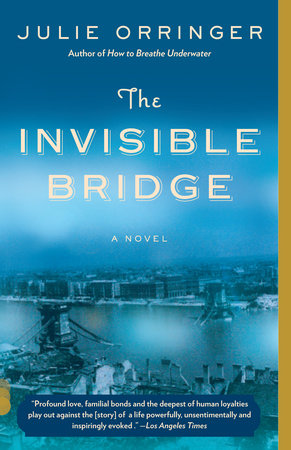
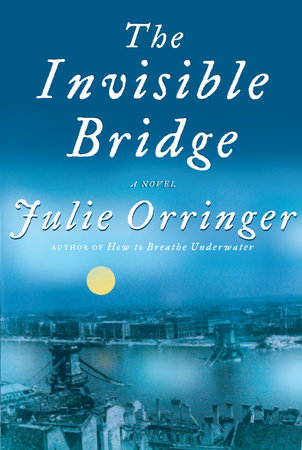
Paris, 1937. Andras Lévi, a Hungarian-Jewish architecture student, arrives from Budapest with a scholarship, a single suitcase, and a mysterious letter he promised to deliver. But when he falls into a complicated relationship with the letter's recipient, he becomes privy to a secret that will alter the course of his—and his family’s—history. From the small Hungarian town of Konyár to the grand opera houses of Budapest and Paris, from the despair of Carpathian winter to an unimaginable life in labor camps, The Invisible Bridge tells the story of a family shattered and remade in history’s darkest hour.
Excerpted from The Invisible Bridge by Julie Orringer. Copyright © 2010 by Julie Orringer. Excerpted by permission of Vintage, a division of Random House, Inc. All rights reserved. No part of this excerpt may be reproduced or reprinted without permission in writing from the publisher.
Julie Orringer is the author of the award-winning short-story collection How to Breathe Underwater, which was a New York Times Notable Book. She is the winner of The Paris Review’s Discovery Prize and the recipient of fellowships from the National Endowment for the Arts, Stanford University, and the Dorothy and Lewis B. Cullman Center for Scholars and Writers at the New York Public Library. She lives in Brooklyn, where she is researching a new novel.
A conversation with
JULIE ORRINGER
author of
THE INVISIBLE BRIDGE
What was your inspiration for THE INVISIBLE BRIDGE?
Ten years ago, a few weeks before I went to Paris for the first time, my grandfather told me he’d lived in that city for two years when he was a young man. That was the first I’d heard of it. He told me he’d been accepted to architecture school on a scholarship in 1937, but had to quit when the war began. Because he was Jewish, and a Hungarian citizen, he was conscripted into the Hungarian labor service and lost his student visa.
Before that moment I’d never known he’d trained to be an architect. He’d been a window dresser for Sears Roebuck and Co. for thirty years: that was what I knew of his professional life. His war experience was even more patchy and abstract in my mind: he’d been in and out of forced labor camps, I knew, but I’d heard nothing about what he’d experienced and witnessed there.
Over the weeks and months that followed, he and I began to talk about that time of his life—how he’d won the scholarship; what it had been like for him, a Jewish boy from rural Hungary, to move to Paris; how he’d survived there; what he’d studied; where he’d lived; who his friends were; why he’d had to leave. Then I started asking about what had happened during the war. Those questions gave rise to a cascade of stories, events that no one in our family had ever spoken of—what his time in forced labor had been like, how his relationship with my grandmother had developed during his furloughs, how his own brothers had been conscripted, imprisoned, and killed. As I listened, it occurred to me that few Americans knew the fate of the Hungarian Jews during the war—Hungary wasn’t occupied by Germany until spring of 1944, its Jewish population left mainly intact until the Final Solution had become such an efficient machine that it did away with more than half of Hungary’s Jews in a matter of months.
As we talked, a narrative began to take shape in my mind—not one that followed my grandfather’s experience exactly, but one that began in 1937 with a young Hungarian Jewish man and a scholarship to architecture school in Paris, and that extended through the war years. I knew the story had the shape and scope of a novel. I had imagined I might always be a short-story writer, but this was a tale that demanded telling.
Did you do any special research while writing the book?
I had long talks with both of my Hungarian grandparents and with my grandfather’s younger brother, Alfred, who had been imprisoned in Siberia. I took one research trip to Paris and Budapest before I began writing, and another trip three years later, after I’d written most of a first draft and had a better sense of what I needed to know in order to finish the novel. I spent a lot of time in those cities getting to know the neighborhoods where my grandfather had lived, the places he’d studied and worked, the streets he’d walked. In the National Hungarian Archives in Budapest, I met a scholar who recommended the works of Randolph Braham, a professor emeritus at CUNY and a former forced labor inmate himself, who had devoted his professional life to studying the Holocaust in Hungary. In those same archives I came across amazing documents: photographs, letters, and—most surprising—dozens of handwritten underground newspapers produced by the forced labor inmates, full of bawdy dark humor. Laughter in the face of death: that was what I’d least expected to find. I knew those newspapers had to be part of the book.
I met other Holocaust survivors and heard their stories; read dozens of books about the war; watched many hours of the Shoah Foundation’s videotaped interviews; listened to radio programs from the 1930s and 40s; pulled artifacts from the reserves of the United States Holocaust Memorial Museum; got to know the maps librarian at the New York Public Library; watched wartime films and films about the war; scoured the Internet; and spent many more hours talking to my family about their experiences. Novels like Jeff Eugenides’s Middlesex and Michael Chabon’s The Amazing Adventures of Kavalier and Clay provided inspiration: evidence of how good research could fertilize good fiction.
After Andras, which characters came to you first? Who was the most difficult to write, and who was the easiest?
Andras and Tibor and Mátyás came into being all at once—each brother’s character is shaped by the others, and shapes the others. I knew that the eldest brother would be more serious, the youngest more prone to flights of fancy; I knew, too, that of all three, Andras’s character would change the most over the course of the novel.
From the beginning I knew that Andras would fall in love, but it came as a surprise to me that he would fall in love with Klara, a woman nine years his senior, instead of with her sixteen-year-old daughter. (The idea presented itself one morning in San Francisco as I was washing the breakfast dishes.) Another surprise was Madame Gérard, who at first seemed solicitous and helpful, but whom I later discovered was jealous, vain, capricious, and prone to schadenfreude. József Hász, too, began in my mind as merely a self-centered frivolous sybarite, but became truly dangerous as the novel unfolded.
How do you create such three-dimensional characters, each with their own vivid and complicated pasts?
I’m glad the characters feel three-dimensional. Certainly each one took a long time to get to know, and evolved in my mind over a span of years. As soon as I knew that Klara was thirty-one when the novel started and had a sixteen-year-old daughter, I knew her past must hold some terrible secret. But it was quite a while before I knew what the secret was, and longer still before I knew how it would affect Andras and his family. As for Andras’s own history, when I first started the novel I wrote many pages about his village and his childhood home and his parents; almost none of that material remains in the final version, but it helped me understand who he was and where he came from. I wanted readers to feel that the characters’ lives extended beyond the scope of the novel in both directions, so I felt I had to know what happened to them before and after the events described in the book.
Tell us a little about your writing process—how you write, when, etc.
Years ago, when I was a Stegner Fellow at Stanford, the writer Tim O’Brien came to talk to us about his work and his writing process. When he told us he wrote for eight hours a day, we all thought he was either crazy or lying. At the time, I wrote for around half that many hours, and it was exhausting. But now I work for eight hours a day, too—and it seems crazy that at one time, three or four hours felt like enough. Especially with this novel, the continuity seemed important—it helped so much to be able to work through a long section, or read and edit an entire chapter, in a single day. Time at colonies helped a great deal too; over the course of the seven years that I worked on this book, I spent about three months at MacDowell and two at Yaddo. There, all distractions were removed except the social ones, which were optional and welcome, and the natural ones (i.e., the woods, the ponds, the mountains), which were helpful to the work.
At home in Brooklyn I have a writing studio in the brownstone next door, a third-floor room that looks out over the garden. There’s a desk, a bookcase, a chair, a bed, three windows, and an automatic teapot. On the walls are old photos, maps, and postcards; on the desk, a miniature complete Shakespeare, each play separately bound; a little glass caterpillar; a wooden dog; silly pictures of my brother and sister; a childhood picture of my husband; a few books. Mornings are usually for revision, afternoons for composition. When I’m working on something new or difficult, I like to write late at night—the hours between 10 p.m. and 3 a.m. feel particularly private and permissive.
Theater and ballet play peripheral but significant roles in the lives of some of the characters in THE INVISIBLE BRIDGE. How did these art forms find a way into your novel?
Both forms are close to my heart. I began studying ballet when I was four, and acting in plays when I was seven or eight. In high school I spent more time in theaters than at home (and certainly more time acting, directing, and writing plays than I did writing fiction). The theater initially came into the novel because of a real-life connection—my grandfather worked as a gopher at the Théâtre Sarah-Bernhardt when he lived in Paris—but I don’t think it would have played such a significant role in the novel, or become so important to the characters, had it not been for the fact that I loved the stage and spent so much time in the theater as a young person. Ballet seemed a natural choice too—I knew something of its pleasures and its language (though I found I had to learn a great deal more as the novel progressed).
1. What does the opening chapter establish about the cultural and social milieu of prewar Budapest? What do Andras’s reactions to the Hász household reveal about the status of Jews within the larger society? How do the differences between the Hász and Lévi families affect their assumptions and behavior during the war? Which scenes and characters most clearly demonstrate the tensions within the Jewish community?
2. Why do Andras and his friends at the École Spéciale tolerate the undercurrent of anti-Semitism at the school even after the verbal attack on Eli Polaner (pp. 48–50) and the spate of vandalism against Jewish students (p. 118)? To what extent are their reactions shaped by their nationalities, political beliefs, or personal histories? Why does Andras agree to infiltrate the meeting of Le Grand Occident (pp. 121–27)? Is his belief that “[the police] wouldn’t deport me . . . Not for serving the ideals of France” (p. 128), as well as the reactions of Professor Vago and Andras’s father to the German invasion of Czechoslovakia (p. 337) naïve, or do they represent widespread opinions and assumptions?
3. Andras and Klara’s love blossoms against the background of uncertainties and fear. Is Klara’s initial lack of openness about her background justified by her situation? Why does she eventually begin an affair with Andras? Are they equally responsible for the arguments, breakups, and reconciliations that characterize their courtship? Do Klara’s revelations (pp. 270–96) change your opinion of her and the way she has behaved?
4. Despite the grim circumstances, Andras and Mendel produce satirical newspapers in the labor camps. What do the excerpts from The Snow Goose (p. 419), The Biting Fly (pp. 457–58), and The Crooked Rail (p. 454–55) show about the strategies that helped laborers preserve their humanity and their sanity? What other survival techniques do Andras and his fellow laborers develop?
5. In Budapest, the Lévi and Hász families sustain themselves with small pleasures, daily tasks at home, and, in the case of the men, working at the few jobs still available to Jews (pp. 446–50, 464–78, and 514–21). Are they driven by practical or emotional needs, or both? Does the attempt to maintain ordinary life represent hope and courage, or a tragic failure to recognize the ever-encroaching danger? What impact do the deprivations and degradations imposed by the Germans have on the relationship between the families? Which characters are the least able or willing to accept the threats to their homeland and their culture?
6. What details in the descriptions of Bánhida (pp. 451–61 and 498–506), Turka (pp. 618–638), and the transport trains (pp. 709–19) most chillingly capture the cruelty perpetrated by the Nazis? In addition to physical abuse and deprivation, what are the psychological effects of the camps’ rules and the laws imposed on civilian populations?
7. General Martón in Bánhida (pp. 506–11), Captain Erdó, and the famous General Vilmos Nagy in Turka all display kindness and compassion. Miklós Klein engages in the tremendously dangerous work of arranging emigrations for fellow Jews (pp. 536–37). What motivates each of them to act as they do? What political ideals and moral principles lie at the heart of Nagy’s stirring speech to the officers-in-training (pp. 641–43)? (Because of his refusal to support official anti-Semitic policies, Nagy was eventually forced to resign from the Hungarian Army; in 1965, he was the first Hungarian named as a Righteous Among the Nations by the Yad Vashem Institute.)
8. Why does Klara refuse to leave Budapest and go to Palestine (p. 647–48)? Is her decision the result of her own set of circumstances, or does it reflect the attitudes of other Jews in Hungary and other countries under Nazi control?
9. “He could no sooner cease being Jewish than he could cease being a brother to his brothers, a son to his father and mother” (p. 57). Discuss the value and importance of Jewish beliefs and traditions to Andras and other Jews, considering such passages as Andras’s feelings in the above quotation and his thoughts on the High Holidays (pp. 253–57); the weddings of Ben Yakov and Ilana (pp. 323–24) and of Andras and Klara (p. 401–2); the family seder in wartime Budapest (pp. 446–50); and the prayers and small rituals conducted in work camps.
10. The narrative tracks the political and military upheavals engulfing Europe as they occur. What do these intermittent reports demonstrate about the failure of both governments and ordinary people to grasp the true objectives of the Nazi regime? How does the author create and sustain a sense of suspense and portending disaster, even for readers familiar with the ultimate course of the war?
11. Throughout the book there are descriptions of Andras’s studies, including information about his lessons and the models he creates and detailed observations of architectural masterpieces in Paris. What perspective does the argument between Pingsson and Le Corbusier offer on the role of the architect in society (pp. 354–47)? Whose point of view do you share? What aspects of architecture as a discipline make it particularly appropriate to the themes explored in the novel? What is the relevance of Andras’s work as a set designer within this context?
12. Andras’s encounters with Mrs. Hász (p. 7) and with Zoltán Novak (pp. 23–24) are the first of many coincidences that determine the future paths of various characters. What other events in the novel are the result of chance or luck? How do the twists and turns of fortune help to create a sense of the extraordinary time in which the novel is set?
13. Does choice also play a significant role in the characters’ lives? What do their decisions—for example, Klara’s voluntary return to Budapest; György’s payments to the Hungarian authorities; and even József’s attack on Andras and Mendel (p. 625)—demonstrate about the importance of retaining a sense of independence and control in the midst of chaos?
14. The Holocaust and other murderous confrontations between ethnic groups can challenge the belief in God. Orringer writes, “[Andras] believed in God, yes, the God of his fathers, the one to whom he’d prayed . . . but that God, the One, was not One who intervened in the way they needed someone to intervene just then. He had designed the cosmos and thrown its doors open to man, and man had moved in. . . . The world was their place now” (p. 549). What is your reaction to Andras’s point of view? Have you read or heard explanations of why terrible events come to pass that more closely reflect your personal beliefs?
15. What did you know about Hungary’s role in World War II before reading The Invisible Bridge? Did the book present information about the United States and its allies that surprised you? Did it affect your views on Zionism and the Jewish emigration to Palestine? Did it deepen your understanding of the causes and the course of the war? What does the epilogue convey about the postwar period and the links among past, present, and future?
16. “In the end, what astonished him most was not the vastness of it all—that was impossible to take in, the hundreds of thousands dead from Hungary alone, and the millions from all over Europe—but the excruciating smallness, the pinpoint upon which every life was balanced” (p.709). Does The Invisible Bridge succeed in capturing both the “vastness of it all” and the “excruciating smallness” of war and its impact on individual lives?
17. Why has Orringer chosen “Any Case” by the Nobel Prize–winning Polish poet Wislawa Szymborska as the coda to her novel? What does it express about individuals caught in the flow of history and the forces that determine their fates?
(For a complete list of available reading group guides, and to sign up for the Reading Group Center e-newsletter, visit www.readinggroupcenter.com.)