Author Q&A
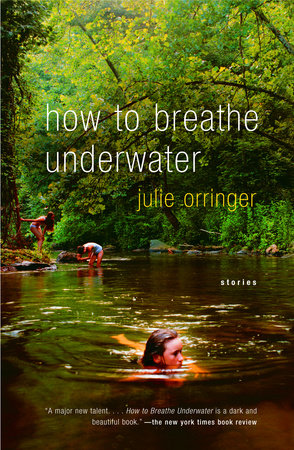
A Conversation with Julie Orringer
Q: Each of the nine stories in your collection focuses on a different young girl—child or adolescent. Reading about them puts one instantly back into one’s own childhood, you capture their voices and concerns so perfectly. Was writing these stories as an adult difficult?
A: I’m fortunate enough to have a younger brother and a much-younger sister—five and eight years younger, respectively—so I had a kind of extended lifeline to childhood and adolescence even as I left that part of my life behind. I also started writing stories pretty early on, and so I think I always paid attention to the way other kids thought and spoke. Nonetheless, it’s always hard to write about kids. You want to do justice to their intelligence and perceptiveness, but at the same time their confusions and misperceptions are fascinating as well. Being a child means being embroiled in a constant struggle to figure out how the world works and how you fit into it. As we watch that process from the comfortable distance of adulthood, we’re often apt to romanticize or simplify the struggle. In reality, though, it’s often painful and brutal and tragic, and it’s one of the most important tasks we have as human beings.
Q: What drew you to writing about this period in life—the complicated terrain between childhood and adulthood?
A: There seems to be so much emotional danger in this part of a young person’s life. Oftentimes the most difficult events—death, illness, change, acts of cruelty against us—hit us before we’ve gained the maturity to understand them. In many of the stories, young women face a task that sometimes seems impossible: they must re-create themselves as adults and learn to survive in a world that confronts them with difficult decisions or with awful truths about the fallibility of human beings. They must learn to hold onto the familial, romantic, and companionate love in their lives, even when that love involves significant emotional risk. In the end, I hope the book suggests that our parents, our siblings, and our friends can be sources of strength and understanding, if we’re willing to accept their limitations and flaws. And I hope the book also suggests that we can look back with compassion and understanding upon our younger selves, upon the stupid things we did as young people. Most of the time we were doing the best we could.
Q: Please talk about the circumstances of your childhood.
A: I lived a kind of nomadic childhood in which reading and writing were always of primary importance. I was born when my parents were third-year medical students at the University of Miami. Despite their long working hours, they spent a lot of time playing with me and reading to me. From the time I was maybe two years old, my father sat down with me and told me stories, which he wrote down on tiny pieces of index card and stapled into miniature books. After a while, he let me tell the stories while he wrote them down. I still have them. They have titles like The Bowling Party and The Funny Blue Car.
When I was four, we moved to Boston while my parents studied at Harvard. We lived in a tiny apartment on a leafy street just a few blocks from my public school. Boston was wonderful—there was sledding, and a library close by, and the Children’s Museum, and we drove to Cape Cod and the White Mountains and Tanglewood. My brother was born. Life was good. Then I turned six and we moved to New Orleans, where the public schools were dismally inadequate and the city was still largely divided along racial lines. At my new private school, I found myself at the bottom of the social hierarchy. I had the wrong clothes, the wrong accent, and even, for a year, had to wear an eye patch to correct my amblyopia—social death for a second-grader. To make matters worse, both my parents actually worked for a living. And I was Jewish. My class contained a few Jewish kids, to be sure, but the school’s main celebrations centered around Christmas, Mardi Gras, and Easter. Our school mascot was the crawfish, an unknown beast within my family’s kosher home.
Due to these circumstances, and probably also due to the fact that I was a year younger than my classmates, I soon became a pariah at that school. My dearth of friends and the many recess hours I spent at the library gave me plenty of time to develop an inner life; I devoured books and loved to write. My favorite novels had young writer-girls as their heroines: Sara Crewe, the story-spinning heroine of A Little Princess; Jo March of Little Women; Laura Ingalls Wilder; and Betsy of Maud Hart Lovelace’s Betsy-Tacy series. In a life more or less devoid of real friendship, these fictional heroes were my closest companions, my big sisters, my role models. From a very early age, I began to envision a life in which what I most wanted to do was write books.
Lucky for me, when I was in eighth grade my family moved to Ann Arbor and I went back to public school. There, one seemed to care how much money your parents made or whether you were Jewish or Muslim or Hindu or Christian. Black and white kids went to school together, lived on the same block, played on the same teams, acted in the same plays. It was a shock to realize that news of my social-pariah status had not reached Ann Arbor. Soon my group of friends included real live human beings, not just characters in books. Ann Arbor was a quiet safe place to grow up. Our idea of a risky afternoon was skipping Orchestra to eat ice cream downtown. My friend Sarah and I thought ourselves very cosmopolitan when we went to the University of Michigan art museum and then drank Italian coffee at a café. Things did get a little crazier as I got older and my friends and I began to spend time in and around Detroit, but that’s a different story…
Q: You explore the impact of loss of parents in a couple of the stories. Please talk about why this theme interests you.
A: My mother was diagnosed with metastatic breast cancer when I was ten years old. So my childhood was infused with the awareness that I might lose my mother, that health was an unreliable thing, that death was real and immediate. My mother did everything she could to fight her cancer—chemotherapy, radiation, a strict Macrobiotic diet—and she lived with the disease for ten years. In the stories, I found myself returning many times to the idea of loss, of instability, of outsiderhood, that comes with having a terminally-ill parent. In “Pilgrims,” the young protagonist is only beginning to accept the realness of her mother’s illness and possible death; there’s been an irrevocable change in her life, and the stability of the time before her mother’s diagnosis will never return. In “What We Save,” a teenage girl faces the fact of her mother’s imminent death, and tries to understand her mother’s need to see a former boyfriend one final time; these difficult circumstances are superimposed upon the background of Disney World, where the family is taking a vacation. My family did in fact travel to Disney World when my mother was very ill—though not as far along in her illness as the mother in that story—and it seemed to me that the brightness and optimism of the theme park threw our family’s situation into sharp, painful relief. I never forgot that feeling and always wanted to write about it.
Q: The cruelty of children towards one another, the power of peer pressure, the careless way in which young boys take advantage of girls sexually, remind us that childhood is not always an innocent state.
A: Indeed not. We all know, having been kids at some point, how awful children can be to one another. We’ve all been tormented on the bus or teased for our stupid haircuts or beaten up in a parking lot. Kids can be astoundingly original and subtle in the torments they devise for one another. They can also be quick to appropriate adult behavior long before they’re ready to accept its consequences. In one of the stories, “Stars of Motown Shining Bright,” a girl has decided she’s going to run off to California, where she plans to live with her older boyfriend and pose for explicit magazines. She’s operating on an idealized, hypersexualized view of herself that has a lot more to do with what she thinks the boyfriend wants than what she wants herself. In fact, she comes from a rather protected suburban milieu, where she’s incapable of envisioning the hard, plain adult realities toward which she’s launching herself. A friend who’s seen some of those realities eventually reins her in. But I didn’t always think this story would turn out well for anyone involved. Oftentimes, in real life, there’s no friend stepping in to turn things around.
Q: In that same story (after a bizarre evening involving sex and a loaded gun), 16-year-old Melissa says, “I feel sorry for our parents, they have no idea what goes on.” And in CARE, six year old Olivia is entrusted by her mother into the hands of an irresponsible, drug-addled aunt. Are parents in the dark about much of what goes on in childhood?
A: I don’t think parents are at all in the dark about what goes on in childhood and adolescence. I think they often know a great deal more about what goes on than kids realize. But maybe there are things parents would rather not acknowledge, truths they’d prefer not to face. It’s got to be incredibly frightening to see your child venturing off into the world to make her own discoveries and mistakes.
Q: What in your own life made you want to become a writer?
A: A million things, I suppose. All that early reading and writing. A love of narrative. I was always intensely curious about what went on between human beings and how experiences change us. Through my own early reading I entered new worlds and found a kind of compassion and understanding that was rare in my life at the time. Much later, at Cornell, I had some wonderful professors who began to talk to me about how it might be possible to construct a life around writing. I’d never considered such a thing, since both my parents were doctors. Did people actually write for a living? During my junior year, Denis Johnson came to give a reading from Jesus’ Son; he talked about the Iowa Writers’ Workshop and his early writing experiences, and I read his book and loved it. Soon after, I started reading all the contemporary fiction I could get my hands on—Raymond Carver, Charles Baxter, Mona Simpson, Tobias Wolff, Lorrie Moore, Alice Munro—I became a junkie, and never looked back. I was a stubborn young person. Despite my professors’ advice to spend some time out in the world, I went to Iowa directly after college. Then came some years of misery, when I was living and working in San Francisco, not yet a writer and not really even an adult. Stanford and the Stegner Program saved me, and my professors and fellow students helped me to mature as a writer.
Q: Why do you write short stories?
A: I like working in both short and long forms, but I feel like the short story is a particularly good medium for learning to write fiction. As a new writer, I think it’s important to feel as if you can take wild risks and make mistakes without incurring devastating losses of time. The short form is perfect for that. I probably wrote thirty short stories during the years in which I wrote the nine that eventually made it into the collection. It was a relief to be able to strike certain stories up to experience and then put them away forever. I’ve also always loved reading short stories. I love the ones that are austere and efficient and compact, like Carver or Tobias Wolff or Yukio Mishima or Flannery O’Connor, and I also love the longer stories that move around in a larger space, like the work of Alice Munro or Katherine Anne Porter or George Saunders. I love the novel too, and am working on one now.
Q: Your husband Ryan Harty is also a writer of short stories, which a collection coming out this fall. Do you consider this to be an odd coincidence?
A: In many ways it’s an incredible coincidence, and yet somehow it doesn’t seem strange at all. We never planned or expected to have first books coming out at the same time, though I suppose we always knew it was a possibility; we met at the Iowa Writers’ Workshop in 1996 and have been together ever since. Later we were both at Stanford. Our writing lives have followed amazingly similar tracks. In addition to being an incredibly talented writer, Ryan has always been a fantastic reader for me—honest and demanding and sensitive. Writing fiction is a lonely and scary endeavor, and it’s an unspeakable relief to be able to share the good and bad times with my best friend. I’m so excited to see his wise, beautiful collection, Bring Me Your Saddest Arizona, coming out into the world.
Q: Is there a literary community in San Francisco? Is it important for you to associate with a literary community (ie at Iowa for example)?
A: San Francisco has a fantastic literary community, of course—one with a rich and varied history. These past few years in particular, an incredible amount of energy has gathered around the Bay Area literary scene. The Stegner Program at Stanford has produced writers like Tom Barbash, ZZ Packer, Michael Byers, and Adam Johnson; McSweeney’s, the Believer, and 826 Valencia are here, with the literary and humanitarian energies of Dave Eggers and Vendela Vida behind them. Zoetrope moved to San Francisco, and editor Tamara Straus has consistently offered panels and readings and other literary events to the Bay Area community. Independent bookstores thrive here. The San Francisco Chronicle has expanded its book section and hired reporters exclusively to cover the literary community. People take writing classes through the Stanford Continuing Studies Program, the Berkeley Extension, and the California College for Arts and Crafts. Private workshop groups abound. Litquake, a citywide celebration of writing that features readings by scores of Bay Area authors, has nearly tripled in size in its second year. In short, it’s an explosion. I’ve lived here for seven years and I’ve never seen anything like it. Perhaps it has something to do with the Internet bust; this town used to be nearly unlivable for emerging artists, but in the Bay Area’s new quieter economic climate, the arts have flowered.
Q: You teach creative writing at Stanford. What is your best advice to young writers— about writing, and about what it takes to get published?
A: One of the first things I’d tell beginning writers (I don’t want to restrict any of these suggestions to “young writers,” since many of the best emerging writers I’ve worked with have been in their forties, fifties, and sixties) is not to concern themselves primarily with getting published. Instead, they should focus upon the writing itself and how to make it better. They should read as much as possible, immerse themselves in the company of other writers, go to readings, take classes. They should set up a writing schedule and then stick to it. They should seek out good books on craft, like Janet Burroway’s Writing Fiction and John Gardner’s The Art of Fiction. And they should read literary magazines that publish work by emerging writers.
I encourage my students to take chances in their work, and not be afraid to throw stories away. But new writers should also teach themselves to be assiduous revisers. Oftentimes you might not discover what a story is really trying to do until the third or seventh or tenth draft. It’s important to realize that the study of fiction and the development of one’s writing is a long, long process and cannot be rushed.
If you feel it’s impossible to wait any longer before sending your work out to journals and magazines, start by doing some research. Go to bookstores and libraries and read literary journals and see what kind of work they’re publishing. Look at Best American Short Stories and The O. Henry Awards and The Pushcart Prize Anthology to see where prize winning stories come from. Send to publications that might be sympathetic to your own writing. Then be prepared to be very patient. Most importantly, keep writing.
Q: What are you working on right now?
A: A novel about a young Hungarian Jewish architecture student living in Paris just before the second world war. The novel is based in part upon the experiences of my maternal grandfather, who lived in Paris from 1937-39 and studied at the Ecole Speciale d’Architecture before returning to Hungary and being conscripted into forced labor. During my childhood and adolescence, my family’s pre-war life and wartime ordeals were rarely discussed. I didn’t even know my grandfather had lived in Paris until I was an adult. As I began planning a trip to France, my grandfather began telling me about his experiences there as a young man, and over the course of many subsequent conversations a novel began to take shape in my mind. In the process of researching the novel I’ve traveled to my mother’s birthplace in Budapest, my grandfather’s childhood home in the Eastern plains of Hungary, and my grandfather’s old haunts in Paris. A surprising number of places are still just as my grandfather remembered them from long ago. The apartment building where he lived in Budapest still has the same bright-green door. His neighborhood boulangerie in Paris still offers the same chaussons pommes. And the École Spéciale is still full of students from all over the world.




 QUICK VIEW