Author Q&A
A Conversation with Elizabeth Berg
Q: In 1985, you won a writing contest sponsored by Parents with an essay about your decision to leave your nursing work to spend more time with your daughters. Was this the beginning of your writing career? Had you been writing before that contest?
EB: I have written for myself all my life. I’ve always felt an overwhelming need to get out what was inside. The vehicle for me was words on paper; not speech, not art, not dance, not anything else. Winning that essay marked the beginning of being published in a mainstream way. But I had always written before that–mostly in journals and in letters.
Q: Had you always known that you would be a writer?
EB: No, I never thought that I would be a writer. I had always been told I could write well, but it never occurred to me that I might make my living that way.
Q: When did you realize that you could make your living as a writer? What did that moment feel like?
EB: It was a gradual process, not a moment. There have been wonderful moments along the way–when I wrote that essay for Parents, when Durable Goods was accepted; perhaps that was the most exciting moment. I experienced a happy alliance with Elizabeth Crow, my first editor at Parents, who was herself a mother, had children the same ages as my children, and understood what I was writing about. It was also, I’ll acknowledge, a financial decision. Nurses don’t get paid very much. It didn’t take long to realize that I could make more as a writer. I loved nursing, but I loved writing more. What has that process felt like–to come to know I could make my living as a writer? Wondrous and tentative. It still feels that way. It always will. I’m simply not over the wondrousness of it.
Q: The columns that you wrote for Parents and New Woman, as well as your first book, Family Traditions: Celebrations for Holidays and Everyday, were nonfiction. Did writing nonfiction prepare you to write fiction or did writing fiction feel like a very different enterprise?
EB: I suppose writing nonfiction did prepare me for writing fiction. Whenever you write anything, you’re honing your skills for writing anything else. In either form, I am concerned with lucidity, rhythm, and, most importantly, getting the feeling across. Also, I work toward achieving a certain kind of intimacy and resonance in my nonfiction just as I do in my novels.
Q: Was it difficult to turn from nonfiction to fiction?
EB: It was awkward, but not really difficult. I was scared, I would say, but it was fun, too. Like a first kiss.
Q: What is the writing process like for you? How do you write?
EB: I find writing to be joyful. Necessary. All-fulfilling. Typically, I write in the mornings, and work for about 4 to 5 hours. I tend to take weekends off. I work on a computer, but I take notes here, there, and everywhere–on gum wrappers, napkins, grocery bags, receipts, the back of my hand. Once I used lipstick to write with. I do not recommend this.
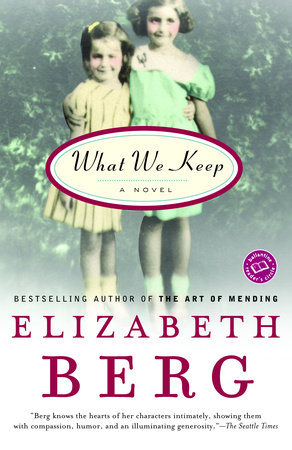
Q: You’ve suggested that you often start with an idea or a feeling that, as you develop it through writing, turns into a novel. What idea or feeling was at the beginning of What We Keep?
EB: At first, I was interested in the impact some exotic stranger might have on a family. I wanted to write about someone who moves in next door and, in her way, seduces every member of that family. I wanted to look at the shaky substructure of a supposedly secure group of people. As I wrote, I became equally interested in the mother-daughter relationship, which, I think, is the most complex relationship there is. I wanted to think on paper about what it is we owe each other.
Q: Were you surprised that this idea evolved from "exotic stranger" to an investigation of mothers and daughters?
EB: Whenever I write a novel, I’m always surprised at what turns up. The subconscious is a mysterious–and mighty–thing. You unearth things in writing that you might not have known were there. It’s good to look at those things, to try to understand them.
Q: What makes the mother-daughter relationship so complex?
EB: It just is that complex. I think that complexity is natural when there’s someone to whom you’re so close and from whom you need so badly to break away, when you’re tied to a person in ways you can understand and in ways you can’t understand.
Q: Ginny and Marion mother during different eras. Do the differences of the eras alter the complexities of the mother-daughter relationship?
EB: That’s an interesting question, but I think the answer is no. I think the complexities are the same regardless of era. In every time the mother-daughter relationship is an extremely close relationship that must break apart. Of course the issues might be different. In the 50s it was a big deal if you could wear lipstick to the dance. Now we’re in the 90s and you have to decide what condom to buy. The specifics are different, but it’s the same age-old battle of pulling away from someone you’re dependent on in order to make your own decisions.
Q: Ginny narrates her story both as a child and as an adult. Did you anticipate that Ginny’s position as an adult narrator would allow her to return to the events of her childhood with a maturity she didn’t possess when she experienced them?
EB: Yes. I knew that if ever she thought carefully, as an adult, about all the things that happened that summer and the months after, she would bring to those events a new understanding. That doesn’t mean, though, that the pain would necessarily be less, or that forgiveness would necessarily follow. Of course, when the reconciliation occurs, Ginny is given a new piece of information that, had she known it before, might have changed everything.
Q: Do you consider Ginny to be a more reliable narrator as an adult than she is as a child?
EB: Well, there is often a kind of fearlessness in children that makes them very reliable narrators indeed–they have a scorching kind of honesty. Also, often, a lack of tact that can actually be refreshing. But they lack the perspective and wisdom that comes with age. In that sense, both the child and the adult Ginny are reliable narrators, each in her own way. Each tells the truth as she sees it. I wanted neither to be blamed for what she felt.
Q: Marion is, perhaps, more likely to elicit blame. Do you blame Marion for what she felt? Do you struggle with her decision?
EB: Do I struggle with Marion’s decision? Or did I struggle with it? The book wrote itself, so I didn’t struggle with her decision then; it simply came, FedEx. It was painful to write, but it had to happen–I didn’t struggle with whether or not it should. After the book was written, I thought, God, that would have been so hard. So hard! I thought she was brave to leave. I thought she was a coward to leave. I thought she was right to leave. I thought she was wrong to leave. I thought she should have tried harder; I thought it was impossible for her to try harder–that she had spent years trying, and that it never really worked. This is how life so often is. Most of the time there are no clear-cut answers. People do what they do, sometimes in haste and confusion, sometimes after much thought and care. I do think, though, that if you don’t listen to your heart, you always suffer.
Q: Although the entire narrative leads up to the moment of reunion, you choose not to write that moment. In fact, it exists outside of language. Ginny is unable to speak. Marion speaks "syllables that are not words." Why did you choose to leave this scene unwritten?
EB: It’s hard for me to think that there’s a reader out there who doesn’t know exactly what happens in that scene. I respect my readers’ intelligence. I often let them fill in the blanks. They know what they’re doing. They bring to my books their own imaginations, their own deep feelings, their own rich experiences. I hope it makes it a more satisfying experience for them, the two of us working together. A little literary potluck.
Q: Did you know where the novel would end when you began writing?
EB: Not really. I sometimes know an ending, even a last line, but in this novel, I wasn’t sure.
Q: You dedicate the novel to "women who risk telling the hard truths," and Ginny suggests that "the truth" is what mothers and daughters owe each other. However, we, as readers, hear truths from Ginny that she isn’t able to tell Marion at the novel’s end. Why?
EB: Well, this is the old struggle, isn’t it? The distance from here to there? What we feel in our hearts versus what we manage to make come out of our mouths? So much of love is presumption. Nuance. Physical gestures as opposed to the spoken word. Even Ginny, in her "love" relationship with Wayne, communicates best by drawing in the dirt and speaking in words that are not any language. In the case of the mother-daughter relationship, so much is often withheld. Daughters can be so stingy with their mothers, so cruel to them. Who knows why? It’s often the nature of the relationship, this lovehate thing. I have a lot of admiration for women who are able to gently love their mothers, who forgive them their trespasses and give them the admiration and respect and, most of all, the understanding that they deserve. I think it’s rare.
Q: Ginny and Sharla offer Marion a narrative of their lives so that "she could put herself there." Ginny insists that this process of reconstruction does "matter" but only "in the way that it could." What does she mean by this?
EB: I meant that it was a tender gesture, that it mattered; but it was, after all, such a weak substitute.
Q: One of your great strengths as a writer is your ability to write about very different women with a sensitive and sympathetic ear. Do you ever struggle to keep your own disapproval or dislike of a character or of her choices out of the text? Do you understand all of the women about whom you write?
EB: I don’t struggle when I’m writing about people I don’t like. I like the challenge of trying to understand another’s point of view. Writing about someone I don’t like does let me understand him or her, at least more than I would otherwise.
Q: Do you like all of the women about whom you write?
EB: I don’t like them all. No. In Joy School, for example, I really hated that controlling woman who was Cynthia’s mother. But I hope to bring a measure of compassion to people I write about, even those I don’t like. In nursing school, I was taught to have "unconditional positive regard" for every patient. That was a very, very valuable lesson to learn: to try to find something, something redeeming about each individual. I try to do that with every character I create.
Q: You write about strong women who must evoke strong reactions in your readers. Is it ever a struggle to keep the responses you anticipate from your readers out of your mind while you write?
EB: I never think about people who are going to read my books while I’m writing them. That would paralyze me. I say what I have to say, and then I have to let the chips fall. After the book is written, I am always interested in what people say about it. Sometimes it’s painful or embarrassing to hear–even praise can be embarrassing–but I always find it interesting. Over the years, I’ve come to think that readers are far more insightful than the critics, that they read more carefully, that they feel things more fully, that they are more likely to understand the author’s intention.
Q: What element of writing comes to you most naturally?
EB: Probably dialogue. When I write dialogue, it’s as though I’m being dictated to. There’s no sense of reaching in any way. It’s as though I’m not even involved. I think I understand why. I have always loved listening to people talk. I love the accents, the words they choose, the particulars of their voices. I could listen forever.
Q: Is writing difficult for you? What is the greatest challenge it presents?
EB: Writing is not now, nor has it ever been, difficult. As I said once in a talk about writing, I’m not here when I write. I’m there. I like it there very much; it feels like heaven to me. I do find it difficult to answer questions about the writing process. It’s hard to know what to say when I’m asked about how I write. If someone asked you how you walked, could you tell them? It’s simply a part of you. The greatest challenge is to try to keep getting better, and to remember that writing is not about how many copies I sell.
Q: Does your reading influence the way you write?
EB: What I read doesn’t directly influence my writing, but it definitely inspires me.
Q: Whom do you read? Whose writing do you admire?
EB: Mostly contemporary fiction. Also some poetry and essays and an occasional nonfiction book, like Anne Fadiman’s The Spirit Catches You and You Fall Down, which was terrific. My favorite writer is E. B. White. I love Alice Munro and Michael Byers. I also love Anne Tyler and Ellen Gilchrist and Jane Hamilton, who is a genius. I love the work of Barbara Ascher–reading her is like experiencing true religion. Lorrie Moore. Wally Lamb. Mark Slouka. Oh, there are so many. I like to leaf through science and math books. I don’t understand them, but they move me. I like art books, photography books. Cookbooks, too.
Q: That sounds as if you’re describing Marion or Ginny. Both of them find themselves moved by the books–science and math books–that move you. Are you always aware of the way in which your personal experience influences your characters? Are you ever surprised, after you’ve written a book, by similarities between yourself and a character?
EB: I feel that I’m part of every character I write. How could that not be? Still, it’s a magical and unknowable process. I’m sometimes surprised when I notice similarities that I hadn’t intended, or when readers alert me to similarities I hadn’t even noticed.
I find that I learn a lot about my books after they’re written. As much as I can, I try to write subconsciously. I don’t like to plot. I just like to let the thing happen, let the book tell me what to do rather than the other way around. For me, the act of writing is like looking at a pointillist painting. You work close up and see things one way; then you stand back and see them another.
Q: In what ways has your writing changed?
EB: I hope my writing has gotten better, that’s all.
Q: What are you working on now? What projects do you see ahead?
EB: I’m working on the next novel. I have a book on writing coming out in August of 1999 called Escaping into the Open. In it is everything I believe about writing, and how to do it. There’s a lot about my philosophy and a lot of practical advice, writing exercises and so on. It’s a way of giving back and a way of fighting back. I wanted to encourage and inspire people who have the desire to write andor pu




 QUICK VIEW