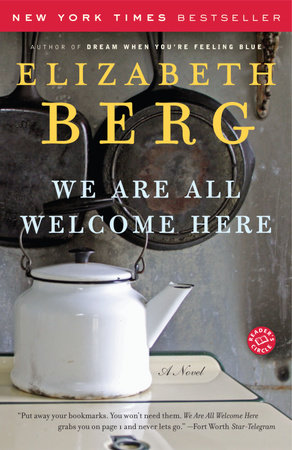
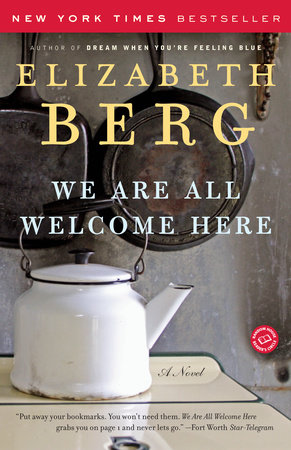
Excerpted from We Are All Welcome Here by Elizabeth Berg. Copyright © 2006 by Elizabeth Berg. Excerpted by permission of Ballantine Books, a division of Random House, Inc. All rights reserved. No part of this excerpt may be reproduced or reprinted without permission in writing from the publisher.
A Conversation with Elizabeth Berg
Question: You’ve said in the past that you until this book came along, you hadn’t ever considered using a reader’s idea or story for one of your novels. But this time, with Pat Raming and Marianne Raming Burke, you took a real life experience and made it your own. What was different this time? What about the Raming’s story spoke to you?
Elizabeth Berg: It wasn't the story that spoke to me, at least at first. Rather it was a photograph Marianne sent me of her mother, Pat. Something in her face was so strong. I needed to know–and tell–about her. What I loved about the true story was Pat's refusal to let extremely difficult circumstances prevent her from having a rich and rewarding life. When I wrote the fictional book, I was interested in looking at a lot of issues. One of these was: Is it "fair" for a severely handicapped woman to try to raise an able-bodied child? Another was: What does freedom really mean?
Q: Paige and Diana may have been based on real people, but they are fictional characters. How did you balance the Raming’s story with the Dunn’s story? And how did you created such a rich, vibrant, unique mother/daughter dynamic?
EB: Oh, this is always such a hard question to answer. The short answer is, Beats me. A longer one is that as a writer you look at something real, and then you consider what might have been if.... My imagination is always straining at the leash, asking to embroider, embellish, and change the things I see. I can't explain how it works, really, how stories and characters are created, but it is very much tied up with trusting the unconscious. Ultimately, the less I know about what I'm doing, the better the work is.
Q: WE ARE ALL WELCOME HERE is rich with the historical detail and political upheaval of the 1960s South. How did you recreate this time period for your readers? Did you talk to people who lived there, do research, or both?
EB: I went to the library and read history. And watched documentaries. I also looked at magazines from that time.
Q: Until this book, most of your books have been set in the Midwest and the Northeast — places you have lived. But this book is so much about the South. Was it different to write about the South, and to write about Southern characters? How? Do you think you’ll return to the South for another novel?
EB: DURABLE GOODS takes place in Texas, but Texas is very different from Mississippi. I'm nuts about the south–the people, the language, the food, the land, the stories and writers that come from there–but it's hard to know whether I'll use it as a location again.
Q: Elvis has a very interesting role in this story. What made you include him, and what do you think he adds to the story?
EB: Elvis is symbolic of a lot of things, dreams coming true being one of them. I didn't know I was going to put him in, but I was happily surprised at the way he did appear.
Q: What are you working on now?
EB: I just finished a novel called DREAM WHEN YOU'RE FEELING BLUE. It's about three sisters and takes place during World War 2. More research!! But it was really fun, because I love the forties: the food, the fashion, and especially the music.
1. Elizabeth Berg includes an Author’s Note at the beginning of the book, informing us that this work of fiction is a bit different from her other novels. What did you think of this choice before reading Berg’s story? Did your opinion change after you read the book? How?
2. At the end of the Prologue, speaking about her mother and herself, Diana reflects: “[Elvis] had a kind of great luck and then terrible tragedy. For us, it was the opposite.” What do you think she means by this? After finishing the novel, do you agree with her?
3. Despite skepticism from the medical community, Paige Dunn gives birth to her daughter, Diana, in an iron lung, and they both survive. Even more amazingly, Paige is determined to raise Diana despite her condition. What do you think about Paige’s decision to keep her baby? Do you support her?
4. How does Paige compensate for her disabilities and serve as a strong parental figure for her daughter? Do you think Diana is forced to grow up a bit faster than other kids her age because of her mother’s condition? Why or why not?
5. Berg sets her novel in Tupelo, Mississippi, during the volatile Freedom Summer of 1964. How does she weave the events of the civil rights movement into her novel? Is the civil rights movement simply background for the story or a part of the story itself?
6. How does Peacie function in the novel? Describe her relationship with Diana. Is it motherly? Sisterly? Something different? How does Peacie interact with Paige? How is their relationship different from Peacie’s relationship with Diana?
7. Discuss Peacie and LaRue. What is their relationship like? How is their life away from the Dunns different? How does their relationship with Diana enhance her understanding of the political and cultural climate of the time?
8. Describe Diana’s friendship with Suralee. How do the girls interact? Why do you think Diana likes to play with Suralee? Can Suralee ever be a good friend?
9. What do you make of Dell’s courtship of Paige? Were you surprised by his treatment of her? Disappointed? How do you think Diana feels about their relationship, both while it is happening and once it is over?
10. Berg’s novel is full of strong female characters. Compare and contrast the women in the novel, from Paige to Peacie to Mrs. Gruder to Mrs. Halloway and others. How are they similar and dissimilar? What about Diana and Suralee? How do they assert themselves as strong figures in the novel, even though they are still very young?
11. Consider how Diana changes and grows throughout the course of the novel. How does she react when her mother gets sick? When her father rejects her? When Peacie and LaRue leave town? Discuss her progression as a character.
12. Berg chooses interesting and appropriate names for a few of her characters, such as Peacie. Do these monikers enrich the characters, in your opinion? Do any other names stand out for you? Why?
13. In the beginning of the novel, Diana reflects, “I believed that despite what people said, money could buy happiness.” Does this prove true in the novel? Do you think she changes her mind after winning the sweepstakes? Why or why not?
14. Elvis Presley makes a grand entrance at the end of the novel. What did you make of his appearance? What did you think of Paige’s reaction to it? Were you happy to see him? Were you disappointed that he doesn’t return?
15. At the end of the novel, Diana tells us that she says a prayer every night, and that she always thanks her mother. Diana adds, “I tell her I’m fine. I say I’m happy. I say she was right.” What do you think she means? What was Paige right about?