Author Q&A
A Conversation with E l i z a b e t h B e r g
Interviewer Heather Lee Schroeder is a writer and editor. She lives in Madison, Wisconsin.
HEATHER LEE SCHROEDER: Is it true that real events inspired this book? Can you talk about those events?
EB: It was knowing people who have endured terrible abuse and hearing those stories and wondering how they got to the various places they were—of forgiveness. That’s something I’ve wondered about for a long time. Then the other thing was, I really did go to an art exhibit at the Institute of Contemporary Art that showed those kids I described in the book in the scene with the really sad little girl. I went back and forth on this book about whether I wanted to write it or not. I had decided not to, but when I saw that exhibit, I felt like I had to. The third thing was an article in The New York Times I read—also mentioned in the book—about the monkeys and the surrogate mothers. That article just killed me. It rang so true, unfortunately, that someone who is so vulnerable will go back again and again to a harmful source because their need is so strong for what they want that source to give them—even if it never does.
HLS: The scene early on where Caroline gives her mother the photo of her dressed up in her mother’s gown, where she seems to be going back to the source, seems remarkably accurate.
EB: I did a Barnes & Noble online discussion group about this novel, and there were divided opinions about that photo. Some people thought she was trying so hard to imitate her mother. And others thought, as I intended, that it was her challenging her mother, that it was her saying, “I know what’s up.” I was reading Eudora Welty’s book on writing the other day—just a couple of passages from it. She was talking about how the art of writing and the art of analysis are two completely separate things. I have seen it happen over and over, not only in my own work but in others’, that readers come to their own conclusions about why things are there, and they fit things together to make their own story. So there ’s what the author intends, there ’s what happens, and then there ’s what the reader takes away. Which isn’t to say there shouldn’t be some consistency, and if most people didn’t understand that the photo was meant to be a challenge, then that’s my fault.
HLS: Is it typical for you to use something from your own life—like these three events that inspired you?
EB: Well, sometimes. It depends on what the book is. For example, Talk Before Sleep was inspired by the death of my best friend to breast cancer, which was, of course, extremely painful and deeply sad, but it was also heartening to see what people do for one another. In the case of What We Keep, it was made up entirely. But there are issues I think about. As always, when a writer looks back on his or her body of work, you see certain themes that just get hammered out over and over again. I really believe writers write about the same thing over and over, just in different forms. I like to explore, with some level of intensity, family and intimate relationships, and I am drawn to really powerful emotions because I think
they’re what we have to wade through to get the work done. One of the problems with this book is that because the abuse didn’t happen to me, I had to circle around and imagine what someone who had endured that would feel like. If you look at the reader reviews on Amazon.com, a lot of people had a problem with this book. I think this book got a short shrift. I don’t think it’s my best book by any means, but I think there ’s more there than some people want to or were able to see.
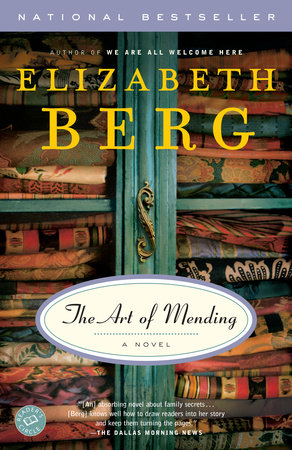
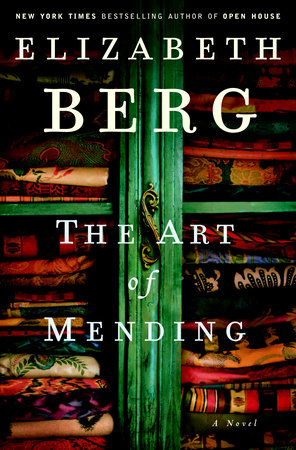
HLS: Were you surprised that this book did get short shrift from its readers? The Art of Mending could probably be described as the most difficult of your novels to read. None of the characters are fully likable. It’s a really tough topic, and ultimately the reader is, in some ways, left to his or her own devices to understand what it means.
EB: You always run that risk. If you’re going to create an unsympathetic narrator, you’re going to get into trouble. I guess it was important for me to write this story, having created other characters that people really did like. I don’t know why this character emerged the way that she did. The narrator is hard to like—but then, everybody in the novel is. I guess, in the end, it represents reality. One of the things that make this novel so complicated is that none of the characters are innocent. To make them unlikable drives home that point. Or maybe since I’ve not experienced abuse, there was a necessary distance between me and the characters that made them seem unsympathetic. The truth is, writing fiction is for me a magical and largely uncontrollable act: the characters create themselves, as does the story. But whether you like the characters or not, I believe the novel makes you think about a lot of things.
HLS: Was this book easy for you to write?
EB: No. Usually I write with such joy and abandon. I had to drag myself to the keyboard to do this, which was why I was going to give up on it when I went to that art exhibit. I grimly went back and said, “Well, I’m going to tell this story the best way I can. I need to getsomething out here.”
HLS: There’s a moment when Caroline unburdens her soul at the hospital while her dad is lying in his hospital bed. Her siblings get frustrated and angry with her for insisting on discussing the issue right then. Was that a bit of a reflection on how you felt about Caroline?
EB: I wanted, always, to make sure that she wasn’t portrayed just as a victim, that there was reason to doubt her, that there was reason to dislike her and to not want to defend her, because, you know, how can someone turn their back on their sister, on their child. It happens at times that children are unlikable or that siblings are unlikable. There’s something to like in all these characters, but there ’s a lot not to like as well.
HLS: Every scene is so precise. Early on, Laura remembers talking to her dad before they go to the fair. You write: “I kept my smile tight to hold back my pride and stuck all my fingers between all my toes for the low pull of pleasure.” That line is so evocative and memorable, and it’s just one of many. Do lines like this come out of you fully formed, or do you spend a lot of time revising to get just the right wording?
EB: They just come. I remember thinking, when I wrote that line, Oh I know just what I mean. That kind of language comes when you trust yourself the most, when you just do that free-falling into creative space and let whatever image you’re thinking of come. My best writing is always done when I am not in control. If I’m not surprised, it’s just not that good. The more I’m surprised, the better it is.
HLS: There is abuse in Laura’s family, but it’s different from what the reader first suspects. Was your decision to avoid using sexual abuse in this story deliberate? If so, why?
EB: You know, it occurs to me only now that maybe it was another subconscious thing. People are becoming inured to sexual abuse, unfortunately; I think it makes their eyes start to glaze over a little bit.
But it’s not just sexual abuse that cripples people, it’s all different kinds. And again, I think that these types of things, if they’re illuminated, can make somebody think twice. If you read about someone who so violates their child and who is so selfish, it’s very dramatic and very far away from how you live your life—hopefully. But it can illuminate the smaller things that you do.
HLS: You do a great job of balancing the past and present throughout the story. Particularly fascinating are Laura’s hazy, golden memories of her childhood and her gradual realization that those memories may not contain all the information of her family’s story. It seems as though most parents have this fantasy that they’re treating all their children exactly the same. It’s kind of an ugly unspoken truth, isn’t it that parents sometimes favor one child over another? Is it fair to suggest that you were busting some parental myths when you wrote The Art of Mending?
EB: My mother says it best when she says, “Yes, you do have favorites, but it changes. It depends on who needs you most.” I’ve found that to be true with my own daughters; I’ll be more sympathetic toward one over the other depending on what the circumstances in their life are. But about revisiting memories: I think the purpose behind those snippets is that you can see an event one way, but then armed with the knowledge that Laura has, her developing knowledge, she sees those things another way entirely. It raises a million questions. I even feel that looking at old pictures. You see more in them every time you look at them.
HLS: Once the reader understands why the mom was abusive toward Caroline, it becomes easier to understand this family’s struggles. Did you always know you were going to give your readers a better understanding of Laura’s mother’s motivation? Did you ever consider leaving your readers in the dark?
EB: I knew why she was doing that. I knew it had something to do with that child she lost. I wondered how that could affect someone. If it were me, because I’m a bit of drama queen myself, how would I react to one child born so close to the death of another? She wasn’t ready to get pregnant again. She wasn’t ready to have another baby. She had the equivalent of postpartum depression, and nobody would listen to her, including her husband, who thought she was perfect all the time. I think it would be really hard to not have your behavior toward the next child affected. Probably, more likely, you would spoil them.
HLS: Or be overly worried about them?
EB: Right.
HLS: You have often said that you admire Alice Munro—a writer who is considered a master of the short story but who doesn’t necessarily make the New York Times bestseller list. What lessons have you
learned from her writing?
EB: I’m not even sure I can articulate this, but I’ll try. There is such unadorned confidence in her writing. She knows that what she’s talking about is interesting. It just is. It’s not an epic trip around the world. It’s not political, except in the domestic sense. But there is such a keen understanding of psychology in her stories and such sympathy and empathy. She is one of the few writers who get me right away and don’t let me go. There is a precision of language. There is a beauty, a great, great beauty in the language, but mostly I think it’s just that she understands people—their foibles, their humor, their sinfulness, their longing, their inabilities and their great abilities. She ’s like a little god. She ’s a literary aphrodisiac. Anne Tyler does that for me, too.
HLS: The Art of Mending is your thirteenth novel. Does the expectation that a fourteenth will follow sometimes seem overwhelming?
EB: Lately it has. There is some sort of shift occurring in me creatively, and I don’t know what it is yet. I have a contract to fulfill, and I think I will never do that again because there is too much of the good-girl, Catholic fourth-grader in me. I need my playfulness back. I’m trying to call forth that playful self.





 QUICK VIEW