Author Q&A
A Conversation with
Thisbe Nissen
author of
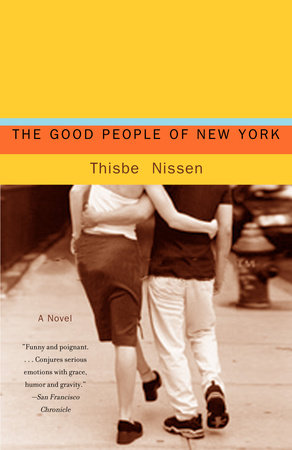
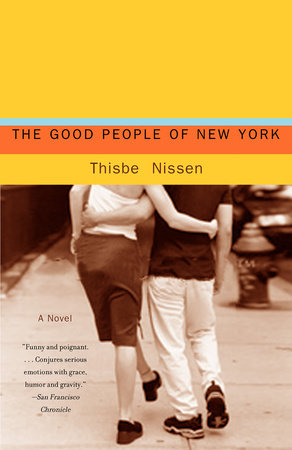
The Good People of New York
Q. What made you want to write this book and how did you begin to formulate the story?
A. I first wrote the story "The Rather Unlikely Courtship of Edwin Anderson and Roz Rosenzweig" in an attempt to chronicle a somewhat fictionalized version of my parents’ courtship. I had no real plans of turning it into a novel at all. Around the same time I wrote a story called ”Think About If You Want," which ostensibly had nothing to do with the other story. But some time passed and I think I realized that the mother character (I had called her Sheila in "Think About…") was actually and without a doubt a much later incarnation of Roz: divorced; raising a daughter; an outspoken, feisty, survivor-of-a-woman who has been unlucky in love and still has this stalwart strength about her. I started bridging the stories. A few years later, The Good People of New York was the result.
Q. You grew up in NYC. How did this affect the writing of your novel?
A. I did grow up in Manhattan, and I think that has, of course, been a source in much of my fiction. My mom recently went to a lecture by John Updike, where someone apparently asked him how much of his work was actually him and he said something like "Writing fiction is like handwriting." You can alter it, camouflage it, twist everything around, use different pens, whatever, but it’s still your handwriting when it comes down to it. I think even if you’re writing the most way out twisted stuff, it’s still you writing it, and so of course it’s impacted by who you are and the experiences you’ve had and the life you’ve lived. I lived in New York for eighteen years, I grew up there, it’s part of me, for better or worse.
Q. Do you identify with any one character in particular?
A. All of them, actually, in one way or another. I guess, particularly Miranda and Darrin. And Wing, too. I think Miranda and Darrin are such close friends in part because they complement each other so completely; maybe they’re more like two halves of the same person, and I see myself a little in that person that they make up together. And then Wing could almost be that Miranda/Darrin person a few years later, post-college, still a kid in many ways, and trying hard to figure out how to be an adult. I definitely put myself in that category.
Q. Do you ever feel "far away" from yourself, as Edwin has become from himself and his family?
A. No, not really, but I’ve known people like Edwin in that regard, felt the kind of fear that comes from being (and being around) such a person.
Q. How long have you been writing? When and how did you begin in earnest?
A. I’ve always written, always wanted to "be a writer when I grew up." I wanted to go to college at Oberlin in part because it was one of the few schools at that time that offered an undergrad Creative Writing major (which I didn’t actually end up doing; I was an English major with a Creative Writing concentration) and I knew then that I wanted to be in workshops, to be able to focus seriously on writing in college. It wasn’t until my junior year, though, that I wrote my first real "story" in order to apply for a Fiction Workshop. It was an incredible class —with a phenomenal professor named Diane Vreuls to whom I owe so much, and an amazing group of peers (of the twelve of us, most everyone is still writing: Myla Goldberg’s novel Bee Season came out last year; Lisa Jervis founded and edits "Bitch Magazine: Feminist Response to Pop Culture," and has had essays appear in numerous anthologies and in such magazines as Ms., Utne Reader, and Bust; Brian Borowka is an award-winning playwright in the MFA program at Phoenix, Arizona; James Borda is writing sci-fi novels; Beth Chimera won a Pushcart Prize for her short fiction, etc.) We were all writing in earnest even then, and I suppose we just kept going from there.
Q. Your writing is very emotional. Do you experience these emotions as you are writing, or are they purely fictional?
A. I’m there inside all those emotions as I’m writing. It’s not a trick or something I force myself through, that’s just the way it goes: if I’m writing them well, then I’m feeling them, too. I’m a generally emotional person to begin with. I have no poker face. Everything’s pretty much hanging out on my sleeve at all times. Tears are never too far below the surface.
Q. This is your first full-length novel. How does writing a book of this length compare to writing short stories?
A. It’s my first published full-length novel, but not the first I’ve written. Maud and Drew is a novel with a home in my closet, and it was the first—the place where I really had no idea what I was doing. I gave myself the freedom to try anything: cut it all into little pieces and rearrange them, hack out huge chunks of text on a very regular basis and alter the course of events dramatically. I got to play when I was writing Maud and Drew, and even if it never sees the light of day (though I do feel bad for poor Maud and Drew, living there in that dark closet), it was worth the two and a half years I spent on it—for the process and what it taught me about how to do better the next time around.
Q. Was the transition from story-writing to novel-writing a difficult one?
A. Not difficult at all. It’s the only way I’ve ever done it: writing stories that then turned into a novel. I also find it’s satisfying to be working on stories while working on a novel. A novel’s such a big, unwieldy beast, and there’s not a lot of short-term gratification in the process, so to be working on a short story concurrently (better yet: a short-short!) gives me that sense of occasional accomplishment: I finished something!
The novel I’m working on now is a very different sort of project for me. It takes place during the course of one summer. The focus is on the inhabitants of a small eastern-shore island and the events that ultimately lead to the death of one character. I’m using a more omniscient point of view to write a story that’s much more somber than what I’ve written before.
Q. What do you feel is the fundamental message you are trying to convey with The Good People of New York, and how does your title relate?
A. I don’t think I’ve really got a "message to convey" at all. If anything, I feel like I’m just trying to open up some portholes into some lives. As for the title: the anecdote included in the final chapter (of the same name) was told to me by my best friend, Michelle, to whom I basically owe my entire sense of humor. She’s twenty times funnier than I could ever hope to be, and every time she tells me a story I’m on the other end of the phone line scribbling madly to get it all down, calling her back a million times begging "please tell me again about the time when…"
Q. How did you feel when you completed this book?
A. I finished the first complete draft while I was in New York staying with my folks. I took my laptop down to the Public Library at 42nd St., and in the course of a couple of weeks I finished the novel and sold it and also happened to fall in love with a man I spotted sitting across the Rose Main Reading Room. A lot of dreams I never ever thought could come true did. I guess I felt pretty incredibly wonderful.




 QUICK VIEW