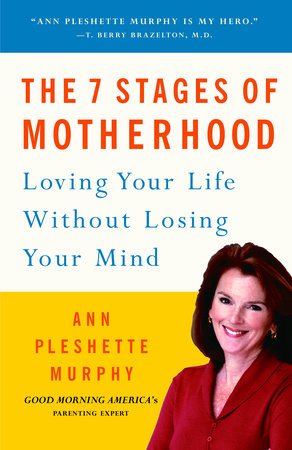
Excerpted from The 7 Stages of Motherhood by Ann Pleshette Murphy. Copyright © 2004 by Ann Pleshette Murphy. Excerpted by permission of Anchor, a division of Random House, Inc. All rights reserved. No part of this excerpt may be reproduced or reprinted without permission in writing from the publisher.
A Conversation with
Ann Pleshette Murphy
Q: There are shelves full of books about parenting. How is this book different?
A: The vast majority of parenting books focus on child development, on the how-tos of baby and child care. My book looks at mother development, how we change and grow from the moment we get pregnant to the day we watch our kids graduate high school.
Q: Why is it needed?
A: Too many moms are encouraged to focus exclusively on their kids’ needs, to read their children’s signals, accommodate their demands; we rarely take the time to reflect on where we are as women and, more important, where we want to be. I don’t believe you can be an effective mother if you don’t ask those questions and find the time to nurture your own development.
Q: You're not a pediatrician or therapist. What perspective do you offer that's different from more clinical books?
A: I would love the reader to see me as the neighbor who lives a few doors down, who’s a little older than she is and has two kids. She knows how tough being a mom can be–in fact, she has an uncanny ability to describe just what you’re going through–and she’s always willing to pull up a chair, pour you a cup of coffee and listen. Her expertise comes not only from her years as a mother, but from close to 20 years in the field of parent education.
Q: Your ten years as editor in chief of Parents magazine gave you every mother's dream–instant access to the most respected child care specialists of our day. Did you call on any of them when you had a problem with your own children? Did you ask any of them to read all or parts of the book?
A: I still call on friends like Nancy Samalin, Berry Brazelton, and Ron Taffel with parenting questions–and I'm proud to say they occasionally call on me with questions about their work! I also sit on the board of Zero to Three, which is like the Mount Olympus of child development experts (I’m one of the mere mortals). Through ZTT and my work as parenting contributor at Good Morning America, I’ve also had the good fortune to add Kyle Pruett, Bill Pollack, Harvey Karp, Justin Richardson, and a host of other wise men and women to my speed dial. But the experts I find most helpful are other moms.
Q: The women you interviewed for the book are very candid, and often very funny about their lives. How did you find these women?
A: All you have to do is ask, “Do you have children?” and most mothers love nothing more than to kvell and/or kvetch about their kids. My problem was figuring out whom to eliminate, not whom to include, because all of the women I interviewed were incredibly forthcoming and wise. Many of them were women I’ve known for years; others were strangers I met through my work at Parents and at GMA. Or on the cross-town bus.
Q: Speaking of your work at Good Morning America, can you tell us a little about your role there?
A: As the show’s parenting contributor, I’m responsible for most of their American Family
segments. In addition to acting as the on-air correspondent, I help produce pieces that run the gamut from taming tantrums to handling adolescent drug abuse. Since I began working at GMA five years ago, more than 200 of these pieces have aired; more important, I have had an amazing opportunity to meet a wide range of leading experts in a variety of child/family fields. And I’ve traveled to dozens of cities to spend time with some wonderful families. Many of the moms I’ve met through my work at GMA appear in my book.
Q: When did you realize that motherhood could be broken down into seven stages?
A: I should note that, as I point out in the book, motherhood rarely progresses in a predictable way. There’s as much circling, sliding, falling back as there is surging ahead to the next stage. That said, there are certain challenges–for example, knowing when to let go, when to hold on–that mothers experience with more intensity during a particular stage of their development. I’ve tried to highlight what those challenges are at each stage and to focus more attention on resolving the problems that crop up with greater intensity at certain times in our lives as mothers.
Q: Which stage is considered the most challenging?
A: The toddler years, like the teen years, are notoriously stressful, because our kids are struggling to figure out who they are–often in direct opposition to us. That said, every stage of motherhood poses challenges and promises rewards; the relative difficulty of one stage versus another has as much to do with our own development as it does with that of our kids.
Q: You often cite examples from your own life. How do your children and husband feel about being included in the book?
A: Like most children, Maddie and Nick love to read funny stories about their early childhoods and I made certain not to include any anecdotes they found embarrassing or excessively personal. Steve claims he did a lot more diaper changing than I give him credit for, but he’s been unbelievably supportive, helpful, and encouraging throughout this process. Every page of this book is informed by the love of my family.
Q: Many women fear that they will turn into their mother when they start their own family. How true is this?
A: There are definitely times when we feel as though we’re channeling our moms, saying things to our kids we swore we would never, ever say. Although we don’t turn into our mothers, we may reexperience past hurts or anger and bring them to bear on our relationships with our children. At the same time, having children often brings us closer to our mothers in very positive ways. We certainly learn to appreciate what they went through with us!
Q: When interviewing women about the book, did one or two issues for all mothers,
regardless of the age of their children, come up more than others?
A: Guilt is endemic to motherhood. So is a tendency to take ourselves for granted, to overlook the countless small acts of caring that define our days as moms. And most mothers still tend to put their needs last.
Q: There have been many stories in the media in the last year or so about motherhood, from the myth of the perfect mommy to dilemmas over working versus staying home. Why the sudden interest? Are our ideas about motherhood changing in some significant way?
A: I think this is a particularly tough time to be a mom. Ironically, because we have so many options (you can be a mother at 20 or at 40, work or stay home, be single or married, straight or gay, live close to your family or hundreds of miles away), we’re faced with a loss of consensus about the right way to raise our kids. And along with society’s conflicting messages about what makes a good-enough mother, there’s an implicit bias these days that the ultimate failure is to fail as a parent. We tolerate failed marriages and the concomitant high levels of divorce; we tolerate failed politicians, business leaders, priests. But we send the message to mothers that if your child messes up, it’s your fault. Worse, long before that child stumbles, we fly the “mothering comes naturally” banner with aggressive cheer, failing to show moms what’s printed on the other side: “If mothering doesn’t come naturally, keep it to yourself.” And in even smaller type: “Because asking for help is tantamount to admitting you’ve failed.” My advice: Burn that banner! There is nothing inherently “natural” about turning your life inside out, reshaping your identity, drastically realigning your priorities, rethinking your relationships, and assuming responsibility for people you love more than life itself. Every mother on the planet needs help and support. I hope this book provides both.
From the Hardcover edition.
1. How does Murphy’s approach differ from other investigations into the day-to-day, year-to-year reality of motherhood? Does the subtitle—“Loving Your Life Without Losing Your Mind”—accurately reflect the contents and voice of the book?
2. “Evidently, there’s a lot of pressure on today’s moms to treat pregnancy as a minor inconvenience and to barrel ahead with the confidence of Seabiscuit,” Murphy writes [p. 6]. Where do you think such pressures originate? In what ways do they echo other demands (or perceived demands) made on women today?
3. Did previous generations of women have a clearer, more realistic perspective on motherhood? What effects have the increasing options and opportunities available to women had on their views and their feelings about becoming mothers? Has the progress women have made brought losses as well? What traditional aspects of motherhood, for example, are no longer practiced or valued? Is the “perfect-mom fantasy” [p. 114] a recent phenomenon, or has it always been a factor in women’s lives?
4. Many of the women Murphy interviews postponed motherhood in order to pursue their careers. What particular challenges does this path present? Does it offer advantages that might be lacking in the lives of women who start their families at a younger age?
5. In addition to reminding readers that “childbirth is not a competitive sport” [p. 26] and that you may not “fall head over heels in love with your baby in the delivery room” [p. 32], what other myths about motherhood does The 7 Stages of Motherhood dispel?
6. In discussing the toddler years, Murphy writes, “All of the books on toddlers will tell you that the trick is to anticipate when the overload button is about to start flashing and to use time-out before your child has a fit—not as punishment. But the reality is, you probably won’t be prescient enough to steer clear of emotional land mines” [p. 97]. Do most books on child-rearing establish unrealistic goals for mothers? To what extent are the thousands of articles and books about parenting published every year responsible for increasing, rather than decreasing, the anxieties and apprehensions mothers feel?
7. When her daughter was in preschool, Murphy got a note from her teacher that read “Please make sure Madeleine wears underpants under her skirt tomorrow” [p. 124]. Sending her child to school “bare-assed” is just one of several embarrassing moments Murphy shares in her book. What is the most embarrassing thing you have ever done as a parent? What thoughts ran through your head? Did it teach you something about being a mother that helped you through other mortifying incidents?
8. Murphy writes, “The overwhelming majority of moms I spoke to found that the birth of their baby transformed even the most egalitarian marriage into a kind of Leave It to Beaver time warp” [p. 53]. Was this your experience? If so, what do you think causes this reaction? To what extent can it be attributed to the social or cultural assumptions that influence men who ordinarily think of themselves as feminists? Do most new mothers inadvertently contribute to this by setting themselves up as “experts,” as Murphy admits to doing? What other factors contribute to the way new parents see themselves and their spouses when they start a family? Consider, for example, the influence of media images (from Donna Reed to Desperate Housewives), memories (good and bad) of your own parents, and the patterns you have developed as a married couple on the way you and your spouse envision yourselves as parents. Are the expectations placed on fathers today as complicated and confusing as those mothers face?
9. One of the difficulties of the school years for many mothers is the tendency to live vicariously through their kids [p. 151]. In what ways do communities, schools, and other parents foster this tendency? Why do some mothers find it more difficult than others to draw the line between supportive interest and over-involvement in their children’s lives? What are some of the solutions Murphy and the others offer to avoid this trap?
10. Many social commentators have written about the insidious effects of our materialistic culture on children. What are the dangers of overindulging our children, both in the short term and the long term? Is there ever a downside to setting limits and saying no to kids?
11. Because parenting styles are shaped by each parent’s own childhood and family culture, Murphy suggests that couples make a list of the three most important rules for their own families [p. 178]. What are your top priorities? What do you think your spouse would consider most important? Do your rules embody or defy the patterns set in your childhood families?
12. Drawing on the stories in the book and on your own experiences, discuss how the gender of a child can influence the way mothers treat them and react to their behavior. What have recent writings about adolescent development, including scientific research into the adolescent brain, contributed to our understanding of kids’ behavior during the preteen and teenage years? How do the insights and examples in The 7 Stages of Motherhood enhance the portrait of adolescence emerging today?
13. Murphy talks often about the push-pull dance of independence/dependence we engage in throughout our children’s lives. Was there a time in your experience of motherhood when letting go was particularly hard? If so, why?
14. If you’re the mother of teens (Stage 7), discuss how your own experiences confirm Murphy’s assertion that “during this phase of motherhood we relive all the other stages, experience everything from the panic of our children’s infancy to the frustrations of toddlerhood to the loneliness of the preteen years” [p. 215]. How do both the emotional and practical aspects of parenting a teen make it necessary to reshape “not only your relationship with your child but your identity as a mother” [p. 217]? Do you agree with the chapter title: “It Gets Easier…and Then They Leave”?
15. Murphy calls motherhood “the defining event in a woman’s life” [p. ix]. Do you agree? How does the decision to become a mother differ from other choices women make in their personal and professional lives? Did The 7 Stages of Motherhood lead you to rethink and reevaluate the choices you and people you know have made?