Author Q&A
Q: Congratulations on your first book. When did you first realize that you wanted to be a writer?
A: I was, I’m afraid, an incorrigible liar when I was a child. The truth just didn’t hold appeal for me. And the lies I told were literally unbelievable, like that I was really Swedish but had had some sort of operation to disguise myself. From such ignoble beginnings, one has no choice but to become a fiction writer—or a felon, I suppose. I started writing stories when I was around six, and by the time I was twelve, when other girls dreamed of their wedding day or prom night, I dreamed of publishing a Borzoi book with Knopf. So, I’m living proof that some dreams do come true.
Q: Which authors are your biggest influences?
A: Two books that made deep impressions on me as a young writer were It Happened in Boston? by Russell H. Greenan, and Ghosts by Ursula Perrin. On my writing desk: The Great Gatsby, To the Lighthouse, Madame Bovary, Lolita, The Dubliners, Revolutionary Road. Contemporary authors I am consistently amazed by: Marilynne Robinson, Alice Munro, Jeffrey Eugenides, J.M. Coetzee, Elizabeth Strout, James Salter, Chang-rae Lee, Graham Swift.
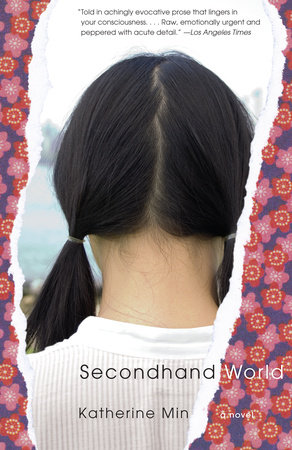
Q: Isadora Myung Hee Sohn, or Isa, is a compelling character—a young Korean American growing up in Schenectady, New York, striving to balance the demands and expectations of her traditional Korean immigrant parents with the pressures and influences of American suburbia. How much of this is based on your experiences as a Korean-American woman? Where did you find her voice?
A: The exterior of Isa’s life—growing up in suburban New York State with Korean parents—resembles the exterior of my own life. Certainly I drew on personal experiences in general ways, experiences with racism, cross-cultural conflict, self-hatred, etc. But Isa is very much her own woman, and her voice comes from some darker, more troubled place. I was originally interested in the idea that people tend to be most judgmental about human behavior when they are young and have the least amount of life experience. One of the testy facts of life is that the process of maturation is a growing away from certainty, toward a much grayer, more muddled, all-bets-are-off unknowing. It’s a comprehension of life that is much more complicated and uneasy, but also more generous, more forgiving. Unfortunately for Isa, the price she has to pay for such knowledge is quite high.
Q: Isa’s relationship with “Hero,” a nearly blind Albino boy at her high school, has a profound influence on her. Why was their relationship so important to Isa?
A: One of the things I write about quite often is the Attraction to the Other. When I was young, I desperately wanted to be blond. Partially this was because blonds were the norm of beauty in this country then, but mostly, I think, it was because being blond was different from what I was. For Isa, a person of color in an overwhelmingly white school, Hero is a reciprocal image—literally a person of no color. He is exotic and, unlike Isa, seemingly comfortable with his difference. She is intrigued by his confidence, and by his luminous, otherworldly beauty. Of course, Isa and Hero are also very much alike; they’re both outsiders, both sheltered by their parents and marked by their looks as different from other people. They share a certain rebel stance. Together they transcend difference, paradoxically, by reveling in it; for them sex becomes a way to both “merge” with the Other, and to explore the particularities of Otherness.
Q: The Korean War hung over the generation who immigrated to the U.S. in the 1950s and ‘60s. How does it affect the Sohn family in Secondhand World?
A: The Korean War was the defining event for my parents’ generation. A third of my father’s high school class was killed; the country was divided and decimated. Imagine the Civil War if it had led to the formation of two separate, hostile nations. Almost everyone my parents’ age has a relative who was taken or happened to be in the North when the split was made, and many do not know to this day if these relatives are alive or dead. This is such an enormous tragedy. I wanted to explore the ways in which the history of our parents and our grandparents affects us, even when that history is not shared. It is always true that whatever experiences our parents have had will influence our own lives in ways we cannot know, but it is especially true with children of immigrants. Isa’s father has told no one about his sister’s real fate, not even his wife. He believes he can start a new life in America, that he can deny his past and its painful memories, but the fact is that you can’t really start over, ever, or not without cost.
Q: The Sohn household faces the challenge of immigrant parents with American-born children and the conflict between assimilation and the upholding of Korean culture. How does that play out in the family?
A: I have tremendous compassion for Isa’s parents. I can’t imagine moving to France, say, and bringing up my children to speak French and to live in French culture. It would seem unthinkable. But that’s what Isa’s parents did; they moved to America and had children who don’t speak Korean or act like Koreans. They themselves are trying to fit in to their adopted culture, and it’s continually exhausting. One of the things Asians in particular give up when they move here is the strong extended family network that supports their efforts as individuals. Isa’s mother has a hard time after Stephen’s death. Already isolated from the culture by difference, she is doubly isolated in grief. On her part, Isa just wants to be a normal All-American kid. Teenagers are often embarrassed by their parents, but children of immigrants are especially prone to feeling shamed by their parents’ accents and perceived foreignness. And sometimes immigrant parents have expectations for their children that carry over from the traditional values of their homeland. It’s a complicated bind that ties Isa and her parents more tightly; there is so much that is inexpressible across cultural and language barriers.
Q: What’s next?
A: My next novel, The Suicide Sonata, weaves among three central characters: a Caucasian violinist with a fetish for Asian women, a Korean-American cellist who is obsessed with Alma Mahler, and a young Japanese-American stalker/would-be assassin. It’s different from anything I’ve ever written, and yet it also deals with the themes of the Attraction to the Other, the limits of intimacy, and self-hatred. I’m envisioning it as a black comedy, but who knows?




 QUICK VIEW