



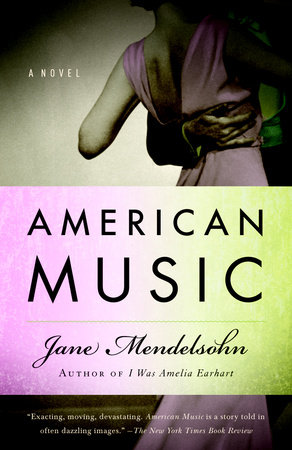

American Music
By Jane Mendelsohn
By Jane Mendelsohn
By Jane Mendelsohn
By Jane Mendelsohn
Part of Vintage Contemporaries
Part of Vintage Contemporaries
Category: Literary Fiction
Category: Literary Fiction
-
$17.00
Jun 14, 2011 | ISBN 9780307473974
-
Jun 01, 2010 | ISBN 9780307593689
YOU MAY ALSO LIKE
 QUICK VIEW
Innocence
QUICK VIEW
Return Trips
QUICK VIEW
Doctor Who: The Drosten’s Curse
QUICK VIEW
Singing into the Piano
QUICK VIEW
The Kid
QUICK VIEW
The Early Ayn Rand
QUICK VIEW
Lost Man’s River
QUICK VIEW
Lilac and Flag
QUICK VIEW
African Silences
QUICK VIEW
How to Avoid Making Art (Or Anything Else You Enjoy)
Praise
“Redefines the genre. . . . Exacting, moving, devastating. American Music is a story told in . . . dazzling images.” —The New York Times Book Review
“Unpretentious, moving, intelligent, and fresh. . . . Like Count Basie and His Orchestra, this book swings.” —Elle
“What a captivating storyteller Mendelsohn can be. . . . A romantic story of romantic stories, full of love and longing.” —The Washington Post
“Glorious. . . . An aleph of a novel—a keyhole one looks into and cannot pull away from.” —Los Angeles Times
“Luminous. . . . Intricately plotted and affectingly written. . . . A piercing, magical revelation about the capricious power of disclosed truths to lift us up or take us down.” —The Boston Globe
“If the artist Edward Hopper had been a writer, he might have dreamed up something like the New York-y 1930s sections of Jane Mendelsohn’s American Music, a beautiful bittersweet novel.” —O, The Oprah Magazine
“Intriguing. . . . Haunting. . . . Dip[s] boldly into the waters of magical realism. . . . Even though life often plays in a minor key, it can be perfect sometimes anyway.” —The Miami Herald
“In her exquisite, psychologically fluent novels, the actual and imagined merge as Mendelsohn tests the power of stories to define, guide, and sometimes destroy us. Her third novel is an intricate puzzle of haunting, far-reaching, secretly connected love stories…. Sensuously rendered.” —Booklist (starred review)
“Beautifully rendered. . . . [Joe, Pearl, and Vivian’s] story is a heartbreaker, stark in its reality. . . . Powerful. . . . Hard to forget.” —Providence Journal
“Invites the kind of reading we don’t often allow ourselves anymore—that accomplished in one sitting…. Mendelsohn allows each of these stories to arrive at what feels like its natural end, like cymbals allowed to tremble until they gradually come to rest.” —Slate
“Haunting, mystical and beautiful, American Music is written in a uniquely creative style that poignantly and powerfully touches the reader contemplating the gift of music in an American period of history yearning for recovery and renewal.” —Historical Novels Review
“As in her earlier novel, I Was Amelia Earhart, Jane Mendelsohn proves a master of historical context: American history itself is as much a character as those who live and die through it.” —The Charleston Post & Courier
“Jane Mendelsohn as produced a taut, sui generis story that should be a major contender for novel of the year. . . . Brilliant, stunning and divinely thought-provoking.” —Sacramento Book Review
21 Books You’ve Been Meaning to Read
Buy Now


Just for joining you’ll get personalized recommendations on your dashboard daily and features only for members.
Find Out More Join Now Sign In