Author Q&A
IN THEIR OWN WORDS
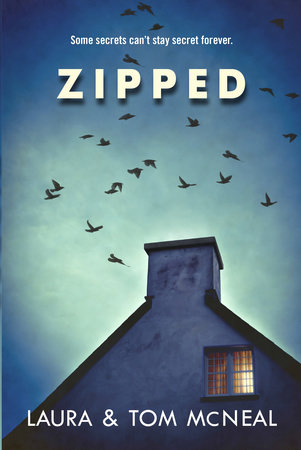
A CONVERSATION WITH LAURA AND TOM MCNEAL ABOUT ZIPPED
Q: How did you write Zipped together–did you work straight from chapter one through to the end, or did you sometimes jump around? Did you work together to create outlines or discuss where the story was headed?
A: The first novel we wrote–Crooked–was like an unplanned car trip. Laura got behind the wheel and drove for one chapter and then slept in the backseat while Tom drove. We switched off after each chapter, so there was the more or less weekly thrill of finding yourself in a new place. About twenty chapters into it, though, we realized we had no idea where we were going, and since a novel really does need the things English teachers talk about–foreshadowing, rising action, climax, and denouement–we had to stop and make a plan. Tom had an idea for an ending, so he wrote a series of climactic scenes. Then we revised the whole thing several times to unify all the events and characters.
With Zipped, we tried to plan where we were going before we got in the car. We mapped out the beginning and the end. We divided up the characters and the chapters–Laura was more or less in charge of Lisa Doyle, Elder Keesler, and Lizette, for example, and Tom wrote scenes introducing Mick, Maurice, and Nora. Whenever a scene called for weather, scenery, Mormon culture, or bird references, Laura drove. When we needed gardening references or jokes about the mind of the adolescent male, she handed Tom the keys.
Q: How do you give each other feedback during the writing process? Is it a help? A strain?
A: One of the reasons we’re married is that we have much the same taste in books, movies, music, and art, with the exception of Gilbert and Sullivan operas and sea chanteys, which Tom patiently endures. Sometimes we disagree about a character, a scene, or even a major plot development, but we try to be tactful about it, just as we try to be polite when suggesting whose fault it is that we ran out of coffee filters. It helps that most of the criticisms are written, not spoken. Our general practice is to take the other person’s computer draft and edit it by inserting brackets. Instead of just ripping out the parts we don’t like, we put brackets around them and write alternatives, which are also in brackets. Brackets save the marriage, basically.
Q: Did you do any research on teenagers, observational or otherwise, before writing the book?
A: A lot of our research was done as actual teenagers. We had to live through adolescence, and it’s kind of nice to have something to show for it. We both taught school for a while, too. When we have particular questions about cars or school policy or music, we consult Tom’s nephew or the children of friends or students at our local high school.
Q: How do you decide what references to make to television, movies, clothes, and music? Are you trying to be up to date with teen culture?
A: We weren’t even very good at that when we were teenagers ourselves. We do occasionally refer to current celebrities or fashions, but we try to keep those references to a minimum because it takes us at least a year to write a book, and then another year for the publication process. By the time the book reaches bookstores, fashion will have moved on, and a new celebrity will be on the cover of Teen People. We can’t entirely eliminate references to clothing and movie stars, of course, because teenagers do talk about those things. What we hope to do, though, is write a book that will still be comprehensible in twenty-five years.
Q: What inspired you to write Zipped?
A: A true story, unfortunately. We heard about a teacher whose son discovered his stepmother’s affair by reading her e-mail. The other characters were also inspired by people we have known–Mormon missionaries Laura knew in high school, boys on the work crew that Tom supervised, a friend Tom had in junior high, a pair of Lebanese brothers who ran an auto shop. We’re mostly inspired, though, by the desire to take a moral dilemma and explore it in a fictional way.
Q: Which characters in the book do you most identify with?
A: Mick and Lisa, as the romantic leads, are probably the characters we’d prefer to claim as cleaned-up, cosmetically enhanced versions of our former selves. We do, however, try to identify with even the loathsome characters–to imagine their points of view, and to sympathize with them, if only for a moment.
Q: When you are writing, whom do you envision reading your work?
A: When we’re writing, we’re concentrating on making Maurice or Mick seem like real people moving through a real town. The presence of an audience would only call attention to the imaginary nature of fiction, so we don’t think about the reader in a direct way. When we’re thinking of an idea for a book, however, we imagine readers who are about the same age as the characters.
Q: What types of books do you like to read? Who are your favorite authors?
A: Laura: I love books that explore one incident and its consequences from every conceivable point of view. Examples that come to mind are the Raj Quartet, by Paul Scott; Atonement, by Ian McEwan; An American Tragedy, by Theodore Dreiser, and That Night, by Alice McDermott.
Tom: There are writers–Alice McDermott, E. L. Doctorow, and Richard Ford, for example–whose mere manner of constructing sentences draws me back to them again and again. More broadly, it boils down to whether I can become immersed in a book or not. If the writing’s good, if the characters are engaging, and if the problems they face have some heft to them, then I’ll fall into this fictional world and enjoy the visit. The best books feel like important visits, and the feelings they afford will linger after you’ve come back home.




 QUICK VIEW