Author Q&A
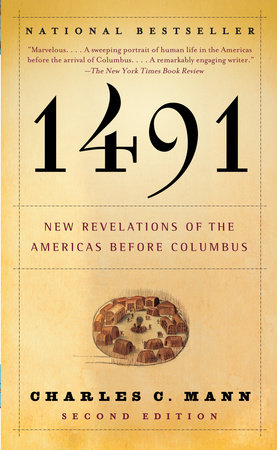
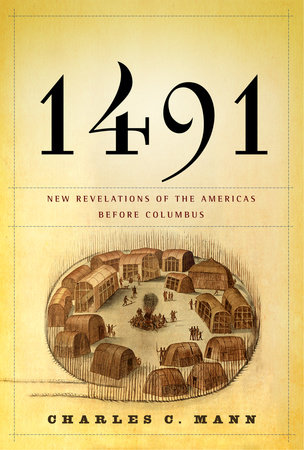
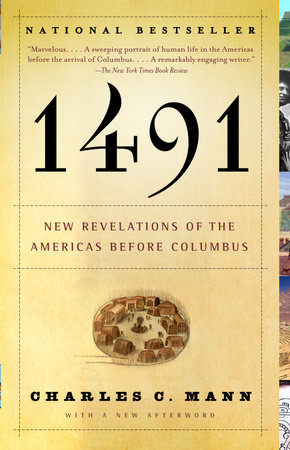
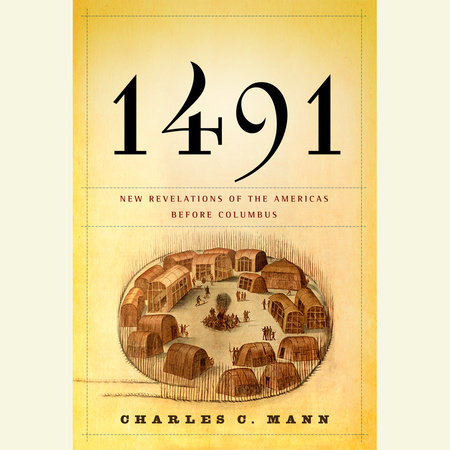
A Conversation withCHARLES C. MANNQ: Although this book had its origins in an Atlantic Monthly cover story, what was it that first drew you to the subject?A: Two things, I think. More than twenty years ago, I wrote an article for Science (I’m a correspondent for the journal’s news division) that involved going to the Yucatan peninsula. I visited some of the Maya ruins there and like so many other people was absolutely fascinated. I’d just spent two years living in Rome, and I was struck by how much more extensive—but equally finely built—the Maya ruins were. I also was astonished by how different the aesthetic system was—the vertiginous staircases, the corbel arches, the huge reliefs, etc.This dovetailed with something else. The summer before seventh grade, my parents moved from the suburbs of Detroit to the Pacific Northwest, an area where the presence of Native Americans seemed much more evident. I was fascinated by the idea that very different peoples had lived in the area in the not too distant past, and that their descendants were still living nearby. But it wasn’t until I got to Yucatan that the penny dropped and I grasped, really and truly, that when Columbus landed he had stumbled across an entire **hemisphere** full of people whose cultures had nothing to do with Europe or Asia. Half the world! It was kind of a Homer Simpson-ish “d’oh!” moment for me. So was realizing that I knew practically nothing about this entire half of the world, and my teachers in school had known practically nothing about it. I decided I would try to find out more when I could. Q: The book argues that most of what we learned at school about the first people to inhabit the Western Hemisphere is wrong. (We now know that Indians were in the Americas far longer and in far greater numbers than previously believed.) What do you think is the most startling aspect of this re-examination by scientists?A: As I was writing the book, friends and acquaintances asked me about what I was working on. Usually, they seemed most surprised when I told them about the extent to which Indians modified the environment. We’re taught in school—or, at any rate, I was taught in school—that for all intents and purposes the Americas were a wilderness in 1492, and that is simply not true. When I tell people that Indians created large chunks of the prairies the pioneers saw by burning down the forests that covered them, they’re usually pretty surprised. But you can look in the colonial accounts yourself. Most of those nice deciduous forests that now carpet Ohio and Illinois and the Texas Hill Country didn’t exist 400 years ago—they were savannas. My favorite example, though, is the Colca Valley in Peru, which is like South America’s Grand Canyon, except that it’s much deeper. The big difference is that most of the canyon is full of agricultural terraces that date back as much as a thousand years. Imagine terracing the Grand Canyon! Q: You write that as the native people have disappeared, the distinction today between anthropologists and archaelogists has blurred. Are there problems with that? A: Not necessarily. It simply means that cultural anthropologists (who study present-day societies) need to be well informed about their subjects’ usually turbulent recent history, and archaeologists (who study past societies) should try to be as informed as possible about what the descendants of their subjects are doing. Q: What do you think of the recent scientific study of the “Kennewick Man” who’s thought to be 9,000 years old? One reason he may be significant—and this is part of your book—is that he furthers the idea that rather than migrating by foot across the Bering Straits 13,000 years ago, many peoples probably traveled by boat. How did this work and how accepted is this theory now? A: The conventional picture—that paleo-Indians (the ancestors of today’s Indians) walked across the Bering Strait 12,000 years ago—has been under persistent attack for a couple decades. One problem is that after walking across the strait, which scientists believe was surprisingly hospitable, the paleo-Indians would then have run into the 2,000-mile-long ice sheets that then covered Canada and the northern United States. For a while, geologists believed that the sheets partially melted at just the right time, creating an ice-free corridor that the paleo-Indians walked through. But now the evidence for this corridor seems pretty weak. So how did the paleo-Indians get here?A currently intriguing theory is that they got here by small boat, skipping along temperate pockets on the shoreline. The pockets were due to the Japanese Current, which still warms coastal British Columbia. There isn’t much direct evidence for this idea, but researchers are increasingly interested in it, because it is beginning to seem like the only plausible answer.Kennewick Man may help answer a related but different question. There is some evidence suggesting that the Americas were settled in as many as five separate waves, with today’s Indians being in the second or third wave. It is possible that examining Kennewick Man could give some evidence for or against this notion. He might have been in an earlier wave, for instance, which would mean that he was not directly ancestral to modern Indians.Incidentally, there has been speculation that Kennewick Man was from Europe, largely based on an early reconstruction of his face that made him look a bit like the actor Patrick Stewart. More recent reconstructions based on better data have eliminated that resemblance. And in any case there is no evidence that I am aware of that solidly suggests a link to Europe—and lots of evidence against it, beginning with the fact that Indians are genetically linked with the peoples of Siberia.Q: Tenochtitlan, the Mexica (Aztec) capital, was more than twice as big as any European city—as much as six times more populous than London, Rome or Madrid—yet the arrival of Europeans created one of the worst disasters in history, with as much as 90 percent of its population dead within a century. What killed so many people?A: One of the biggest changes in historians’ understanding since the 1960s is their knowledge of the overwhelming role played by epidemic disease. Most of the really bad epidemic diseases—smallpox, measles, influenza—were originally diseases that afflicted domestic animals. Measles, for example, is a variant of rinderpest, a cow disease. Europeans lived in such close contact with their farm animals that slightly mutated forms of their diseases were able to jump the species barrier. By a quirk of history, the Americas had no domesticable animals to speak of—the dog and the llama, in the Andes, are the main exceptions. So Indians were what epidemiologists call “virgin soil”—their immune systems were utterly unprepared for these diseases when Europeans brought them over.The results were ghastly beyond imagining. It is widely believed that between 1500 and 1600 nine out of ten Native Americans died. Most of these people had never even seen Europeans—the diseases raced into the interior ahead of the English, French, and Spanish. It was the greatest demographic calamity in the history of the world.Disease, more than anything else, let Europeans win the hemisphere. Hernan Cortes, who conquered Tenochtitlan and the Mexica (Aztec) empire, is a good example. In what is now called the noche triste (sad night), the Mexica drove him from the city, killing three-quarters of his force and most of his horses. After fleeing, Cortes supposedly collapsed in tears at the ruin of his hopes. The only reason he was able to make good on his determination to come back is that some of his Spanish reinforcements inadvertently brought smallpox with them. The epidemic killed at least a third of the city’s inhabitants, including the Mexica leader and much of his army. Q: Amazonian Indians knew how to farm the rain forest without destroying it to the point where scientists are now studying their process today. Is there any hope this will work and how successful where they back then? A: Today when we think of farming we imagine plowed fields and large swathes of grain. The inhabitants of the Amazon came up with entirely different ways of farming. To begin with, they sheltered the fragile soil of the tropical forest from the punishing sun and rain by growing most of their crops as trees—two-thirds of Amazonian crop species, according to one survey, were trees. It was a kind of agroforestry that was unlike anything in Europe.Equally or more important, they developed techniques to improve the usually poor tropical soils. The Amazon is dotted with patches of terra preta do Indios—Indian black earth—which has kept its vitality for generations. A Brazilian-American-German collaboration of geographers, soil scientists, archaeologists, and agronomists is now trying to understand the processes by which Indians created terra preta, and hopes to apply these techniques to other poor soils in the tropics.Q: Why do some criticize the ideas put forth here? On the right, detractors charge that they discredit European culture by inflating the scale of native loss here. On the left, environmentalists want to believe that America in 1491 was “an Edenic land . . . untrammeled by man.” A: I think both of these complaints derive from a peculiarly contemporary compulsion to see everything in red-state, blue-state terms. To begin with, neither Indians or Europeans then had a modern conception of disease. Nor did they have any real ability to prevent the epidemics. In general, they both believed that sickness was a reflection of the will of God. Most of the deaths, as I mentioned before, occurred among peoples who had never seen Europeans—which is to say that Europeans didn’t even know that they were occurring. So to claim that the epidemics magnify the culpability of Europeans seems kind of naïve to me. Don’t get me wrong—Europeans did lots of bad things to Indians. I’m just not sure how useful it is to think of the epidemics in the same breath.Similarly, the left tends not to like hearing that Indians heavily managed nature—they did not “tread lightly on the land.” Environmentalists fear that admitting that the Amazon forest was largely created by human action—that much of it is, in a sense, a whole lot of old orchards—somehow gives the green light to the bulldozers. I don’t see it. Indians were, by and large, quite good land managers. Rather than pretending they were not, we should study their techniques. Some of them may be useful to us, as we face the problem of managing the land wisely. Q: You write that between 1616 and 1619, an epidemic—possibly viral hepatitus—killed 90% of the people in coastal New England . . . in just 3 years! How did the living survive with such a crippling loss of life? A: It was devastating, of course. How could it not be? There is pretty clear evidence that the overwhelming and inexplicable mortality plunged native society into a kind of spiritual crisis. Had their gods failed them? Were they being punished? It was one reason that so many Indians were interested in learning about Christianity.Something similar happened to Europe after the Black Death, which shook Europeans’ faith in the Church. Countless schismatic movements emerged in the aftermath. Many historians believe that one long-term consequence was the emergence of Martin Luther and the Protestant Reformation. Q: You say that, if not for Pizarro and the Spanish, the Inkas “might have created a monolithic culture as enduring as China.” What specifically prevented that from happening? A: Epidemic disease was a major factor. The same plague of smallpox that overwhelmed Tenochtitlan—the epidemic that gave the Mexica empire to Cortes—swept through Central America and into the Andes. I know I’m sounding like a broken record, but that’s because the epidemics were mind-bogglingly important in American history. This epidemic arrived in about 1525 and killed perhaps half of the empire’s population, including the Inka emperor, his chosen successor, and much of the court. The result was a devastating civil war for the throne—ruin upon ruin. Pizarro, a very lucky man, came right after the war. A brilliant politician, he was able to play off the two factions against each other and won early, devastating victories from which the Inka never recovered. Q: Were you surprised to learn about the relative sophistication of various tribes, such as the Olmec who may have had a 365-day calendar and invented the number zero as early as 750 BC (but didn’t use the wheel…)? A: Yes, I was, at first. Later I’ve come to realize that cultures develop wildly unevenly, and what comes quick and obvious to one is slow and mysterious to another. Europeans, for instance, knew all about true arches, but the Olmec didn’t. Indians understood the engineering principles of suspension bridges centuries before Europeans—for a while conquistadors refused to cross Indian suspension bridges, because they couldn’t understand how they could stand up without anything supporting them (must be black magic, the Spaniards thought). The Olmec seem to have invented the zero by at least the time of Christ and maybe much earlier, whereas Europeans didn’t use it until 1700—Descartes didn’t know about it, for instance. On the one hand, you think, how could Indians not have used the wheel? On the other, you think, how could Descartes—in the running for world’s smartest person—not have understood that zero was a number? Q: Why do you think this is all finally coming to light now and not earlier? A: I’m not sure, but I’ll give you my guess. Scholars of the 19th century and the first part of the 20th wrote at a time when European nations were flattening everything before their path. It was natural to assume that non-white peoples were history’s losers, unimportant in the scheme of things. After the Second World War, in which a nonwhite nation (Japan) proved a difficult adversary, researchers took stock. And then when the great European empires crumbled, they began to look again at the histories of these other societies. But even then the new techniques necessary to understand some of these ancient histories were mainly confined to archaeology, geography, ecology, and other fields. Few researchers crossed the disciplinary boundaries, so new knowledge in one field didn’t percolate to other fields. The first important articles about the devastating impact of the epidemics appeared in the 1960s, but they were in journals like Current Anthropology and the Bulletin of the History of Medicine, and history textbook-writers didn’t see them. Now, at last, some of the disciplinary barriers are coming down. Q: How long did the research for this book take and is there a next project for you yet? A: In a way, I’ve been working on this book off and on since my trip to Yucatan. But I only seriously began collecting material in the early 1990s, when I realized that somebody should write a book about this stuff. I only dared imagine writing that book myself in 1998 or so. As for a next project, I have one in mind, but I don’t want to jinx it by talking prematurely.




 QUICK VIEW