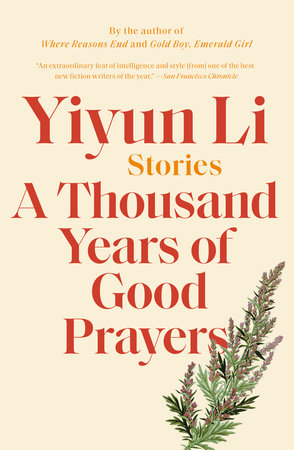
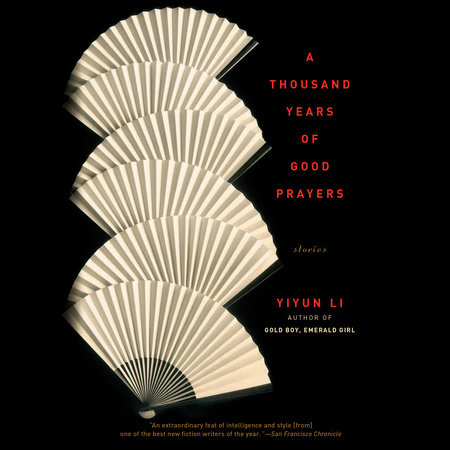
Excerpted from A Thousand Years of Good Prayers by Yiyun Li. Copyright © 2005 by Yiyun Li. Excerpted by permission of Random House Trade Paperbacks, a division of Random House, Inc. All rights reserved. No part of this excerpt may be reproduced or reprinted without permission in writing from the publisher.
A Conversation with Yiyun Li
Question: A Thousand Years of Good Prayers presents readers
with a stunning vision of China, past and present. When
you think of your homeland, what thoughts or images come
to mind? What are your feelings about China today?
Yiyun Li: I have always said that there are two Chinas. The
first is a country filled with people, like my family and many
others, who try to lead serious and meaningful lives despite
the political, economic and cultural dilemmas they face.
The second is a country with a government controlled by
one party, made rich from corruption and injustice. I love
the first China but do not love the second. So when I think
about China today, I always have mixed feelings.
Q: When did you come to America, and what brought you
here?
YL: I came to America in 1996 to attend the University of
Iowa. I had planned to pursue a Ph.D. in immunology and
hoped to stay in the medical science field as a researcher.
Q: But instead of becoming an immunologist, you became
a writer—that is quite a switch! How did that happen?
YL: I had never thought of becoming a writer nor had I
written anything before I came to Iowa. But once there I
stumbled into a community writing class, which led to more
writing classes, and I began to seriously consider changing
my career.
Q: Such a career change must have been quite daunting.
What inspired you to actually pursue writing? Did you have
a literary role model or teacher, who encouraged you along
the way?
YL: Several teachers early on were very encouraging and
supportive, among them the Pulitzer Prize–winner James
Alan McPherson, a great mentor and friend. When he read
my first story, “Immortality,” he became so excited that he
actually tracked me down through a friend. He asked her to
bring me two things: a present for my baby (I was seven
months pregnant when I workshopped the story with him),
and a message saying I was a great writer and that I had to
keep writing. From that moment on I had no doubt that I
wanted to write, and that I wanted to write well.
My literary role model is William Trevor, a great writer
himself and a true gentleman. I always consider him my
most important teacher in writing. I read his work again and
again to get to my own voice.
Q: Speaking about your own voice and approach, how do
you go about constructing a story? What process do you go
through, to imagine the characters, structure, and plotline?
YL: I like to ask myself what kind of character would do
certain things that other people would not do. For instance,
I once saw a news clip that reported a beggar coming into a
crowded marketplace with a sign: “If you give me ten yuan,
I will let you cut me once; if you finish my life in one cut,
you don’t owe me anything.” It was just one of the hundreds
of little tales we hear and see every day, but I could not forget
the beggar. In my mind, I kept imagining a woman who
would come forward and cut the beggar with all justification
and tenderness. What kind of character would do this? I
thought about this and eventually the character Sansan
(from “Love in the Marketplace”) came to me. Most of my
stories come this way, with a minor character (sometimes
very minor) as a seed for imagination.
Q: I was struck by a wonderful line in the title story about
the power of a new language. As Mr. Shi’s daughter says, a
new language “makes you a new person.” Did you find this
to be true when you began writing in English?
YL: Absolutely. For me, writing in English is the most liberating
experience. In English, I am free to express things that
I would have consciously censored—both out of political
pressure and cultural pressure—had I been writing in Chinese.
Q: The “American dream” is a prevalent theme in your
work. What does it mean to you personally, and also in your
storytelling?
YL: For me, the American dream meant that I could pick up
writing and become a writer, something I had never dared to
dream before coming here. For my characters, it means
freedom to escape totalitarian control on many different
levels—from parental supervision to the ideological control
of the Communist party.
Q: The stories in this collection are infused with aphorism
and mythology. Where did you learn these wise and wonderful
proverbs?
YL: Most of them I inherited from Chinese tradition and
translated into English. Someone at a reading once said that
he counted more than sixty of these sayings and I was quite
surprised by the number. A lot of them are used in dialogue,
which is how Chinese speak: full of proverbs and references
to mythology. I used these to make the dialogue more genuine.
Q: Along those lines, what is your own favorite adage about
life?
YL: There is a saying in Chinese: For someone to achieve
anything, he has to first work as hard as he can; whether he
is allowed the achievement, however, is determined afterwards
by the heavenly power. I think the saying reflects how
I feel about life and my characters. Several readers have
commented on the fatalism of many of the characters in the
stories, and I think that the fatalism came with my belief in
this Chinese saying.
Q: Are you working on anything new?
YL: I am working on a novel set in China in 1979. It tells the
story of the disintegration of a community after a public execution
of a female political prisoner.
Q: America’s history with China is complex, to say the least,
and will be a defining relationship for the world of the
twenty-first century. What do you think Americans should
know about China that they might not already know? On
the other hand, what do you think the Chinese should know
about Americans?
YL: One time, I met two old women in the street here in
America who read “Extra” and loved the story. They said to
me, “we both agreed we could be Granny Lin.” Another
time someone told me that after reading “The Princess of
Nebraska,” he realized every Chinese graduate student he
walked past in the street might have a rich story. These are
the things that I think people in both countries tend to
forget—that deep down we are all human beings, and the
pains and joys we have are the same. In a way, I think the
two countries are set up in the public view as competitors,
which can lead some Americans and Chinese to feel wariness
or animosity toward one another. But in the end, people
here in America are like what you will find in China, too.
1. For “Extra”
Consider Granny Lin and Kang. How is each an “extra”?
What explains their bond?
2. For “Extra”
Granny Lin cherishes her time with Kang as her “brief
love story” (p. 22). What does she mean by this? Granny Lin
also believes that “to love someone is to want to please him,
even when one is not able to” (p. 19). How does this hold
true in her friendship with Kang? How would you describe
what it means to truly love someone?
3. For “Extra”
Why does Granny Lin think the truth is futile? Discuss
her reaction to Old Tang’s death, and to Kang’s disappearance.
Why doesn’t Granny defend herself? How do other
characters in A Thousand Years of Good Prayers view the possibility
for achieving truth and justice?
4. For “After A Life”
Why did Jian’s birth turn the Sus’s relationship cold, although
the challenge of Beibei’s condition did not? Why
were Mr. and Mrs. Su able to share misfortune, but not happiness?
( 215 )
5. For “After A Life”
Imagine the questions that Mr. Su never gathered the
courage to ask Mrs. Su. What might he want to ask her, in
his deepest heart? Why does he decide, instead, that “things
unsaid had better remain so” (p. 40)?
6. For “After A Life”
Discuss the theme of shame in “After a Life,” and the
many forms it takes in both the Su and Fong families. Does
anyone overcome the weight of shame? Who deals with it
best? Who hides it and remains imprisoned by it? What
roles do honor and dishonor play throughout the entire collection
of stories?
7. For “Immortality”
Describe the identity of the narrator of “Immortality.”
What atmosphere does this collective voice create?
8. For “Immortality”
Assess the complex attitudes of the people toward the
Great Papas, the dictator, and the impersonator. How are
these cultural figures—heroes and villains both—“larger
than the universe” (p. 53) yet vulnerable to time? Do they
achieve immortality in the hearts and minds of the people?
9. For “Immortality”
Yiyun Li presents the history of China through aphorism,
mythology and storytelling. What does one gain from such a
literary portrayal that one does not through history books?
10. For “The Princess of Nebraska”
“The Princess of Nebraska” is set in the heartland of
America, during a small street parade. Discuss the juxtaposition
of each character’s life in China with his or her
new experiences in America. How do they each react in this
new environment?
11. For “The Princess of Nebraska”
Sasha believes that “moving on” (p. 69) is an American
concept that suits her well. Do you agree that Americans
have a unique ability to start fresh and forget the past? Do
you see this optimism reflected in other cultures, or would
you agree that it is an American outlook? Later, Sasha says
Americans are “born to be themselves, naïve and contented
with their naivety” (p. 78). Describe the insights behind this
appraisal. Do you agree or disagree? What does this story
reveal about Chinese and American psyches, and how do
these revelations resonate throughout the entire book?
12. For “The Princess of Nebraska”
At the end of “The Princess of Nebraska,” what do you
think Sasha decides to do about the baby?
13. For “Love in the Marketplace”
Why does Sansan love the movie Casablanca so dearly?
In what ways does it encompass “all she wants to teach the
students about life?” (p. 95)
14. For “Love in the Marketplace”
Discuss Sansan’s sacrifice. Did she act virtuously or
foolishly? What lies beneath her fierce attachment to the
notion of her own “nobleness” (p. 102)? Later, why is Sansan
so tenderly affected by the beggar in the marketplace, and
his “promise”?
15. For “Son”
Think about Sansan in “Love in the Marketplace,” Han
in “Son,” and Mr. Shi’s daughter in “A Thousand Years of
Good Prayers.” How are the children of this generation in
China, now adults, breaking away from the traditions of,
and duties to, their parents?
16. For “Son”
What moves Han to reveal the long-kept secret of his
sexuality to his mother? Were you surprised by her reaction?
Is Han’s mother as “traditional” as he believes?
17. For “The Arrangement”
Why does Ruolan’s mother refuse a divorce? What is the
“arrangement” that she has worked out with Uncle Bing and
Ruolan’s father?
Uncle Bing says he’s “one of those fools who puts a
magic leaf in front of his eyes and then stops seeing mountains
and seas” (p. 143). What does this mean? Have you
ever fallen victim to a similar preoccupation?
18. For “The Arrangement”
Uncle Bing says he’s “one of those fools who puts a
magic leaf in front of his eyes and then stops seeing mountains
and seas” (p. 143). What does this mean? Have you
ever fallen victim to a similar preoccupation?
19. For “Death Is Not A Bad Joke If Told The Right Way”
What does Mrs. Pang mean when she says “Nobody
knows who he will become tomorrow?” (p. 152) What does
this sentiment reveal about life in China?
20. For “Death Is Not A Bad Joke If Told The Right Way”
Discuss the importance of Mr. Du’s orchids. Why is Mr.
Du happy when they go out of fashion? What do the orchids
mean to him?
21. For “Death Is Not A Bad Joke If Told The Right Way”
Do you think Mrs. Pang have been proud of Mr. Pang at
the end of his life, as the girl believes?
22. For “Persimmons”
Describe the view of life and death that the villagers
hold. Is existence controlled by fate? God? Man? Consider,
also, their attitude toward the possibility for justice.
23. For “A Thousand Years of Good Prayers”
Describe the emotional barriers to communication in “A
Thousand Years of Good Prayers.” Are Mr. Bing and his
daughter able to express their feelings? Why? Does language
hinder or promote their abilities? How does the power to
communicate in a new language make one “a new person”
24. For “A Thousand Years of Good Prayers”
Yiyun Li sets many of her stories in her homeland of
China. What is the spirit of the people like there? What
mood pervades the workers’ lives? How would you describe
the way characters such as Granny Kang, Mr. and Mrs. Su,
Sansan, and Mr. Du, respond to adversity?
25. For “A Thousand Years of Good Prayers”
Discuss your impressions of the world and the characters
that Yiyun Li has created. Draw comparisons and contrasts
between the stories in the collection as a whole.
Which story is the most memorable or the most powerful for
you and why? What themes are woven throughout the entire
collection? What images or feelings emerge when you think
of the collection as a whole?