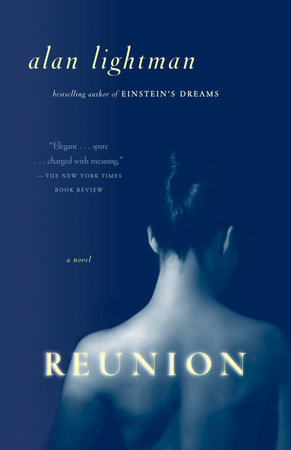
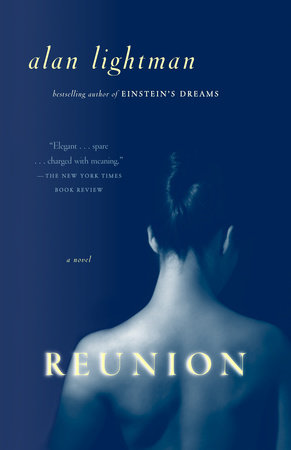
Excerpted from Reunion by Alan Lightman. Copyright © 2003 by Alan Lightman. Excerpted by permission of Vintage, a division of Random House, Inc. All rights reserved. No part of this excerpt may be reproduced or reprinted without permission in writing from the publisher.
Alan Lightman is the author of six novels, including the National Book Award finalist The Diagnosis, a book-length narrative poem, two collections of essays, and several books on science. His work has appeared in The Atlantic, Granta, The New Yorker, The New York Review of Books, and Nature, among other publications. A theoretical physicist as well as a novelist, he has served on the faculties of Harvard and MIT, and was the first person to receive a dual faculty appointment at MIT in science and in the humanities.
A conversation with Alan Lightman
Q: In your new novel, Reunion, your central character Charles journeys from the present to the past to revisit himself as a young college student. Can you tell us something about Charles and how his journey begins?
A: At the opening of the novel, Charles is in his early fifties, a literature professor at a small, second-rate college somewhere in the Northeast. As a young man, he had been a promising poet, but he has not lived up to that promise. He now lives in a big, rambling house, left to him by his successful wife, whom he divorced ten years ago. Since then, Charles has had a string of empty relationships. For reasons that he doesn't understand, he has decided to attend his thirtieth year college reunion. And there, at the reunion, he becomes a witness to his senior year in college, a year in which he was involved in a passionate but ultimately devastating love affair with a ballet dancer named Juliana. I won't reveal how this witnessing the past comes about, but once it begins, Charles is drawn to the spectacle like a moth to a flame, wishing that he could tear himself away but finding that he is unable to do so.
Q: An idealist and romantic in his 20s, Charles has developed into a dispassionate skeptic. What do you think he expected of himself?
A: I believe that Charles, as a twenty-two-year old young man, expected what many of us expect in our youth. He saw the future stretching in front of him to infinity, shimmering with unlimited opportunities and hopes. He saw himself as immortal. More than that, he was a talented poet, all of his teachers told him so, he seethed with his talent, and he had aspirations of being a great writer. And he hoped to be a man loved by women.
Q: Your title, Reunion, represents several different kinds of reunions: the thirtieth-year college reunion that Charles attends, a reunion between Charles and Juliana, and a reunion between Charles and his younger self at age twenty two. Can you discuss this idea?
A: Of course, I like the triple meaning of reunion here, but for me the most important reunion is between the fifty-two-year-old Charles and his twenty-two-year-old self. Aging is one of the most powerful, beautiful, and horrifying experiences of life. In what ways are we the same person, and yet a different person, as ourselves ten years ago, twenty years ago, thirty years ago? I have often wondered what it would be like to meet myself of twenty or thirty years ago. What would I say to myself? What would I want to know about my younger self that I have now forgotten, or misremembered, or distorted in the vast hallways of time? What joys, what regrets would I want to express to my younger self?
Q: Tell us a little about Juliana.
A: Juliana is a private person who tells us little about her past. Evidently, she had an abusive father who abandoned the family and an alcoholic mother. At age 12 she ran away from home to live in New York City with her aunt, a former ballet dancer. Juliana becomes a dancer herself. Dancing is her life. Her ambition is to dance with Balanchine, to be as good as Suzanne Farrell. Like many dancers, she is obsessively compulsive about her body and her weight. She lives in a world of certainty, ballet, ballet, ballet. Yet, she still needs intimate relationships with men, as if the rigid formality of ballet doesn't allow enough freedom to her body. She makes love to Charles in the tiny ballerinas' dressing room, late at night.
Q: There is a lot about ballet in the novel. How did you research this?
A: I have always been fascinated by ballet, as an art form centered on the body. A friend of mine, a former dancer himself and now teacher of dance, shepherded me around New York to visit a number of the ballet studios still in existence from the1960s, when most of the novel takes place. I attended some classes and rehearsals. My friend also got me into a remarkable class of the Royal Ballet, from London, when they were performing in Boston. Beyond these wonderful experiences, I read some of the autobiographies of famous ballerinas and watched some documentaries about ballet.
Q: Much of Reunion takes place during the social and political chaos of the late 1960s. How did these events impact your characters?
A: The young Charles is undergoing a soul-searching period of his life brought on by the usual confusions of a twenty-two-year old and the overpowering love affair with Juliana. The chaos of the Vietnam War and all of the questions of the 1960s only add to his confusion. At times, he thinks about his future as a great poet. At other times, he thinks that he will be drafted and killed in Vietnam, like some of his classmates, and that the future extends only for the next day, that the only important moment is the present. As for so many young men of this era, Charles has ambivalent feelings about the War and many of the social issues of the day. On the one hand, he believes that the War is wrong, that various social inequalities are wrong. On the other hand, he is not sure that he should jeopardize his future by being an activist, burning his draft card, setting fire to buildings, joining the Black Panthers, and so on. Juliana, on the other hand, seems to float above the social and political issues of the day. She lives in a world of certainy. Ballet is her rock, her beauty, her purity, and her torment.
Q: Haunted by the turns his life has taken, stunned as he witnesses a replay of his senior year in college, the older Charles remembers various conflicting versions of his love affair with Juliana and is shocked to realize that his own recollections may be more self-serving than accurate after all these years. Is this revelation a commentary on how we view ourselves versus how the world views us?
A: Memory is a clay-like substance. I believe that we distort, bend, and reshape personal memory to fit our self image, to manufacture our self identity. The most mysterious aspect of existence, in my opinion, is consciousness, self awareness. And that consciousness and "I-ness" is, in turn, determined in part by memory, memory of events in the past, relationships in the past, actions and decisions in the past, who we were in the past. Because memory is malleable, all of those past decisions, actions, and impulses of the heart are also malleable, they twist and shimmer in a half light, subject to interpretation and reconstruction, so that it is impossible to say what really happened. Reality itself disappears in a haze of uncertainty and human frailty.
Q: Your previous fiction clearly melds your scientific background into your fiction. Reunion is a much more romantic book, and the relationship between Charles and Juliana is one of great passion. Would you describe yourself as a romantic?
A: Yes, I would describe myself as a romantic. From a young age, I have struggled with a kind of split personality: on one side intuitive, artistic, romantic; on the other side rational, scientific, dispassionate. In high school, I wrote poetry and I also built rockets. I constantly feel these two sides warring with each other, in my professional work, in my friendships, in love relationships. Even in my fiction, I find this tension. I think that Reunion comes far closer to my romantic and passionate side than any of my previous books.
From the Hardcover edition.
1. Why is Charles crying at the end of the novel [p. 231]? Is it for lost youth, lost love, his lost child, loss of power, loss of the ability to feel, or something else altogether? Did he learn something during his reunion that makes him cry?
2. Charles muses: “Although I was prepared to suffer, it never occurred to me that she might be using me the way that Lena used Ulrich. . . . It never occurred to me that she might travel from one man to the next to avoid being abandoned. Or to avoid being worshiped like a goddess, a worship she both relished and despised” [pp. 128-9]. Is this a fair characterization of Juliana? Are all the signs of Juliana’s self-absorption [see p. 122 and p. 139] apparent only now to the older Charles, or did the younger Charles notice but choose to ignore them? Is to love, necessarily, to suffer, or did Charles just happen to fall for the wrong person? What might be Juliana’s version of their relationship?
3. How is the life of a dancer evoked? Charles comments, “Her life is so simple, focused on one single thing” [p. 87], but does he ever really understand the commitment Juliana makes? Would Juliana describe her life differently than Charles?
4. Charles reflects that “through [Juliana] he is learning who he is. He is her ‘sensitive college boy,’ she tells him. She says that he is arrogant at times but willing to admit his mistakes” [p. 146]. But the older Charles tells his younger self that his mistake was “[y]ou knew nothing about yourself” [p. 96]. Does Charles, in fact, ever learn who he is and why he is that way?
5. Does Charles’s reunion experience confirm Kierkegaard’s assertion that “Life can be understood only looking backward, but it can be lived only going forward” [p. 40]? Under this theory, is it possible to learn from one’s mistakes and to change the course of one’s life? Is understanding empowering to Charles or merely depressing?
6. How might one describe Charles’s personality? Is his description of himself as “selfish” accurate [p. 10]? Is Charles a sympathetic or likeable character? Does Charles’s personality alter from when he was a young student to when he becomes a middle-aged professor? Does Charles take responsibility for his actions?
7. Is the theory about “relativity of values” that is so attractive to Charles essentially a selfish one [pp. 6-8]? Does Charles behave consistently with this theory? Do the actions of the other characters in Reunion support the conclusion of Charles’s favorite book, The Morning of Artifice, that “at bottom people are selfish” [p. 96]? Is love necessarily selfish? How might the older Charles answer the questions posed by his younger self: “Is it possible for a person to love without wanting love back? . . . Or is love, by its nature, a reciprocity, like oceans and clouds, an evaporating of seawater and a replenishing by rain?” [p. 192]
8. What does the reader know about Charles’s relationship with his wife, and why does Charles (or the author) choose to reveal so little about his marriage? Why did Barbara leave him everything in the divorce [pp. 129-130]? Charles observes that his relationship with his daughter might have suffered because of his affair with Juliana [p. 225], but he does not comment on how his marriage might have been affected. Why not? How might his marriage have been affected by his affair? Why does Charles disdain the ambition his wife embraced [pp. 129-130]?
9. The older Charles recollects of his younger self: “Charles senses that he shares something with Galloway, some kind of dissatisfaction with life” [p. 57]. What other qualities do the young Charles and Galloway have in common? How does Charles’s relationship with Juliana compare to Galloway’s relationship with her? How does Charles really feel about Galloway? Does Charles grow up to become just like him?
10. Charles theorizes: “The astronomer . . . was a tragic figure of sorts. He allowed his personal pride to end his promising professional career. And there lies the tragedy” [p. 16]. Is Cunningham also a tragic figure? Is Charles? Is Juliana? Is Michael Bisi? With whom does Charles identify? Who does he admire and despise and why? Is “an opportunity lost” a “true tragedy” as the older Charles asserts [p. 39]? If so, is Reunion a tragedy?
11. In his narrative, Charles alludes to two types of power. First, Lena, who caused the astronomer’s downfall, discovered “the most powerful force in the universe, and that force is all the stronger for not being diluted with compassion” [p. 17]. What is this powerful force? Second, Charles attributes “the power of not knowing the future” [p. 161] to his younger self. How is this lack of knowledge empowering? Which type of power turns out to be the stronger one in Reunion?
12. Why is Charles angry with Cunningham for not understanding the astronomer as he does [p. 47]?
13. The older Charles remembers, “Still, there’s something about Nick that Charles admires” [p. 105]. Then, later, Charles recalls that on the rabbit hunting trip “He realizes how much he hates Nick” [p. 115]. Upon what is Charles’s love-hate relationship with Nick Blanchard based? Can Nick Blanchard be understood as a product of everything that was simultaneously good and bad about America in the 1960s? How does Charles distinguish himself not only from Nick but also from that period in America’s history [see p. 76]?
14. What are the different narrative voices that Lightman utilizes in Reunion? How do they differ in tone and in perspective? How does Lightman effectively convey the different points of view and attitudes of an older man and a younger man? How does Lightman transition from voice to voice, and are these transitions smooth or jarring to the reader? How do the different voices affect the reader’s relationship with the characters? [See pp. 26, 50-51, 74, 94 and 130 for examples of shifts in narrative voice.]
15. Charles recollects contradictory accounts of both his confrontation with Galloway [pp. 173-81] and his final meeting with Juliana [pp. 208-217]. How do Charles’s conflicting memories illustrate what he wants to remember about these events in his life and what he wants to forget? Why might he hide certain truths from himself even long after they are past?
16. What decision do you think Juliana ultimately makes regarding her life? Does an understanding of the themes explored in Reunion hinge upon her decision?
17. What does Charles mean when he writes, “We are all being seduced” [p. 23]?
18. What does Charles admire about Emily Dickinson [p. 54]? If you are familiar with the life or works of Emily Dickinson, do you see any similarities between Dickinson and Charles?
19. What is the attitude of the author, himself a university professor, toward college professors and college life in general? Are the portraits of Charles and Galloway flattering? What is the significance of Galloway’s argument in front of the class with the student assistant about the order of names on academic publications [p. 62-66]?